The Great Resignation sounds like an alarmist newspaper headline, but it has sound academic roots. A professor at the UCL University London—Anthony Klotz—originally coined the term back in May 2021. The Great Resignation is a statistically significant increase in people leaving their jobs during the pandemic.
What’s important to us today as employers and recruiters is to understand:
- Who is resigning?
- Why are they leaving?
- Where are they going?
- What can we do about it as employers facing a skills shortage?
Who is resigning?
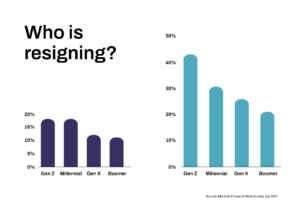
Baby boomers: The “big quit” relates to baby boomers, people born in the mid-1960s. They were nearing their retirement just as the pandemic hit and simply fast-forwarded their date of retirement and left the workforce entirely.
Gen Z & millennials: There was a huge spike in the number of Gen Z and millennials who quit their jobs. Gen Z in particular, feels sceptical about the grand promises made by companies around benefits and perks. They’re reluctant to join companies unless they hit the sweet spot in terms of values.
Students: Students who were studying during the pandemic might have delayed their graduation to avoid completing their student life in a virtual setting.
All of this adds up and leads to people leaving the workforce a lot faster than they are being replaced.
Why are they resigning?
There are studies done by behavioural scientists around life-pivoting moments and the impact that they can have. These could be getting married, moving houses or becoming parents. It turns out that when these moments happen, you’re more likely to change careers.
The pandemic was a mass life-pivoting event that was experienced simultaneously by millions. Furloughs during the lockdown compelled people to pause their work lives. People reassessed their priorities and realised the job they were in wasn’t the right fit.
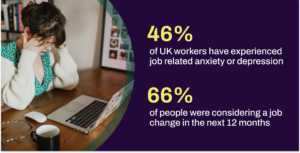
Depression and anxiety also spurred people to quit their jobs and find more meaningful careers.
Where are they going?
Sector change: This isn’t happening evenly across sectors because COVID-19 didn’t impact sectors evenly. Some people lost their jobs because of lockdowns or because their sector was particularly negatively impacted such as tourism. They were forced into new roles and positions to sustain their livelihoods and ended up working in a totally new industry. There was also a big backlog of people who delayed changing jobs because furlough had protected them or there weren’t enough opportunities available during the pandemic. So when the world opened up, these people sprung into action.
Retirement & long term illness: Some baby boomers chose to retire early, while some quit because of the effects of long COVID. According to government data, around 400000 people were economically inactive as compared to pre-COVID times.
 A Perfect Storm
With more people retiring early, fewer people with the right skills entering the workforce and many more feeling disillusioned, depressed and disengaged from work, people are now looking for alternatives. This is being exacerbated by high job vacancies even with a looming recession.
So what can we do as employers and leaders? Let’s discuss a few possible solutions.
A Perfect Storm
With more people retiring early, fewer people with the right skills entering the workforce and many more feeling disillusioned, depressed and disengaged from work, people are now looking for alternatives. This is being exacerbated by high job vacancies even with a looming recession.
So what can we do as employers and leaders? Let’s discuss a few possible solutions.
Building your values & culture
In remote setups, it’s harder to understand and communicate what your company values are. Here are some questions that you can ask yourself to help you build your values and messaging.
Care: Do you care about your employees as much as you care about your customers? Do your employee benefits show that you go above and beyond to make sure you have a healthy workplace?
Interest: Are you interested in working with innovative employment policies?
Social: Does your team environment promote teamwork and camaraderie? Do people get to work with other departments? Do you host social events?
Economic: Apart from offering a good salary, what is the economic security of your company like?
Development: Do you invest in your employees and recognise their achievements? Do you provide opportunities for career enhancement and promotions?
New post-pandemic work rituals
Rituals are shared behaviours: they affirm the common patterns, values, joys and risks that bind a community together into a culture.
As remote and hybrid work is here to stay, how can you keep your workers connected in a shared culture? It’s beneficial to understand what your workplace culture actually is. Let’s discuss a few best practises:
Building support networks: Workers need non-work-related interactions to bond as a team of individuals and not just as a team of job titles. We can help people support each other through more virtual Employee Resource Groups (ERGs). For example, LGBTQ+, parents and caregivers, neuro diverse workers, workers with disabilities etc.
“Healthy meetings”: In a remote setup, it’s harder to spot signs of burnout. Driving awareness, education and support about these signs are important. Two key factors that employers can look at are having short meetings and normalising breaks between meetings. Encourage taking regular screen breaks and the importance of staying hydrated.
Feedback opportunities: In a physical workplace, it’s easier for managers to say “my door is always open”. However, having to set up a video call even for a casual chat can be a bit more intimidating virtually. Reach out to your employees to ask them how they’re feeling. You can also install a virtual suggestion or feedback box and carry out anonymous surveys to do a pulse check.
Flexible work setups: A few famous companies like Google and Apple tried to enforce a back-to-office policy and it was met by severe resistance and backlash. Some employees even quit their jobs. The best model is to give employees flexibility that makes their work fit their lives and gives them the agency to manage their own time.
Today, it’s not a binary choice. It’s not just choosing between home and office. A new phenomenon that arose from the pandemic was workations: mixing holiday and work. Offering this benefit to your teams can have a powerful effect on retention.
The beauty of it is that it’s free of cost to employers (as long as you’re careful to minimise all compliance risks). At WorkMotion, we have developed software that can enable these benefits while minimising all compliant risks. We can also help you meet talent shortages by helping you onboard your talent in over 160 countries.
If you’re interested in learning more about building global, remote and flexible teams, talk to our experts today.













![idWjC-9cC6_logos 1 [Vectorized]](https://workmotion.com/wp-content/uploads/2026/02/idWjC-9cC6_logos-1-Vectorized.svg)