

You can’t use the same employment contract in every country and expect it to stay compliant.
A contract that works in the U.S. or UK can create problems when you hire in Germany, Spain, or Poland. Local labor laws change everything from notice period rules and probationary period limits to overtime pay, statutory benefits, and termination requirements.
If you have an international hiring team, employment contracts need to match the employee’s country, contract type, and legal classification from day one. If they don’t, payroll delays and compliance risks usually follow.
What Is an Employment Contract?
An employment contract is a legally binding agreement between an employer and employee. It defines the terms of employment, including compensation, working hours, benefits, job duties, notice period, and other specified terms tied to the employment relationship.
Here are some examples of the documentation involved in hiring employees.
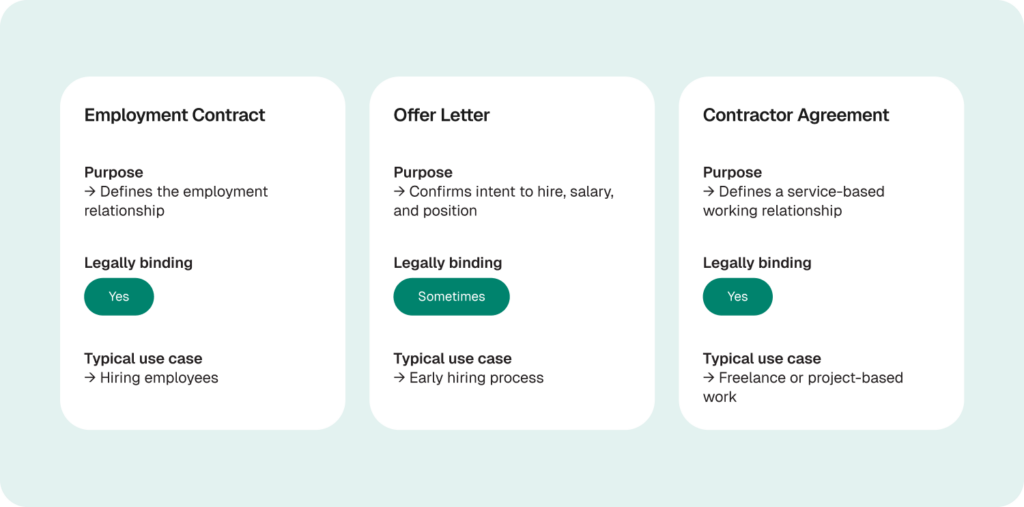
An independent contractor vs. employee classification affects tax treatment, employee benefits, and the risk of misclassification. Companies managing freelancers separately from employee contracts often use dedicated contractor management workflows.
Types of Employment Contracts
The types of employment contracts your team can use depend on the role, country, and employment relationship you’re creating. Different contract types also trigger different labor laws, tax obligations, and employee benefits requirements.
| Contract type | What it means | Key compliance consideration |
| Permanent contract | Ongoing employment with no end date | Most employees fall into this category |
| Fixed-term contract | Employment for a specific period or until a defined end date | Fixed term rules in Germany and Spain are stricter than when you hire in the UK or the U.S. |
| Part-time contract | Reduced hours per week with pro-rated pay and benefits | Minimum wage, paid time, and vacation time rules still apply |
| Temporary contract | Short-term employment for seasonal work or a specific task | Local limits may apply to contract duration |
| Zero-hours contract | No guaranteed working hours | Limited enforceability in some countries |
| Contractor agreement | Service-based agreement with an independent contractor | Different tax and compliance rules than employment |
International hiring teams often combine multiple models across markets. For example, your business may use an Employer of Record for one new hire, direct hiring for another, and separate workflows for global contractors.
What Must an Employment Contract Include?
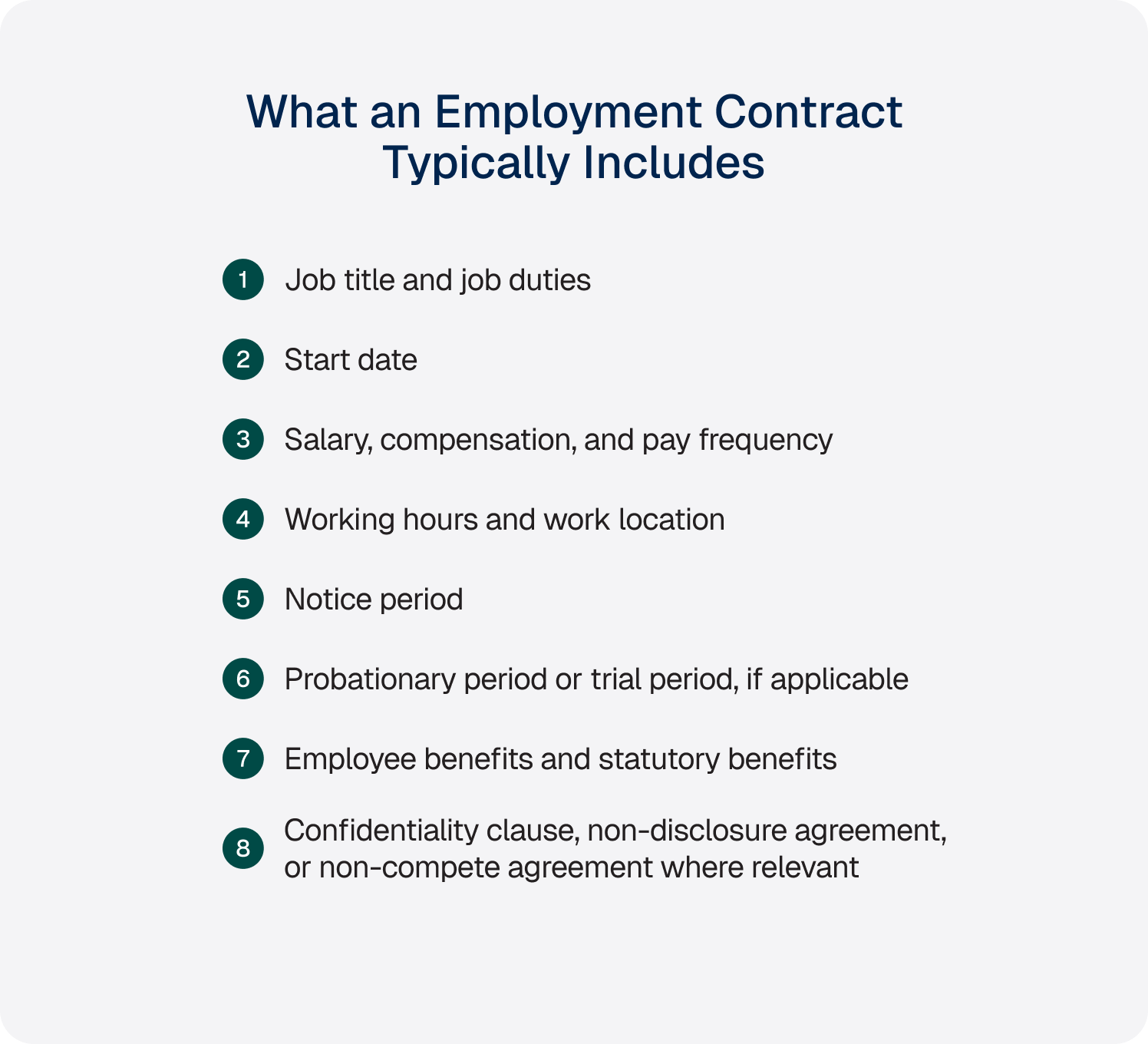
Most employment contracts include the same core terms, even though labor laws vary by country.
A written employment contract should typically include:
- Job title and job duties
- Start date
- Salary, compensation, and pay frequency
- Working hours and work location
- Notice period
- Probationary period or trial period, if applicable
- Employee benefits and statutory benefits
- Confidentiality clause, non-disclosure agreement, or non-compete agreement where relevant
Country-Specific Requirements
Many countries also require additional clauses tied to the local employment relationship. These can include:
- Minimum wage compliance
- Sick leave
- Holiday pay
- Personal leave
- Termination procedures
- Employer contributions to social security
- Retirement plans
Some jurisdictions also require written contracts in the local language. Others require clauses covering intellectual property, trade secrets, non-solicitation, governing law, or how employees must protect trade secrets and other sensitive information tied to the employer’s business.
As your workforce grows, managing contract changes across countries becomes just as important as creating compliant employee contracts in the first place.
How Employment Contract Requirements Vary by Country
Employment contracts can change dramatically from one country to another. A German employment agreement built around AÜG labor leasing rules looks nothing like a contract used to hire in France or the UK, for example.
That’s why one global template rarely works. Rules around fixed-term contracts, notice periods, paid leave, probation, and written contract requirements all vary by jurisdiction.
Germany
When you hire in Germany, employment contracts must follow strict rules around fixed-term employment, statutory notice periods, and employee leasing. Germany allows probation periods of up to six months, while fixed-term contracts must usually be agreed upon in writing under German labor law.
The German Business Location Center outlines these employment contract requirements in detail.
Spain
Companies that hire in Spain often need clauses tied to collective bargaining agreements, working hours, holiday pay, and statutory benefits.
Spain also places tighter limits on fixed-term contracts than many U.S. employers expect.
United Kingdom
When you hire in the UK, employers must provide written employment terms from day one.
The UK does not use at-will employment as in the U.S., and fixed-term employees still receive statutory notice protections.
Poland
Companies that hire in Poland must follow local rules covering probation, written contracts, social security registration, and maximum fixed-term duration.
Polish labor law generally limits fixed-term employment to three contracts or 33 months.
Examples From Other Countries
- France: Employment contracts often include highly localized clauses governing overtime pay, statutory benefits, collective bargaining agreements, and termination rules. France also applies strict language requirements and fixed-term employment rules. France’s public service guidance on fixed-term contracts outlines many of these requirements.
- Italy: Italian employment agreements are heavily shaped by collective bargaining agreements (CBAs). Contracts often need detailed terms covering salary, working hours, leave entitlements, and termination conditions.
- Netherlands: Dutch employers must provide clear written employment terms, especially around working hours, compensation, and contract duration. The Dutch government’s employment contract guidance for businesses explains these requirements further.
- Portugal: Portugal applies strict rules around probation periods, paid leave, and contract renewals. Employment terms must align closely with local labor law and social security requirements.
These are only a few examples of how employment contracts can differ across Europe and globally. Rules around termination, employee protections, fixed-term employment, language requirements, and statutory benefits vary significantly by jurisdiction.
If you’re looking to hire across multiple locations, WorkMotion generates locally compliant employment contracts in-platform, with transparent pricing for teams that need compliant onboarding without manual drafting or legal review.
Book a demo to see how it works.
Offer Letter vs. Employment Contract vs. Local Addendum
Global hiring usually involves three different documents, and each serves a different purpose.
1. Offer Letter
An offer letter confirms the basic terms of the job, including salary, position, start date, and sometimes a short job description. It usually focuses on intent to hire rather than the full legal employment relationship.
2. Employment Contract
The employment contract is the legally binding written document between employer and employee. It defines the full working relationship, including compensation, benefits, notice periods, working hours, and termination terms.
This is also where local labor laws matter most. Minimum wage rules, sick leave, statutory benefits, and fixed term contract limits all depend on where the employee works.
3. Local Addendum
Some companies use a global employment agreement template with a country-specific addendum attached. The addendum localizes terms that can’t be standardized globally, including governing law, termination procedures, statutory leave, and mandatory employee protections.
That’s why there’s no single employment contract example that works everywhere. Even similar employee contracts may require different clauses depending on the country, hiring model, or whether the worker is engaged through global contractors.
As local requirements change, many international teams centralize contract changes to keep written contracts compliant across multiple countries.
4 Common Employment Contract Mistakes (and Their Consequences)
Even well-written employment contracts can create compliance risk if the wrong structure or terms are used. These are some of the most common mistakes international hiring teams make.
1. Misclassifying an Independent Contractor as an Employee
This happens when a company hires someone as an independent contractor even though the working relationship looks like standard employment.
What Happens If You Get It Wrong?
The employer can face back taxes, unpaid social security contributions, penalties, and retroactive employee benefits claims. In some countries, authorities may also reclassify the worker as an employee automatically.
This risk is especially high in countries like Spain, France, and Germany.
2. Missing Mandatory Statutory Clauses
Some employers use global templates without adapting them to local labor laws.
What Happens If You Get It Wrong?
Mandatory terms may apply automatically even if they are missing from the written employment contract. In Germany, for example, a missing probationary period clause can default to standard legal rules. Missing clauses tied to minimum wage, sick leave, or working hours can also create disputes later.
These issues become harder to fix after the employee works under the agreement.
3. Using the Wrong Contract Type
A fixed-term contract may seem simpler during the hiring process, especially for new employees or temporary hiring. But many countries limit how long these agreements can last.
What Happens If You Get It Wrong?
The employee may automatically become permanent under local law. In countries like Spain, France, and Italy, repeated renewals of a fixed-term agreement can trigger full employee protections, termination rights, and additional compensation obligations.
This is one reason global teams need country-specific guidance on how to write employment contracts instead of reusing the same template everywhere.
4. Using English-Only Contracts Where Local Language Versions Are Expected
Some countries require employment documents in the local language, especially when employee rights, termination rules, or statutory benefits are involved.
What Happens If You Get It Wrong?
Parts of the agreement may become difficult to enforce. This can affect non-compete clauses, confidentiality protections, disciplinary procedures, or disputes involving the employer’s clients and confidential information.
This risk is especially common in France, Spain, and Poland.
How Employment Contracts Connect to Onboarding and Payroll
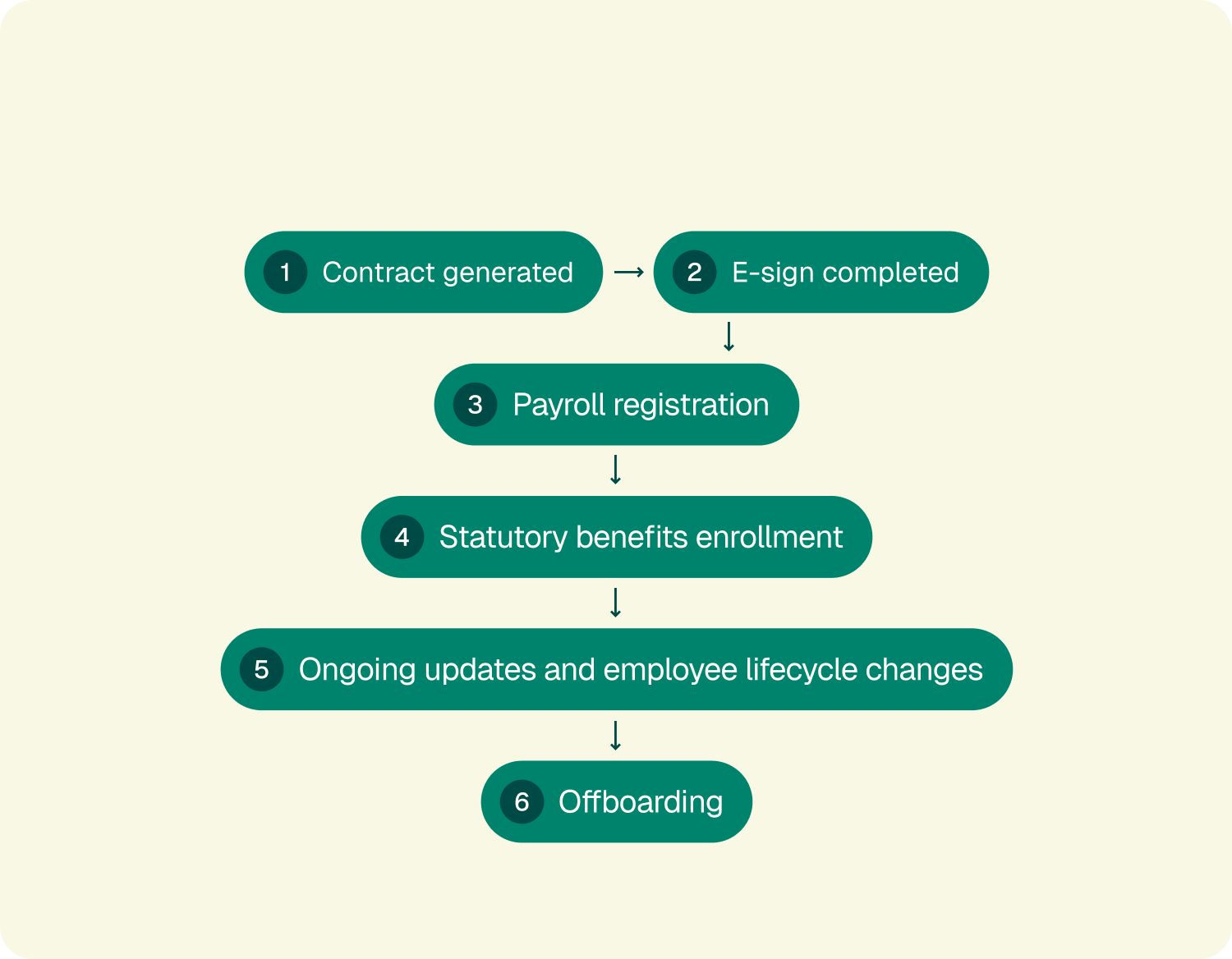
The hiring process doesn’t stop once the contract is signed. Every step after that depends on accurate employment terms from day one.
Typical Onboarding Workflow
- Contract generated — Day 1
- E-sign completed — Day 1–2
- Payroll registration — Day 3–5
- Statutory benefits enrollment — Day 5–7
- Ongoing updates and employee lifecycle changes
- Offboarding
If the original agreement contains errors, delays usually happen at steps two and three. Incorrect salary terms, missing statutory clauses, or the wrong fixed-term setup often require legal corrections before payroll can move forward.
That’s especially important for new employees hired across multiple countries, where onboarding rules, social security registration, and benefits enrollment timelines all vary.
Stay on Top of Employment Contracts in Every Country With WorkMotion
Generic templates create compliance risk fast. A contract that works in one country can create payroll delays, unenforceable clauses, or worker classification problems in another.
That’s why international hiring teams need country-specific contract generation from the start. Local labor laws shape everything from statutory benefits and termination rules to payroll registration and onboarding timelines.
WorkMotion is built for SMEs hiring into Europe without local entities. The platform helps teams generate locally compliant employment documents, onboard employees quickly, and manage payroll and statutory benefits across multiple countries.
Your next steps:
- Review where your current hiring templates are reused across countries
- Identify which employee documents need local legal terms or translations
- Standardize onboarding workflows before adding more international hires
The earlier your team fixes these gaps, the easier it becomes to scale hiring without creating compliance issues later.
WorkMotion can help you move from manual templates and fragmented onboarding to compliant international hiring workflows in days, not months.
Book a demo to learn more.


















![idWjC-9cC6_logos 1 [Vectorized]](https://workmotion.com/wp-content/uploads/2026/02/idWjC-9cC6_logos-1-Vectorized.svg)