

You’ve built a reliable HR foundation for your US team using Gusto, but now you’ve found the perfect engineering candidate in Germany or Spain. Deel seems like the obvious next step for global hiring, but you need to know if their compliance claims hold up under strict European labor laws.
The platform you choose determines who carries the legal risk when a regulator audits your staff leasing licenses or a worker challenges their employment classification.
Comparing Gusto vs Deel is incomplete without a third option: WorkMotion. We’ll look at how these three platforms handle payroll, benefits, pricing, and scalability, and why an independently certified provider with its own European entities is critical for cross-border growth.
Gusto vs Deel vs WorkMotion: At a Glance
If you’re short on time, here’s a quick breakdown of how these three platforms compare across core capabilities.
While they all handle HR and payroll, their structural differences become obvious when you look at their compliance models and pricing.
| Feature | WorkMotion | Gusto | Deel |
|---|---|---|---|
| Primary market | European compliance | US domestic | Global scale |
| International EOR | 160+ countries | Via Remote (11 countries) | 150+ countries |
| Entity model | Own entities in key markets, EOR partners in special use cases | Partner network | Own entities and partners |
| IEC certification | ✦ IEC Gold | No | No |
| EOR pricing | From €499per employee / month | ~$699per employee / month (via Remote) | From $599per employee / month |
| Trustpilot rating | 4.8 / 5 | 2.3 / 5 | 4.7 / 5 |
Deel vs Gusto vs WorkMotion: What Each Platform Is and Isn’t
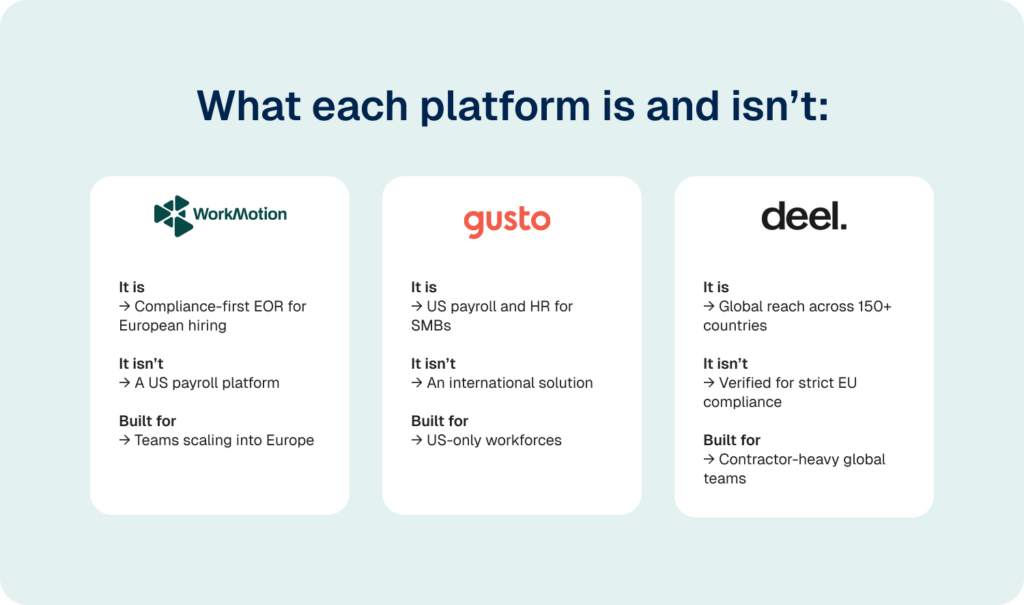
When choosing an HR or Employer of Record (EOR) platform, the underlying operating model matters more than a feature checklist. The compliance infrastructure a provider uses dictates who holds the legal accountability when something goes wrong.
The exact system that flawlessly manages 30 US employees on Gusto can expose your business to severe misclassification risks the moment you hire across a border. Here’s how the three platforms fundamentally operate.
WorkMotion

WorkMotion is a compliance-first Employer of Record built specifically for companies hiring internationally, with a deep specialization in European markets. It isn’t a US payroll platform. Instead, it operates exactly where Gusto leaves off and where Deel’s compliance verification gaps become apparent. It’s designed to help you manage payroll, tax filing, and benefits administration for your international workforce.
As an EOR, WorkMotion becomes the legal employer in-country. Its Spanish entity employs your Spanish hire. You manage the day-to-day work, while WorkMotion handles localized contracts, payroll in local currency, statutory benefits, and ongoing legal compliance.
Three structural differentiators set WorkMotion apart from its competitors:
- Deep European Licensing: WorkMotion doesn’t just own entities; it secures the specific labor leasing licenses required by local jurisdictions (like the German AÜG or French Portage Salarial).
- First compliance-certified EOR: WorkMotion holds the IEC Gold Certificate, awarded by The IEC Group. Because many providers make unverified compliance claims, this independent advisory firm audited WorkMotion across 1,000+ checkpoints covering licensing, payroll, data protection, and employee lifecycle management.
- Transparent pricing model: Buyers receive country-specific cost breakdowns that show the exact salary, employer contributions, statutory benefits, and service fees before committing.
Best understood as: The international employment layer for companies scaling beyond US borders. It’s not a replacement for Gusto, but the specialized infrastructure that fills Gusto’s international gap and provides the verified European compliance that Deel’s EOR product lacks.
Book a demo to see how WorkMotion handles compliant international hiring for your specific markets.
Gusto
Gusto If your workforce is entirely based in the United States, Gusto is arguably the gold standard for SMBs. It’s a domestic HR software powerhouse that automates W-2 payroll, manages local tax filings across multiple states, and handles complex benefits administration (like health insurance and 401(k)s) with ease.
The platform shines because it doesn’t require a dedicated HR administrator to run smoothly. The employee self-service portal is intuitive, the pricing tiers are clear, and the core HR processes just work.
Gusto’s limitation is that it stops at the US border. It has zero native international employment infrastructure. If you want to hire globally through Gusto, you’re actually using a white-labeled version of Remote’s EOR service, which is currently restricted to just 11 countries. Because Gusto relies entirely on this third-party partnership, they hold no direct compliance accountability and operate no owned entities abroad.
Best understood as: An exceptional domestic payroll provider that works best when paired with a dedicated international solution, the moment your hiring needs expand beyond the US.
Deel

If your primary goal is sheer geographic reach, Deel is the heavyweight in the room. It consolidates contractor management, EOR services, global payroll, and comprehensive HR tools into one massive ecosystem.
Its biggest advantage is its footprint. Supporting multi-currency payroll across 150+ countries, Deel allows companies to rapidly onboard talent and pay international contractors almost anywhere on earth.
However, while Deel has aggressively expanded to own business entities in over 120 countries, simply owning an entity doesn’t guarantee full regulatory compliance. In fact, Deel holds the necessary official labor leasing licenses in under a fifth of the jurisdictions where local laws mandate them. Plus, they don’t offer an independent, third-party compliance certification for their EOR operations.
Best understood as: A powerhouse for global scale and contractor payments. But if you’re hiring in Europe’s strictly regulated markets, your legal team will need to do heavy lifting to confirm they actually hold the right licenses to employ your team safely.
The Key Decision Variable: Entity Ownership vs. Licensing Depth
A few years ago, the big debate in global hiring was whether an EOR used its own entities or a partner network. Today, owning an entity is just the baseline. The real question is whether that entity holds the specific, highly regulated labor leasing licenses required by local law (like the German AÜG or French Portage Salarial).
Owning a business entity in a country doesn’t automatically give you the legal right to lease employees there.
Here’s how the three platforms stack up when you look at compliance depth:
- Gusto: Gusto can’t legally employ anyone outside the US. Their international coverage relies entirely on a partnership with Remote, limited to 11 countries. You aren’t getting Gusto’s compliance infrastructure abroad, you’re getting a third party’s.
- Deel: While they own the business entities in most countries, the legal exposure shifts if they don’t hold the specific labor leasing licenses required to act as an EOR. If a local authority audits your European team and finds the EOR lacks the proper licensing, the liability often flows directly back to you. You’ll need your legal team to manually verify their licensing status in every regulated market you enter, or consider Deel alternatives.
- WorkMotion: WorkMotion doesn’t just use its own entities in key European markets, it secures the specific labor leasing licenses required by local jurisdictions. More importantly, this compliance depth has been independently audited and verified by the IEC Gold Certificate.
Book a demo to see how WorkMotion handles compliance in your target markets.
Feature-by-Feature Comparison
Buying decisions are made in the details—how each platform behaves under real operational conditions as compliance complexity increases. Here’s how Gusto, Deel, and WorkMotion compare across core HR functions.
Payroll
Running payroll across borders means navigating different currencies, tax codes, and cutoff dates. Here’s how each platform handles the complexity of paying your team accurately and on time.
WorkMotion
WorkMotion runs global payroll in 160+ countries, ensuring your team gets paid in their local currency without hidden exchange rate markups. It goes beyond basic processing by calculating exact employer contributions, managing tax withholdings, and handling statutory deductions in accordance with local law.
Most importantly, WorkMotion processes payroll as the legal employer. When you hire in Italy, WorkMotion’s Italian entity appears on the payslip, bearing legal accountability. This direct compliance model provides unmatched peace of mind.
Gusto
Gusto offers unlimited payroll runs and next day direct deposit for domestic teams. It automatically handles federal, state, and local tax filings, while generating W-2s and 1099s without extra manual effort.
It provides a remarkably clean domestic payroll experience that syncs perfectly with time tracking and accounting software. But, if you’re researching how to choose payroll software for a growing international team, keep in mind that Gusto’s international payroll is only available via its Remote partnership in 11 countries.
Deel
Deel excels at consolidating global payments into a single dashboard. It handles contractor payments at scale, supporting multi currency payroll across 150+ countries with automated tax calculations and invoicing.
EOR payroll is also available globally, allowing you to fund your entire global payroll in bulk. While it’s a highly effective payroll platform, buyers should verify the licensing depth of the entity processing that payroll in heavily regulated markets to ensure full compliance.
HR Tools
A good HR platform centralizes your employee data and streamlines daily tasks like onboarding and time tracking. Let’s look at whether these platforms act as your primary HRIS or work alongside your existing tech stack.
WorkMotion
WorkMotion functions as a specialized global employment layer rather than a traditional, all-in-one HRIS. It handles the heavy lifting of international HR tasks, managing localized employment contracts, onboarding, expense management, time tracking, and payslips specifically for your global workforce.
If you want to establish your own entity later, direct hiring solutions help you transition smoothly while retaining full brand control. Plus, HR recommendation tools help you navigate local labor laws and benchmark salaries. Most customers keep Gusto for their US team and use WorkMotion to manage their international employees.
Gusto
Gusto provides a robust suite of HR tools built specifically for US-based businesses. It streamlines daily HR processes with automated workflows for onboarding, document management, and PTO tracking. Employees get a clean employee self service portal to access their paystubs and benefits information.
It’s designed for simplicity and works incredibly well without a dedicated HRIS, though it can show limits as your organizational complexity and international footprint grow.
Deel
Deel integrates comprehensive HR software directly into its platform, aiming to replace your standalone HRIS. It includes features like automated onboarding workflows, document management, and time-off tracking for your entire global workforce.
This is a genuine advantage for companies wanting a single platform to manage contractors, US employees, and international hires, provided the compliance verification gaps in European markets are acceptable to your legal team.
Benefits
Statutory benefits in Europe are legal obligations that vary completely by country. What applies in Germany is entirely different from France, Spain, or Portugal.
WorkMotion
WorkMotion handles statutory benefits in each country as part of its EOR service. This includes mandatory pension contributions, healthcare, paid leave, and country-specific entitlements like Portugal’s 13th-month salary obligation or France’s mandatory profit-sharing above certain headcount thresholds.
Beyond the legal minimums, WorkMotion offers a comprehensive suite of employee benefits and services to help you remain competitive. This includes private health insurance (in partnership with SafetyWing), business travel insurance, stock-based compensation, per diems, and special tax schemes.
Gusto
Gusto is the gold standard for US benefits administration. It administers health, dental, vision, life insurance, FSA, HSA, and 401(k)s (powered by Guideline), and includes a benefits broker service with access to over 9,000 plans. It even offers automatic short-term savings built right into payday. Its expertise, however, doesn’t extend beyond the US.
Deel
Deel administers global benefits across both contractor and EOR engagements, offering a benefits library across 134 countries. They provide expert guidance on what to offer in each market and allow you to shop for benefits using their network of global and local brokers.
Statutory benefits are handled where Deel operates as the legal employer, and they offer optional add-ons like travel and wellness benefits at affordable rates.
Compliance and Legal Coverage
This is where the three platforms diverge most meaningfully. True compliance goes further than just having a local entity. It’s about holding the right licenses and proving your processes can withstand an audit.
WorkMotion
WorkMotion carries compliance accountability directly through its own licensed entities. Operating as an EOR without the right licenses is a liability that can land on your company directly, resulting in fines and back-taxes.
WorkMotion addresses this by holding the necessary licenses and registrations in 94% of relevant markets. Its IEC Gold Certificate (cert no. IEC-EOR-20250627001) means its processes have been independently audited across 1,000+ control points, not self-declared. WorkMotion also guarantees EU data residency for European clients with strict GDPR or internal data protection requirements.
Gusto
Gusto manages US payroll tax compliance, including federal, state, and local tax filings. It offers a dedicated Compliance Hub that provides real-time alerts on changing labor laws, paid leave policies, and overtime thresholds. However, outside the US, global employment compliance isn’t part of the native product.
Gusto also lacks a published, independently audited compliance certification.
Deel
Deel manages compliance across its massive network of owned entities and offers a Compliance Hub to track regulatory changes. For contractor misclassification risks, they offer “Deel Premium” and “Contractor of Record” services to shield companies from liability.
However, on the EOR side, because it holds official labor leasing licenses in less than 20% of the entities where it is a legal requirement, some prospects flag licensing questions in regulated European markets.
Deel also lacks a published, independently audited compliance certification for its EOR services. Compliance and legal coverage is what causes many users to switch to WorkMotion over Deel.
Pricing
When considering pricing, you need to take into account more than the headline monthly fee. Many platforms offer upgrades or gate certain features behind costly tiers, causing the final price to rise considerably.
WorkMotion
WorkMotion charges a flat per-employee per-month fee. Every quote includes the service fee, employer social contributions, and mandatory benefits broken down by country.
This way, your finance team knows the full employment cost before committing. Costs can vary by market, but you can get a rough estimate using WorkMotion’s employment cost calculator.
All plans are backed by a money-back guarantee:
- EOR: Starting at €499/employee/mo
- Direct Hiring: Starting at €399/employee/mo
- Contractor Management: Starting at €29/contractor/mo
Gusto
Gusto’s pricing is highly transparent and accessible for small businesses, though costs rise as you add headcount and upgrade feature tiers.
Gusto uses a tiered subscription model that combines a base monthly fee with a per-person fee:
- Contractor Only: $35/mo base + $6/mo per person
- Simple: $49/mo base + $6/mo per person
- Plus: $80/mo base + $12/mo per person
- Premium: $180/mo base + $22/mo per person
- International EOR (via Remote): Starts around $699/employee/mo
Deel
While Deel advertises “no hidden fees,” their modular structure means your total software costs will expand as you add HR, recruiting, or development features.
Deel offers flexible, modular pricing based on your specific hiring needs.
- EOR: Starting at $599/employee/mo (Standard) or $899/employee/mo (Enterprise)
- Contractors: Starting at $49/contractor/mo
- Contractor of Record: Starting at $325/contractor/mo
- Deel HR: Modular add-ons ranging from $5 to $30/employee/mo
Customer Support
When a payroll issue blocks a payment or a legal question arises, you need fast, accurate answers. Support quality is a critical part of your compliance posture, especially when dealing with international labor laws.
WorkMotion
WorkMotion uses a specialist support architecture rather than a generic ticketing queue. Employers get a dedicated Customer Success Manager, while employees get a Talent Success Manager to guide them through onboarding.
Behind the scenes, local HR professionals, payroll specialists, and a legal team handle the complex compliance work. For routine questions, an AI assistant named Wanda provides 24/7 answers.
This expert-led model is reflected in their Trustpilot presence, where reviews are overwhelmingly positive with a 4.8/5 score. Customers consistently highlight fast contract turnaround and responsive compliance guidance, contributing to a 97.7% Client Satisfaction (CSAT) score and a 93.5% Talent Satisfaction (TSAT) score.
Gusto
Gusto offers support for its US payroll platform, but growing companies often hit roadblocks as their needs become more complex. A look at their Trustpilot profile reveals a significant number of 1-star reviews specifically citing customer service frustrations.
“It’s become impossible to reach a real person in customer service anymore,” says one US-based TrustPilot reviewer. “I’m now considering switching to another software provider that offers more responsive and reliable support.”
When comparing WorkMotion vs Gusto, WorkMotion easily wins on the customer support front.
Deel
Deel offers 24/7 global support to handle its massive customer base. Their Trustpilot profile shows a mix of experiences. Many users praise the platform’s ease of use, but others report that support quality varies significantly at scale.
When dealing with complex European compliance queries, some customers find themselves stuck in a standard ticketing queue rather than getting direct access to local legal or HR specialists.
Integrations
Your HR platform shouldn’t exist in a silo. Choose a platform that easily connects with your existing accounting software, communication tools, and core HR systems.
WorkMotion
WorkMotion integrates with major HRIS and payroll platforms like Personio, BambooHR, and Workday. WorkMotion has an enhanced data integration with Personio, offering automatic data synchronization and a unified onboarding experience.
They also offer an open API for automated workflows. This means companies can keep their existing HR tools and use WorkMotion strictly as the employment layer for international hires without manual data entry.
Gusto
Gusto integrates with widely used accounting tools (like QuickBooks and Xero), time-tracking platforms, and a selection of HR tools. They also offer Gusto Embedded Payroll APIs for building payroll directly into your own platform.
The integration depth is highly appropriate for the SMBs it serves, allowing you to connect Gusto with your favorite tools across expense management, insights, and reporting.
Deel
Deel boasts a massive App Store integration library, connecting to major HRIS, accounting, and productivity tools. Featured apps include SAP SuccessFactors, NetSuite, Google Workspace, and Slack.
They cover categories from Applicant Tracking Systems (ATS) to Learning Management and Expense Management. With the Deel API and Workflow Builder, it has one of the largest integration ecosystems in the category, designed to centralize your entire global workforce management.
When Each Platform Fits
The right choice reflects the complexity of your employment operation, not the number of features on a checklist.
Choose WorkMotion If
- You need a provider that holds specific labor leasing licenses (like the AÜG for Germany) and carries independent compliance certification (IEC Gold).
- Compliance accountability is a hard requirement. You want an audited process, not a self-declared claim.
- You’re an SME hiring internationally.
- You need EU data residency for European clients.
- You’re currently on Gusto and have outgrown what it can cover, or you’re evaluating Deel and want more compliance depth in regulated European markets.
- Setting up a local entity is not viable because it’s too slow (3–6 months) or too costly for the number of hires you need.
Choose Gusto If
- Your team is entirely US-based with no near-term international hiring plans.
- You want a clean, accessible payroll and benefits experience at a transparent price point.
- HR complexity is limited to domestic tax filings, PTO management, and standard US benefits administration.
- You don’t have a dedicated HR team and need a platform that operates simply without heavy configuration.
Choose Deel If
- You need broad global coverage across contractors and EOR in one system.
- Speed at scale across many countries is your primary decision variable.
- Your internal legal or compliance team is resourced to validate provider licensing claims directly in regulated European markets.
- Contractor payments are a primary use case alongside EOR.
Use WorkMotion Alongside Gusto or Deel If
You don’t want to replace your entire HR stack to hire internationally.
If you have a US team on Gusto and need to add international hires, you can run both systems in parallel. US payroll stays in Gusto and international hires onboard through WorkMotion. This is the most common use case for WorkMotion customers coming from a Gusto background.
Also, if you have a global EOR through Deel but need to fill a compliance or licensing gap in a specific European market (like Germany or France), you can use WorkMotion to consolidate European hiring under a provider with certified compliance.
Book a demo to see how WorkMotion integrates with your current setup.
Get Started With WorkMotion Today
Choosing between Gusto and Deel doesn’t have to be an either-or decision. Gusto remains an exceptional choice for your domestic US workforce, while Deel offers unmatched scale for paying global contractors.
But when you are ready to hire full-time employees in highly regulated European markets, you need specialized infrastructure. Relying on third-party partners or unverified compliance claims exposes your business to unnecessary legal risk.
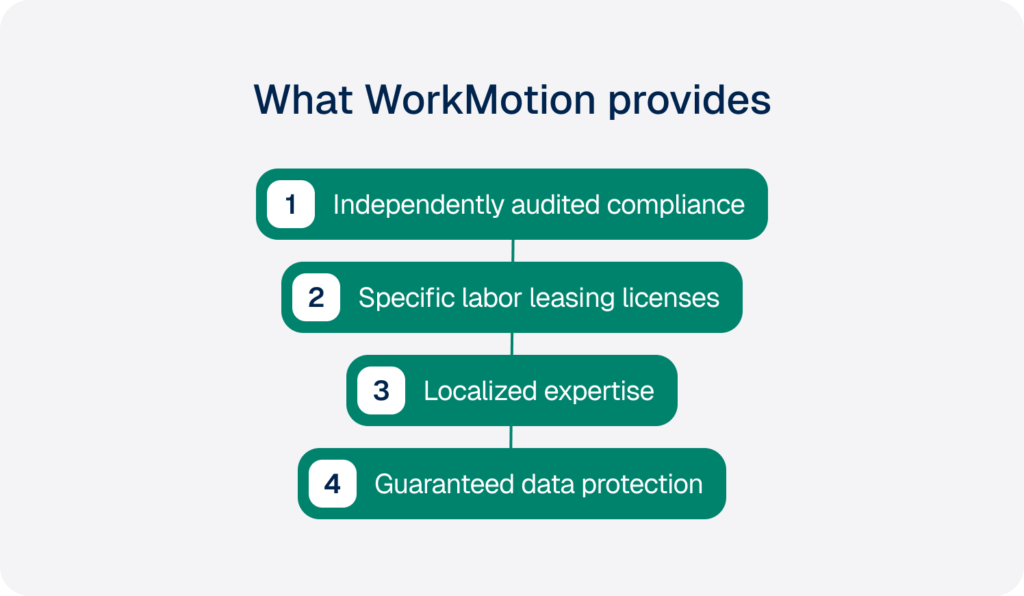
WorkMotion provides the verified compliance layer your European expansion requires:
- Independently audited compliance: WorkMotion is the only EOR holding the IEC Gold Certificate, proving its processes meet the highest legal standards.
- Specific labor leasing licenses: It secures the exact local licenses (like the German AÜG) needed to employ your team legally, rather than just setting up a basic business entity.
- Localized expertise: WorkMotion provides dedicated support teams that understand the nuances of European labor laws, ensuring your hires are onboarded compliantly in just days.
- Guaranteed data protection: The platform ensures strict adherence to GDPR with guaranteed EU data residency.
You can easily run WorkMotion alongside your existing Gusto setup to manage your international team without disrupting your US payroll.
Ready to see how we handle the compliance heavy lifting in your target countries? Book a demo with our global hiring experts today. If you’d prefer to look around first, take a product tour.
















![idWjC-9cC6_logos 1 [Vectorized]](https://workmotion.com/wp-content/uploads/2026/02/idWjC-9cC6_logos-1-Vectorized.svg)