

You’re deep into evaluating Employer of Record (EOR) and record services providers, sitting through demos, and comparing two big names in the modern global hiring space: Deel and Oyster. Both platforms boast excellent user experiences and operate their own entities across the globe. But when you actually place a new hire in Germany, France, or the Netherlands, do their compliance claims hold up under the scrutiny of strict European local labor laws?
The EOR you select ultimately determines who carries the legal risk when a local regulator audits your staff leasing licenses or an international employee challenges their contract. Comparing Deel vs Oyster only gives you part of the picture. To make a fully informed decision, you need to evaluate a third approach: WorkMotion.
We’ll break down how Deel, Oyster, and WorkMotion differ across entity ownership, compliance depth, pricing, and onboarding speed, and why an independently certified provider is critical for European expansion.
Oyster vs Deel vs WorkMotion: At a Glance
Here’s a quick summary of how these three platforms compare across core capabilities.
| Feature | WorkMotion | Deel | Oyster |
|---|---|---|---|
| Entity model | Mixed | Mixed | Mixed |
| Best for | European compliance | Global scale | Startup simplicity |
| IEC certification | ✦ IEC Gold | No | No |
| EOR pricing | From €499per employee / month | From $599per employee / month | From $699per employee / month |
| Contractor pricing | €29per contractor / month | From $49per contractor / month | From $29per contractor / month |
| Country coverage | 160+ countries | 150+ countries | 180+ countries |
| Biggest strength | Certified compliance & support | Massive footprint | Clean UX |
| Biggest flaw | Not a full HRIS | Inconsistent support | Unverified compliance |
| Trustpilot rating | 4.8 / 5 | 4.6 / 5 | 3.9 / 5 |
Deel vs Oyster vs WorkMotion: What Each Platform Is and What It Isn’t
When selecting an EOR service, the underlying operating model is far more important than a simple feature checklist. The compliance infrastructure a provider uses dictates who holds the legal accountability when something goes wrong. Here’s a look at how these three platforms fundamentally operate.
WorkMotion

When expanding into highly regulated European markets, WorkMotion acts as your specialized compliance shield. Rather than trying to be everything to everyone globally, it focuses on providing an airtight legal framework for European employment.
By acting as the legal employer of record, WorkMotion takes on the administrative burden. You direct your employees’ daily projects, and WorkMotion takes care of the localized contracts, global payroll in multiple currencies, statutory benefits, and ongoing risk management.
Three structural differentiators set WorkMotion apart from broader global platforms:
- First compliance-certified EOR: WorkMotion holds the IEC Gold Certificate (awarded July 2025). This is the first independent compliance certification in the category, meaning processes are externally audited across 1,000+ checkpoints rather than just self-declared. Neither Deel nor Oyster currently holds an equivalent third-party certification.
- Country-specific licensing depth: Owning an entity is just the baseline. WorkMotion secures the specific licenses each regulated market requires. While the German AÜG is a well-known example, WorkMotion also holds necessary staff leasing and employment agency licenses in places like France (Portage Salarial) and the Netherlands (WAADI registration). Hiring through an unlicensed provider in any of these jurisdictions carries legal exposure that flows back to you.
- Specialist-led customer support: Scaling EORs often struggle with support consistency. WorkMotion maintains a 4.8 Trustpilot rating by providing dedicated support specialists, including legal, payroll, and in-country HR experts, rather than routing complex compliance questions through a generic ticketing queue.
Best understood as: The compliance-first EOR for companies hiring into Europe. It goes beyond simply processing international payroll by offering independently certified compliance, deep country-specific licensing, and a support model that SMEs can actually rely on.
Find out what it takes to hire legally in your next European market. Book a demo with our compliance experts today.
Deel

Deel is a giant in the global HR space, designed to help enterprises scale across borders rapidly. It brings together global payroll services, EOR capabilities, contractor management, and HR tools under one roof.
Its biggest strength lies in its breadth. Covering 150+ countries, Deel offers incredibly fast onboarding, a massive contractor payment network, and a wide array of advanced features that streamline complex global operations.
But buyers frequently point out structural concerns regarding compliance depth. Even though Deel has established its own business entities in over 120 nations, they only possess the required official labor leasing licenses in fewer than a fifth of those locations.
Also, as one of the largest providers in the category, customer service quality can vary, particularly when SMEs need responsive specialist support for nuanced European compliance questions.
Best understood as: A high-scale EOR with a massive product suite. However, its compliance depth and support responsiveness in regulated European markets warrant direct verification before you sign a contract.
Oyster

Oyster is a startup-friendly EOR positioned around simplicity, transparent onboarding, and a clean employee experience. It helps companies hire their first few international employees easily.
The platform’s advantage is its intuitive design and predictable per-employee pricing. It resonates strongly with SMBs and early-stage companies that want a straightforward EOR solution without enterprise-level complexity.
Oyster operates on a mixed model, relying on trusted partner vendors in many countries rather than owning the infrastructure themselves. Like Deel, they possess specific legal labor licenses in less than 20% of their entities, which can create compliance exposure in highly regulated European markets. Companies wanting more compliance assurance may want to consider Oyster HR alternatives.
Best understood as: An SMB-focused EOR with a highly approachable UX. But for companies expanding into strictly regulated European markets, compliance certification depth and country-specific licensing warrant verification before committing.
The Key Decision Variable: Licensing Depth and Independent Compliance Verification
If a local authority flags a misclassification issue or audits your payroll, the legal fallout lands on the official employer of record. Navigating tax regulations and local laws requires deep local expertise. But if that EOR doesn’t have the right local licenses, the liability can easily bounce right back to you.
In the past, buyers just wanted to know if an EOR used its own legal entities instead of local partners. That standard has shifted. Deel, Oyster, and WorkMotion all have their own infrastructure in major markets. The real test today is whether those entities actually possess the strict, country-specific permits needed to operate legally, and if an independent auditor has verified their setup.
Take Germany as an example. Simply registering a business there doesn’t grant you permission to lease out employees. You have to secure the AÜG license. You’ll find similar hurdles in Portugal, Italy, and the Netherlands. An EOR might proudly claim they own an entity in a specific country, but without the exact local license, they’re operating in a legal gray area.
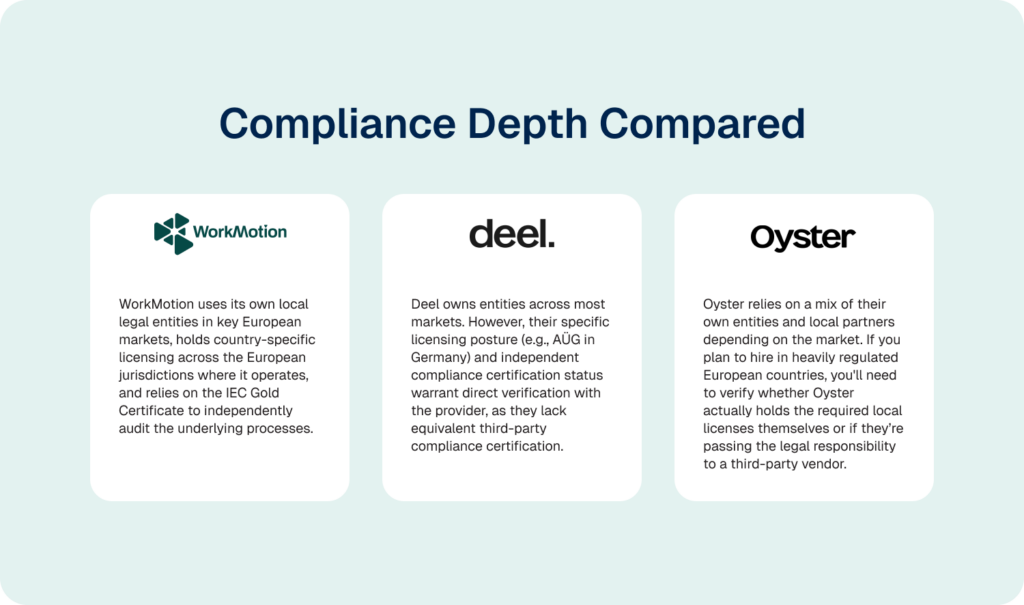
Here’s how the three platforms stack up when you look at compliance depth:
Don’t leave your European expansion to chance. Book a demo to review the exact licenses and frameworks you’ll need to scale safely.
Feature-by-Feature Comparison
Buying decisions are made in the details. How each platform behaves under real operational conditions as compliance complexity increases is what separates a good marketing pitch from a reliable HR infrastructure. Here’s how Deel, Oyster, and WorkMotion compare across core functions.
Pricing
Comparing base subscription fees won’t give you the full financial picture. What really matters is your total cost of employment and how predictable your invoices will be month over month. You have to factor in mandatory social contributions, severance accruals, and upfront deposits for both full time employees and contractors to see which platform actually protects your budget.
WorkMotion
WorkMotion breaks down costs by country before you sign anything. That includes the core service fee alongside mandatory benefits and employer social contributions. You can also use WorkMotion’s employment cost calculator to get a market-specific estimate.
If the service falls short for any reason, the plans are backed by a money-back guarantee:
- EOR: Starting at €499/employee/mo
- Direct Hiring: Starting at €399/employee/mo
- Contractor Management: Starting at €29/contractor/mo
Deel
Deel offers tiered EOR pricing and a modular structure. Your total software costs will expand as you add HR, recruiting, or development features:
- EOR: Starting at $599/employee/mo (Standard) or $899/employee/mo (Enterprise)
- Contractors: Starting at $49/contractor/mo
- Contractor of Record: Starting at $325/contractor/mo
- Deel HR: Modular add-ons ranging from $5 to $30/employee/mo
Oyster
Oyster markets its pricing as transparent and all-inclusive, meaning they don’t charge extra for setup, onboarding, or offboarding. However, you’ll need to put down a refundable deposit for each EOR team member before they start to secure on-time payments.
They also offer scale pricing if you’re hiring in volume:
- EOR: $699/employee/mo
- Contractors: $29/contractor/mo
- Global Payroll: $29/employee/mo
Compliance, Licensing, and Entity Ownership
This is where the three providers truly separate themselves. Checking the box on entity ownership doesn’t guarantee you’re compliant. To actually protect your business, your EOR needs the exact local permits, compliance tools, and the independent audits to prove their setup is legally sound.
WorkMotion
WorkMotion takes on direct legal responsibility by employing your team through its own European entities. It doesn’t just set up a basic business entity. It secures the exact local licenses required in the countries where it operates.
Plus, the IEC Gold Certificate proves its workflows have passed an independent audit of over 1,000 control points. It also guarantees EU data residency for clients prioritizing GDPR compliance and offers employment liability insurance coverage.
Deel
Deel handles local compliance through an extensive global footprint of over 120 entities. But because they only hold official labor leasing licenses in a fraction (under 20%) of the jurisdictions that mandate them, you must verify their specific licensing status country by country. Deel also doesn’t currently publish an independent, third-party compliance audit for its EOR offering.
Oyster
Oyster supports hiring in multiple countries, but they rely on a mix of their own entities and local partners depending on the market. While they provide legal-reviewed agreements, they don’t publish an independent compliance certification. If you plan to hire in heavily regulated European countries, you’ll need to keep in mind that Oyster only holds official labor leasing licenses in less than 20% of entities.
Country Coverage
Your EOR needs to operate where your talent lives. Let’s look at the global coverage of each EOR and where they focus their infrastructure.
WorkMotion
WorkMotion covers 160+ countries with locally compliant contracts, payroll in local currency, and statutory benefits. It operates its own licensed entities in key European markets, including Spain, Germany, France, Poland, Italy, Portugal, and the UK.
Deel
Deel boasts massive global coverage, supporting EOR and contractor payments across 150+ countries. They also highlight having 150+ entities globally to support this footprint.
Oyster
Oyster supports hiring in 180+ locations across every continent. They also act as a direct global payroll provider in 26 countries.
Onboarding Speed
Securing top talent means moving fast before they accept another offer. Here’s how quickly each provider can turn a signed contract into an active, payroll-ready employee.
WorkMotion
WorkMotion onboards new hires in European markets in just three to five business days from a signed contract to payroll enrollment. Because they use their own entities and pre-built, country-specific employment contracts, no third-party sign-off is required.
Contract creation takes only 10 minutes, and the platform handles contract negotiation fully in-app. Trustpilot reviews consistently cite this contract turnaround speed as a major advantage for securing top talent quickly.
“Great experience so far,” says a Trustpilot user in the Netherlands. “The process of drafting and signing my employee contract was quick and customer service was really fast and responsive.”
Deel
Deel’s EOR onboarding typically runs three to five business days in most markets, though contract generation alone can take two to five business days depending on the country.
They do market the ability to get employees onboarded “in as little as one day” in certain streamlined scenarios, supported by their massive network of 130+ owned entities.
Oyster
Oyster markets the ability to onboard new talent “in as fast as 48 hours” with the help of country-specific onboarding managers. Users frequently cite their clean UX and guided onboarding checklists as a positive experience for new hires, though actual timelines will vary based on the complexity of the local jurisdiction.
Contractor Management
Many global teams rely on a mix of full-time employees and freelancers. You need a platform that handles both without creating separate administrative silos.
WorkMotion
WorkMotion includes contractor management alongside its EOR services. It features a centralized dashboard, payment processing in 100+ local currencies with automated currency conversion, and automated contract generation.
The platform also includes a misclassification risk assessment tool and allows for easy contractor-to-employee conversion when you’re ready to transition a freelancer to a full-time hire.
Deel
Contractor management is arguably Deel’s strongest product. They offer a massive contractor payment network supporting 120+ currencies and 15+ payout methods (including crypto, Wise, and Revolut).
They automate invoicing based on contract terms (fixed, PAYG, or milestone) and provide a Contractor of Record service where Deel hires contractors on your behalf to put classification and compliance on autopilot.
Oyster
For contractors, Oyster offers a fully self-serve platform to hire, pay, and manage contractors in 180+ countries for $29 per contractor per month. It allows you to instantly generate compliant contracts, automate invoicing, and send global payments in 120+ currencies. It also includes an employee misclassification test and allows you to manage contractor time off and expenses from the same dashboard.
Customer Support
For SMEs without internal compliance or HR resources, support responsiveness is part of the compliance posture, not a separate variable. This is where WorkMotion typically wins the WorkMotion vs Deel vs Oyster HR debate.
WorkMotion
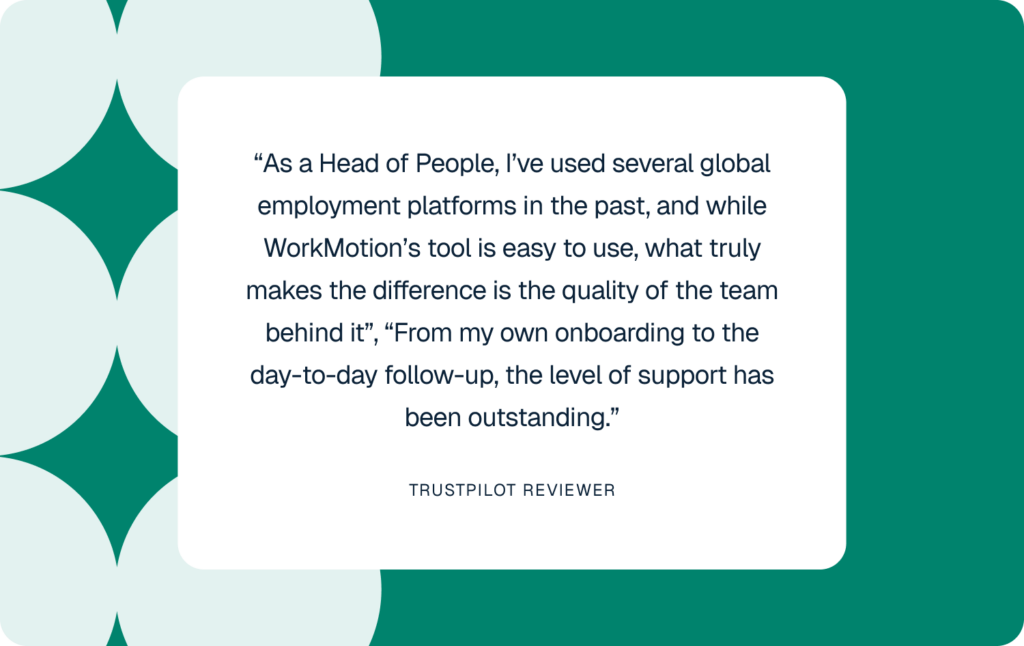
WorkMotion uses a dedicated support model rather than a generic ticketing queue. You get a dedicated team including a Customer Success Manager, a Talent Success Manager, local HR experts, payroll specialists, and a legal team. This approach has earned a 4.8 Trustpilot rating, with customer feedback consistently highlighting fast contract turnaround and responsive compliance guidance.
Deel
Deel provides 24/7 global support to handle its massive customer base. But as they’ve scaled, some users have found that their support teams lack the deep, localized expertise required for complex European compliance. When you need nuanced legal guidance rather than a generic ticketing queue, the cracks start to show.
“Do not use for Europe-based employees. Unprofessional and automated service with no employees seemingly trained in European labour law and regulations. Salaries are paid late, not in full,” reports a Netherlands-based Trustpilot user. “Contracts are based on US templates that do not carry over at all into European law. Leaves out important clauses like holiday pay and takes months to correct this.”
Oyster
Oyster is generally well-regarded for its UX and onboarding experience. However, their Trustpilot rating sits at 3.9, with some recent reviews citing slow response times and difficulties resolving complex payment or contractual issues.
“Oyster provides the EOR service but their customer service is spotty, getting different answers from different people, slow on responses, and odd policies on deposits,” says a German Trustpilot reviewer.
Integrations
A modern EOR should plug right into your current workflows. Here’s how these platforms connect with your favorite accounting, HRIS, and communication tools.
WorkMotion
Instead of forcing you to abandon your current tech stack, WorkMotion acts as a plug-and-play employment layer. It syncs effortlessly with core HRIS platforms like BambooHR, Workday, and Personio to eliminate duplicate data entry.
If you have custom needs, their open API allows your developers to build tailored workflows, ensuring your employee data flows right into your central systems.
Deel
Deel has an extensive App Store filled with enterprise-grade connections. You can link up with SAP SuccessFactors, NetSuite, and Google Workspace, or use their Workflow Builder to automate onboarding tasks.
Oyster
Oyster integrates smoothly with external and project management tools, aiding employee development and employee management. They integrate with popular startup and mid-market tools such as Factorial, Workable, and Ashby. They also offer a robust Zapier integration that unlocks connections to over 5,000 apps, including Asana and Google Sheets.
When Each Platform Fits
The right EOR is the one whose entity model, license stack, and compliance depth match the markets where you’re hiring.
Choose WorkMotion If
- You’re a mid-sized team focusing your hiring efforts on European markets like Germany, Spain, France, Poland, Italy, or Portugal.
- You demand a partner that holds the required local permits and backs it up with an IEC Gold certification.
- You don’t want to guess about legal accountability. You expect an independently audited compliance process rather than taking a software vendor’s word for it.
- You must guarantee EU data residency to satisfy strict local regulations and client demands.
- You’ve outgrown Deel or Oyster after hitting compliance roadblocks or licensing gaps in heavily regulated countries.
Choose Deel If
- You want to consolidate EOR, contractor payouts, and global payroll services into one massive system to cover as much of the globe as possible.
- You value speed and geographic breadth above all else to fuel your business growth and manage complex global operations.
- You employ an in-house legal team that has the bandwidth to manually double-check your provider’s licensing claims and manage legal risk management on a country-by-country basis.
Choose Oyster If
- You’re an SMB or early-stage company hiring your first one to three international employees.
- A user-friendly platform and straightforward onboarding are your primary decision factors.
- Your hiring is concentrated in markets where Oyster has documented own legal entities.
- Compliance verification depth is not the deciding factor for your use case.
Use WorkMotion Alongside Deel or Oyster If
- You already have a global EOR but need to fill a compliance or licensing gap in a specific European market.
- You want to consolidate European hiring under a provider with owned entities and certified compliance without migrating your entire HR stack.
What WorkMotion Brings That Deel and Oyster Don’t
When you look past the marketing, WorkMotion offers three verifiable, hard-to-replicate structural advantages tied directly to business outcomes.
- Audit-ready assurance: Because WorkMotion holds the IEC Gold Certificate, you never have to take a software vendor’s word on compliance. You get the peace of mind that comes from an independent, third-party verification of their entire legal framework.
- Zero legal gray areas in Europe: WorkMotion doesn’t just set up shell companies. They secure the exact, highly regulated staff leasing permits required to operate legally in the strictest European jurisdictions. This ensures that legal exposure never flows back to your business.
- Answers from actual experts: When a complex tax issue or termination question arises, you don’t want to be stuck in a generic ticketing queue. WorkMotion provides direct access to local HR professionals and legal specialists, which is exactly why they maintain a 4.8 Trustpilot rating from growing SMEs.
WorkMotion competes on independently verified compliance, country-specific local expertise, and SME-grade support, not on being the cheapest option. For companies hiring into Europe, that combination is often the difference between a clean audit and a problem that flows back to your business.
If you’re ready to scale safely into Europe, book a demo today. Or, take a product tour and explore the platform on your own.

















![idWjC-9cC6_logos 1 [Vectorized]](https://workmotion.com/wp-content/uploads/2026/02/idWjC-9cC6_logos-1-Vectorized.svg)