
Gusto and Rippling have earned their reputations for US payroll and HR. But the moment you want to hire outside the United States, a compliance gap opens that neither platform was designed to close.
Running US payroll software doesn’t make you the legal employer in another country. Hiring in Germany, Spain, or Poland requires local entities, locally compliant contracts, and statutory benefits that vary by jurisdiction. Managing this through US payroll tools creates real legal and tax exposure.
This guide compares Gusto, Rippling, and WorkMotion, an international employment layer built for exactly this problem. We analyze pricing, payroll services, HR features, compliance support, and scalability, so you can build the right combination for your workforce.
Gusto vs Rippling vs WorkMotion: At a Glance
Before evaluating each tool, here’s what WorkMotion, Gusto, and Rippling offer at a glance.
| Feature | WorkMotion | Gusto | Rippling |
|---|---|---|---|
| Primary market | International EOR for SMEs | US small businesses | US mid-market |
| International EOR | Yes | Limited (Remote partnership) | Yes |
| Entity model | Own entities in key markets, EOR partners in special use cases | Partner-dependent (Remote) | Hybrid (owned + partner network) |
| IEC compliance certified | ✦ IEC Gold | No | No |
| EOR Pricing | €499/mo | $699/mo | Custom quote |
| TrustPilot Rating | 4.8 / 5 | 2.4 / 5 | 4.6 / 5 |
Gusto vs Rippling vs WorkMotion: What Each Platform Is And Isn’t
The difference between these platforms comes down to operating philosophy. A system optimized for 20 US employees creates compliance exposure when you want to hire employee number 21 in Germany. Understanding what each platform was built to do helps you match tools to your actual employment structure.
WorkMotion

WorkMotion is a compliance-first global Employer of Record built in Europe for companies scaling internationally. When you hire through WorkMotion, WorkMotion’s legal entity in that country becomes the legal employer. That entity handles employment contracts under local law, payroll in local currency, statutory benefits, tax withholding, and ongoing compliance obligations.
Three structural elements set WorkMotion apart from generic EOR providers:
- Own entity network: WorkMotion operates its own legal entities in key markets, which ensures compliance accountability rather than relying on third-party partner networks.
- IEC Gold Certification: WorkMotion became the first EOR in the industry to achieve independent compliance certification in July 2025, with 94% of relevant entities properly licensed. This matters because operating without proper licenses transfers legal liability directly to client companies in many jurisdictions.
- Necessary country-specific licensing: WorkMotion holds the licenses required to operate compliantly in each market. For example, Germany’s Arbeitnehmerüberlassungsgesetz (AÜG) staff leasing license is a hard legal requirement. Operating without it means both the EOR and client company operate non-compliantly. This is one example of the country-by-country licensing principle WorkMotion follows globally.
WorkMotion acts as your international employment layer where US payroll tools leave off. You manage the work, and WorkMotion handles contracts, payroll, benefits, and compliance.
Gusto
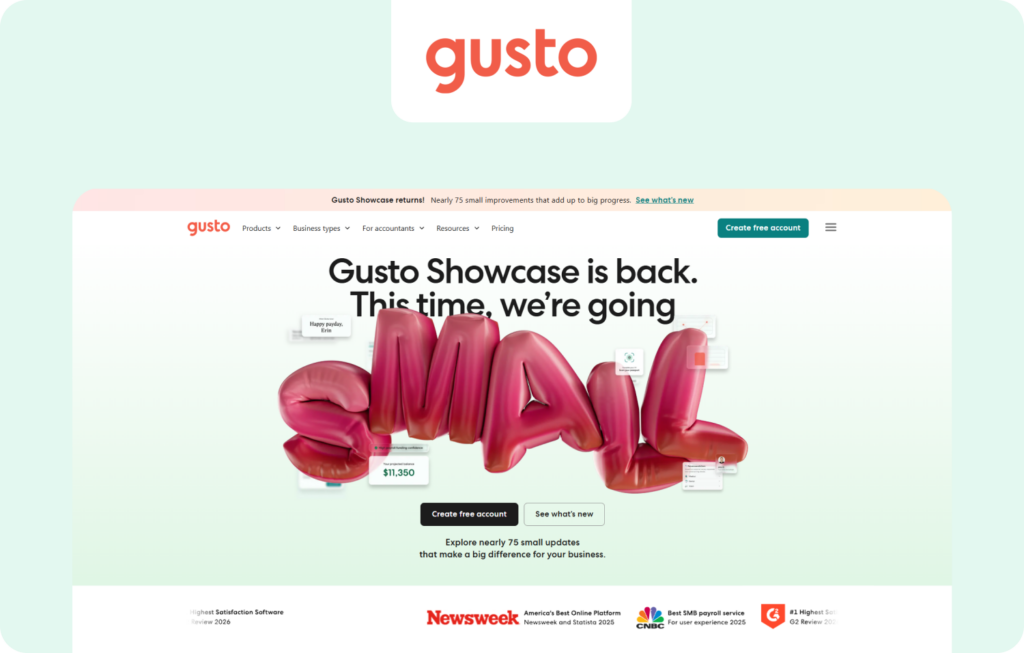
Gusto is a US-focused payroll and benefits platform designed for small businesses. The platform is easily accessible with a clean interface, straightforward setup requiring minimal manual effort, and transparent pricing. This makes it one of the easier payroll systems for companies without dedicated HR teams.
Gusto handles federal, state, and local tax filings automatically, processes W-2s and 1099s, and administers US employee benefits including health insurance, 401(k)s, and FSAs. For domestic US operations, it’s a solid choice.
But, Gusto offers no native international employment capability. For global hiring, Gusto partners with Remote to provide Employer of Record services in 11 countries (Australia, Brazil, Canada, India, Ireland, Mexico, Netherlands, Philippines, Portugal, UK, and Spain). This partnership model means Gusto doesn’t own entities abroad and doesn’t carry direct compliance accountability for international hires.
If you’re looking for a clean US payroll platform, Gusto is a valid choice. Remember, it requires a separate solution when you need to hire outside the United States.
Rippling
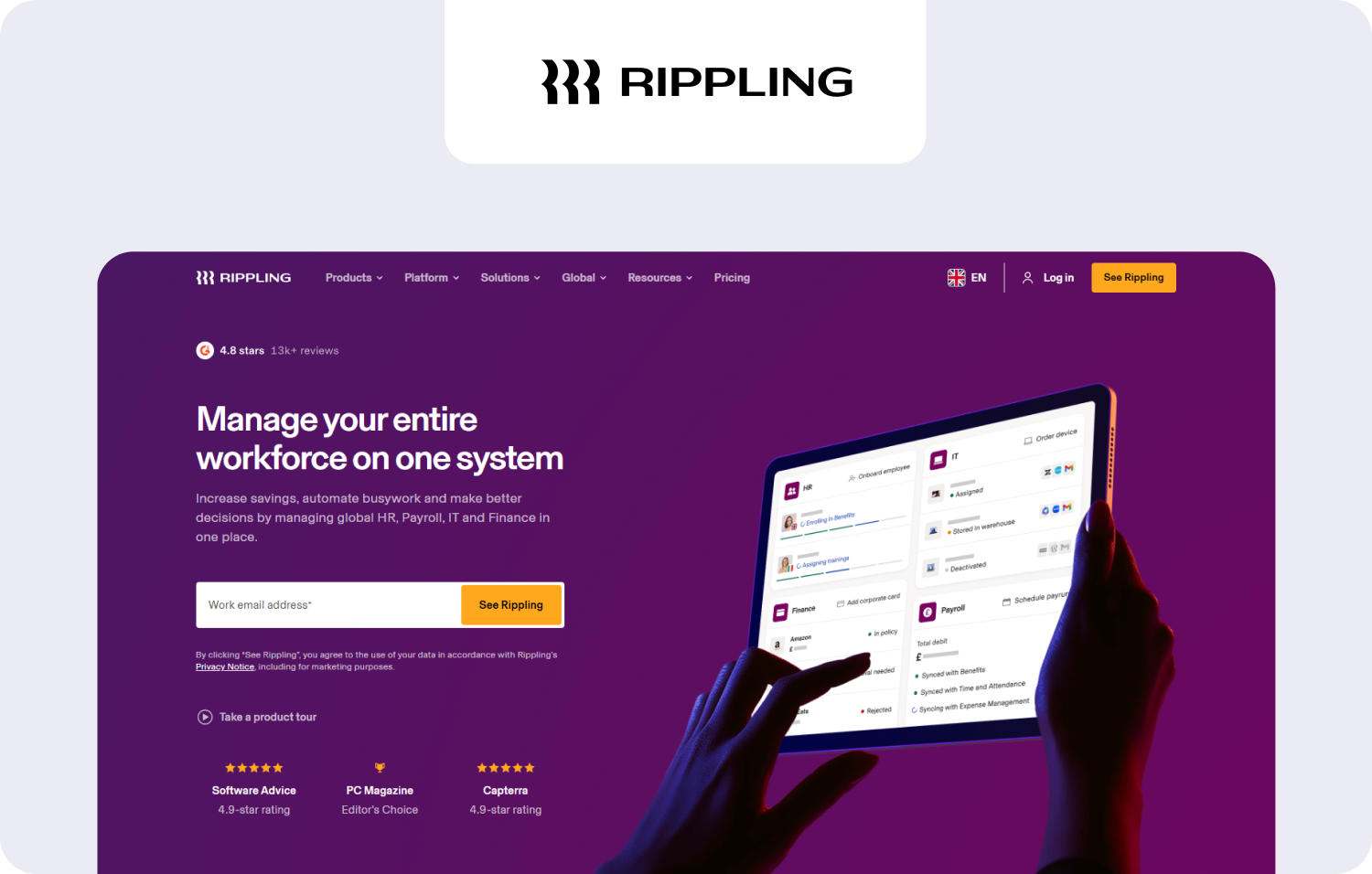
Rippling is an all-in-one workforce management platform consolidating HR, payroll, IT, and finance operations. The core value proposition centers on eliminating tool fragmentation and consolidating employee data. One system provisions employee devices, grants software access, processes payroll, and manages expenses.
For US-centric technology companies seeking operational consolidation, Rippling delivers genuine advantages. The platform handles payroll for multiple states, automates IT provisioning during onboarding, and provides granular permissions across all modules with customizable reporting.
While Rippling offers international hiring through its Employer of Record service in 85+ countries, it’s not a dedicated global employment solution. Customers also need to verify if Rippling operates through its own entities or if it relies on third-party local partners in your preferred international markets.
Rippling is a strong US-centric platform with extensive HR capabilities, but international hiring varies by geography.
Feature-by-Feature Comparison
Buying decisions get made in the details, the key differences between platforms. Specifically, how each platform behaves under real operational conditions when something goes wrong, when you need to scale quickly, or when compliance complexity increases. This comparison is based on vendor documentation, official feature descriptions, and publicly available pricing information.
Gusto, Rippling, and WorkMotion are all well-built platforms for their intended markets. What differs is scope, geography, and compliance accountability structure.
Payroll
Payroll capabilities reveal each platform’s core strength and geographic boundaries. Look beyond whether the platform can process payments accurately to assess where they can legally employ workers, and who carries compliance accountability when something goes wrong.
WorkMotion
WorkMotion runs payroll in 160+ countries in local currency, managing employer tax contributions, statutory deductions, and benefits per local labor law. This matters because processing payroll and being the legal employer are different things.
Most payroll platforms can calculate what someone in Spain should be paid. WorkMotion actually employs that person through its Spanish entity, making it accountable for accurate tax remittance, proper contributions to social security, and compliance with local labor regulations.
When you hire through WorkMotion, your employees receive payslips in their local language, with deductions itemized according to local regulations. Statutory benefits like Spain’s employer social security contributions or France’s mandatory profit-sharing provisions get handled as standard operating procedure rather than add-ons requiring manual configuration.
Gusto
Gusto processes US payroll accurately and handles federal, state, and local tax filings automatically. The platform generates W-2s, 1099s, and other tax forms, and employees receive payroll run notifications with clear pay stubs via direct deposit.
Gusto focuses on domestic payroll, meaning global payroll capabilities run through its partnership with Remote, available in only 11 countries.
Rippling
In a Rippling vs Gusto comparison, Rippling processes US payroll with more configuration depth than Gusto. This is ideal for multi-state operations or companies with complex pay structures. The platform integrates tightly with Rippling’s time-tracking and expense management modules, reducing data entry between systems.
For international payroll, Rippling offers five days to payday in popular markets. But specific country coverage and whether Rippling operates through own entities versus third-party partners varies by market.
HR Tools
HR tools evaluation depends on whether you’re replacing your entire HR system or adding international employment capability alongside existing infrastructure. Gusto and Rippling aim to be your primary HRIS, while WorkMotion operates as your international employment layer that integrates with whatever US platform you already use.
WorkMotion
WorkMotion acts as your international HR layer rather than a full HRIS. The platform manages employment contracts, employee onboarding workflows, expense tracking, PTO policies, and document storage for international hires.
Most WorkMotion customers maintain their existing US HR platform (like Gusto, Rippling, or BambooHR) and run WorkMotion in parallel for international employees. This way, you avoid forcing a full HR migration while keeping a consolidated view of your global workforce.
WorkMotion also offers instant contract creation. It generates locally compliant employment contracts immediately rather than requiring two to five day waiting periods common with other EOR providers. When you’re competing for talent in tight European labor markets, being able to send a contract within hours instead of days matters.
Gusto
Gusto provides onboarding checklists, document storage, and PTO tracking suitable for small US teams. The platform is designed for simplicity. Teams without dedicated HR staff can operate it effectively.
However, as workforce complexity grows, some teams may find that Gusto’s simplicity becomes a limitation.
Rippling
Rippling offers standard HR fundamentals plus workflow automation capabilities that larger teams find valuable. Role-based permissions are more granular than Gusto’s, and the platform’s integration with IT provisioning creates genuinely automated onboarding experiences.
For mid-market companies with technical operations teams, Rippling’s additional complexity translates to more powerful automation. For smaller teams, it may be more platform than needed.
Benefits
Understanding benefits administration requires acknowledging the differences around the globe. In Europe, statutory benefits are legal obligations, not configurable options. What applies in France differs from the UK, which differs from Spain, which differs from Portugal. A US-based HR team cannot navigate this complexity through US payroll software alone.
WorkMotion
WorkMotion handles statutory benefits as part of standard EOR service. When you hire in Portugal, the 13th-month salary gets built into compensation planning automatically. When hiring in Germany, mandatory pension contributions, healthcare enrollment with statutory providers, and proper unemployment insurance registration happen by default.
Beyond statutory minimums, WorkMotion advises on what supplemental benefits are standard in specific markets. This helps you remain competitive for talent without accidentally creating compliance gaps by offering benefits structured incorrectly for local law.
Gusto
Gusto provides strong US benefits administration. The platform connects with health insurance carriers, manages FSA and HSA deductions, administers 401(k) contributions, and offers benefits consulting for small businesses navigating carrier selection.
For US benefits specifically, Gusto performs well at its price point. But statutory benefits infrastructure for non-US hires doesn’t exist within Gusto’s native platform.
Rippling
Rippling administers US benefits with plenty of configuration options, which is useful for multi-state teams or companies offering tiered benefits structures by location or role. International benefits administration exists within Rippling’s EOR offering but varies by market.
Compliance and Legal Coverage
This is where platforms diverge most meaningfully, and where the business consequences of provider choice become clearest. Operating as an Employer of Record without proper licenses creates legal exposure for both the EOR and the client company. In some jurisdictions, liability transfers directly to the client.
WorkMotion
Operating as an Employer of Record without the right licenses is a liability that can land on your company directly. This means your company faces fines, back-taxes, and disputes even when compliance was supposedly outsourced.
WorkMotion addresses this by holding the necessary licenses and registrations in each market it operates in, running through its own legal entities rather than third-party partners, and maintaining clear accountability chains when compliance questions arise.
WorkMotion also became the first EOR to achieve IEC Gold Certification, an independent compliance audit structured around 10 comprehensive pillars including legal licensing, employment law, tax and payroll, and benefits and social security. The audit evaluated over 1,000 control points across 10-20 representative countries per provider, heavily weighing the most complex and regulated markets in Europe.
This certification validated WorkMotion’s comprehensive compliance infrastructure, which also includes:
- Dedicated legal team oversight with qualified legal professionals who advise on complex cases including terminations, disputes, and regulatory processes.
- Direct compliance accountability through own-entity structure (not partner dependencies).
- Localized employment contracts drafted to regional labor law standards.
- EU data residency for clients with GDPR and data protection requirements.
Gusto
Gusto manages US payroll tax compliance effectively, handling federal, state, and local tax filings, W-2 and 1099 generation, and quarterly reporting. Outside the United States, compliance coverage depends on the Remote partnership arrangement.
Rippling
Rippling handles US compliance across payroll and benefits. For international compliance, Rippling’s EOR service provides support, but the depth of coverage and who ultimately carries compliance accountability depends on the specific market.
This is something always worth asking vendors directly: In the specific countries you need coverage, does the provider own entities, and who carries ultimate compliance liability if something goes wrong?
Pricing
Don’t anchor your evaluation on the advertised monthly base fee. The real question is how costs behave as your workforce becomes more geographically distributed. And how much of the compliance burden each provider actually takes off your plate.
WorkMotion
WorkMotion charges a per-employee monthly EOR fee on top of gross salary and in-country employer contributions. Before you hire, you can see the full cost of employment per country. This includes WorkMotion’s service fee, statutory employer contributions, and mandatory benefits.
Gusto and Rippling are priced for US payroll administration. WorkMotion is priced for international employment. If you’re using WorkMotion alongside either of those tools, you’re paying for two distinct services solving two distinct problems — not overlapping costs.
The more relevant cost comparison is WorkMotion’s EOR fee versus what it actually costs to establish and maintain a local entity in markets where you need to hire. Entity setup across most European markets involves notary and registration fees, minimum share capital requirements, legal advisor costs, and a multi-week registration process.
That’s before you can even employ a single person. For companies placing one or two new hires in a new market, EOR almost always delivers faster access at a lower total cost, with compliance built in from day one.
Pricing plans:
- Employee of record: from €499/talent/mo
- Direct hiring: €399/talent/mo
- Contract management: €29/talent/mo
Gusto
Gusto offers transparent tiered pricing:
- Contractor: $35/mo + $6/contractor payments
- Simple: $49/mo + $6/person
- Plus Plan: $80/mo + $12/person
- Premium: $180/mo + $22/person
- EOR (through Remote): $699/mo/employee (only available in 11 countries)
Rippling
Rippling uses modular pricing. You pay a core platform fee plus individual modules (HR, payroll, IT, benefits, finance). This flexibility is real, but it makes total cost of ownership harder to forecast without working through a full scope conversation.
There’s no public pricing available, which can create friction during early research stages when teams are comparing options before engaging sales processes.
Scalability
Scalability differences become visible when you move from 10 employees to 50, or from one country to five. The platform that works perfectly at your current size may create operational bottlenecks, or structural gaps, as geographic complexity increases.
WorkMotion
WorkMotion scales with international headcount across 160+ countries. The own-entity model means adding a new market doesn’t require evaluating a new compliance relationship or verifying third-party partner credentials. WorkMotion’s infrastructure supports consistent global operations.
This structural advantage becomes clearer as you scale. Hiring your fifth employee in Poland, eighth in Spain, and third in Germany through the same EOR means you’re working with one compliance framework, one contract structure, one support team.
Gusto
Gusto scales well for domestic US growth. But Gusto cannot absorb international hiring into its native platform. Teams find themselves managing two separate systems (Gusto for US, separate EOR for international) by default.
Rippling
Rippling scales effectively for US-based growth, and international scaling does exist. The question to consider is, as you add countries, does scaling happen through Rippling’s own infrastructure or through partner arrangements that vary by market?
Customer Support
When payroll fails for an employee in the Netherlands three hours before their bank expects funds, who answers, how fast do they respond, and can they actually solve the problem?
Many EOR platforms route issues to generic support queues where the person answering may not know the country, the law, or the urgency. This creates resolution delays that damage employee experience and create operational risk.
WorkMotion
WorkMotion’s support model assigns named specialists rather than routing to generalist support pools. Each client works with a dedicated Customer Success Manager during onboarding and for ongoing strategy. Each international employee works with a dedicated Talent Success Manager for country-specific documentation and compliance requirements.
There are local HR professionals with in-country labor law expertise, payroll specialists, legal teams, and invoicing specialists. Wanda AI (WorkMotion’s support automation) handles routine questions around the clock while transferring complex scenarios to relevant specialists.
WorkMotion publishes its SLAs against actual 2025 delivery results, not projected performance:
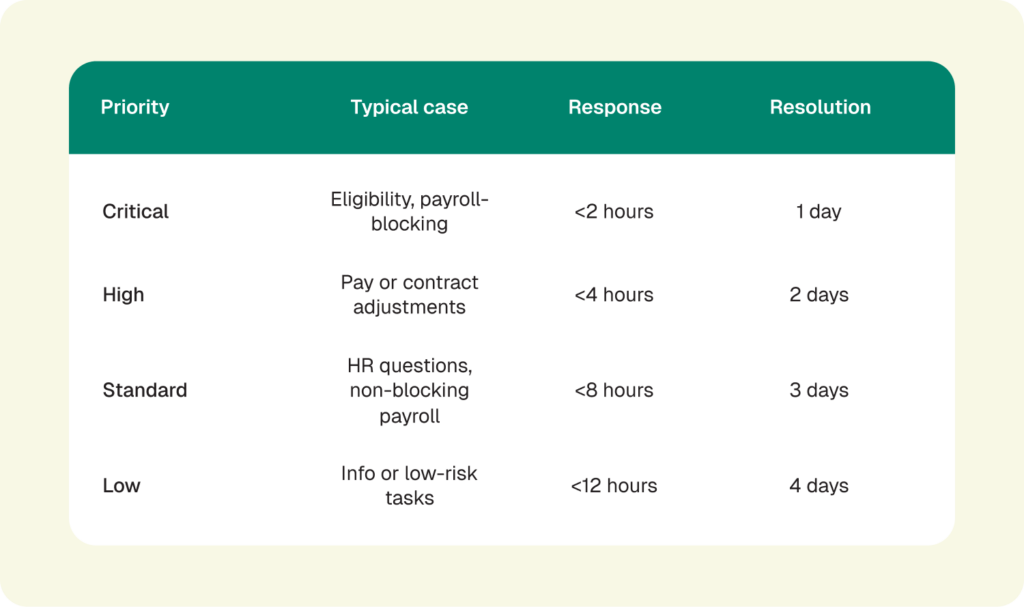
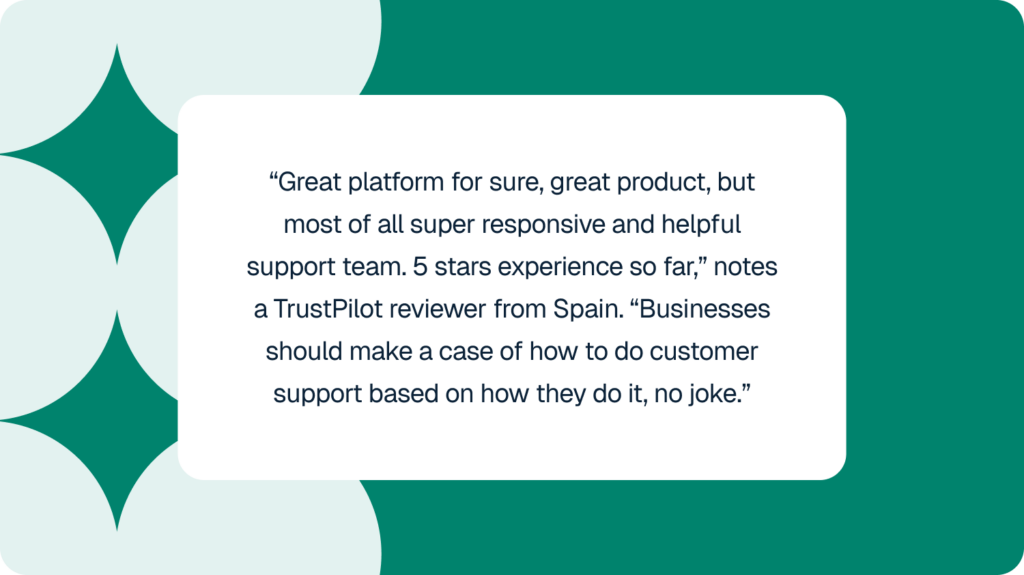
WorkMotion’s verified 2026 delivery metrics include +42.38 NPS, 95.45% CSAT, and a 93.05% TSAT. That last score measures satisfaction of the employees hired through the platform, not just the HR teams managing them. Few EOR providers track this at all. This is reflected in TrustPilot reviews.
Gusto
Gusto’s customer support is well-regarded at its price point, designed primarily for US payroll questions. But users do report slow and unhelpful customer experiences.
“If you need to call customer service for anything, you will be on the phone, mostly on hold for an hour minimum,” says a US customer on TrustPilot. “Customer service does not seem to know their own product.”
Rippling
Rippling operates its customer service team on a tiered model, with basic levels relying on self-service documentation and dedicated account management reserved for higher premium plans. International support via phone isn’t available 24/7. That’s a meaningful gap for teams managing employees across time zones where payroll issues don’t follow business hours.
Integrations
Integration capabilities determine whether your HR platform operates as an isolated system or connects seamlessly with the tools your team already uses.
WorkMotion
WorkMotion integrates with common HRIS and payroll platforms, allowing companies to maintain consolidated workforce views without migrating entire HR stacks. Companies running Gusto or Rippling for US employees and WorkMotion for international hires can connect both systems to centralize reporting.
Gusto
Gusto integrates with widely used accounting platforms (QuickBooks, Xero, FreshBooks), time-tracking systems, and various HR tools.
Rippling
Rippling supports a broad integration ecosystem with 600+ connections. It also offers the ability to use developer kits and publish integrations in the Rippling App Shop.
When Each Platform Fits
The right platform reflects the complexity of your employment operation, not the number of features in the sales deck. Here’s how to compare WorkMotion vs Gusto vs Rippling based on your use case.
Choose WorkMotion If
- You want to hire outside the United States, particularly into European markets with complex labor regulations.
- You need more than basic HR capabilities and basic payroll features.
- You need a provider that owns its entities, holds the necessary licenses in regulated markets, and carries independent compliance certification.
- Your company is an SME in tech, SaaS, fintech, AI, e-commerce, or a related sector.
- You want to hire compliantly in a new market without committing to entity setup and need to move in days, not months.
Choose Gusto If
- Your team operates entirely within the United States with no near-term international hiring plans.
- You’re a small business without a dedicated support and HR team that needs clean, accessible payroll and benefits administration at transparent pricing.
- Your priority is straightforward domestic tax filing and benefits management over configurability.
Choose Rippling If
- You’re a US-centric mid-market business looking to consolidate HR, IT, payroll, and finance into one operational system.
- IT management and device provisioning matter as much as payroll processing to your organization.
- You’re comfortable with modular pricing and a sales-led procurement process.
Use WorkMotion Alongside Gusto or Rippling If
You’re a growing business with an established US team on Gusto or Rippling and need to add international hires without migrating your entire HR stack. This is the most common deployment pattern for WorkMotion customers coming from either platform.
US payroll stays in Gusto or Rippling. International hires onboard through WorkMotion. Both systems run in parallel, with WorkMotion acting as your global employment layer while your existing tools continue handling domestic operations.
Implementation Considerations
Preparation matters more than software features. The organizations that get the most out of any of these platforms are the ones that define their workflows, data structures, and process requirements before implementation begins.
WorkMotion
WorkMotion onboards international hires in three to five business days across most European markets — from signed employment agreement to payroll enrollment.
Before you start:
- Define target countries and expected hiring volumes.
- Map PTO policies to local statutory minimums, which vary significantly by country.
- Configure multi-country reporting if board or investor visibility is required.
For teams transitioning from another EOR provider, verify WorkMotion’s entity ownership and licensing in your specific markets before initiating the switch. Most transitions complete within one payroll cycle.
Gusto
For domestic US operations, Gusto typically delivers the fastest time-to-value.
Before you start:
- Classify workers correctly (W-2 employees vs. 1099 contractors).
- Complete state tax registrations for every state where you have employees.
- Gather historical payroll data if migrating mid-year.
Rippling
Rippling requires more upfront configuration given its modular architecture, but that investment pays off in automation and cross-functional visibility once live. HR, IT, finance, and payroll connect in ways that simpler tools don’t support.
Before you start:
- Define which modules to activate and in what sequence.
- Map IT provisioning workflows, particularly for device management.
- Confirm entity ownership vs. partner arrangements for any international markets you need.
Get Started With WorkMotion
Gusto and Rippling are well-built platforms for their intended purpose: US payroll and HR administration for domestic teams. When your hiring crosses borders, you need a different layer — one that owns entities, holds proper licenses, and carries direct compliance accountability.
WorkMotion fills this gap with:
- Own entities in key European markets — direct compliance accountability, no third-party dependencies.
- IEC Gold Compliance Certification, the first independently certified EOR in the industry.
- Country-specific licensing where legally required.
- EU data residency for European clients with GDPR obligations.
- Three to five business day onboarding across most European markets.
- 4.8 Trustpilot rating from customers across tech, SaaS, e-commerce, and fintech.
The most common pattern is that US teams stay in their existing payroll platform, international hires onboard through WorkMotion, and no full HR migration is required. WorkMotion integrates with your current tools to provide consolidated workforce reporting across geographies.
Book a demo to see what compliant international hiring looks like for your specific markets and headcount requirements. Or take a product tour if you’d prefer to explore the platform independently first.

















![idWjC-9cC6_logos 1 [Vectorized]](https://workmotion.com/wp-content/uploads/2026/02/idWjC-9cC6_logos-1-Vectorized.svg)