

The candidate signed the offer. Then your team realized there was no entity in Poland, no compliant contract, and no way to legally run payroll for the hire.
If you already have legal entities in every country where you hire, payroll software may be enough. But if you’re hiring across multiple countries without entities, you’ll likely need an Employer of Record (EOR) to stay compliant with local labor laws, payroll tax rules, and employment regulations.
To help you find the right global payroll service, we’ve broken down the 10 global payroll providers and where each one fits best.
We’ll compare compliance coverage, onboarding speed, pricing transparency, entity ownership, and international hiring support so you can avoid choosing a payroll platform that doesn’t match your hiring model or compliance needs.
Global Payroll vs EOR vs Local Vendors: Which Do You Actually Need?
When comparing global payroll services, you’re often looking at three different models.
Some providers only process payroll. Some legally employ workers on your behalf. Others are local vendors that support a single country.
The biggest decision point is whether your business already has a legal entity in the country where you want to hire. If you don’t, payroll software alone can create compliance risks around tax registration, employment contracts, and local labor laws.

When Payroll Software Is Enough
Global payroll software works well when your business already has:
- A registered legal entity
- A local bank account
- Tax registration in the target country
In this setup, payroll service providers help automate payroll processing, manage payroll data, support payroll accuracy, and centralize international payroll operations across multiple countries.
This model is common among multinational organizations that have already established local entities and mainly need stronger global payroll coordination.
When You Need an Employer of Record
If your company doesn’t have a legal entity in the target country, you’ll usually need an Employer of Record.
The provider becomes the legal employer while your employee works for your business day to day. The EOR handles compliant payroll, payroll tax filings, benefits administration, employment contracts, and local compliance requirements.
This model is often used when:
- You need to hire within days, not months
- You’re entering a new market
- You want to avoid €30K+ entity setup costs
- Your team doesn’t want ongoing compliance overhead
Many companies evaluating the best EOR service providers are trying to solve hiring speed and compliance management at the same time.
When Foreign Employer Registration Makes Sense
Some companies want more control than EOR provides but aren’t ready to open a full local entity.
In these cases, foreign employer registration can be a middle ground. Your employees work under your brand while the provider supports payroll administration, registration, and local compliance obligations.
With Direct Hiring, WorkMotion supports foreign employer registration, payroll administration, and local compliance across several European markets, allowing employees to work under your brand without building a full entity structure first.
How We Evaluated These Global Payroll Service Providers
Not all global payroll services are built for the same type of hiring model. Some focus on payroll processing for businesses with existing entities, while others support compliant international hiring through EOR infrastructure and local employment support.
To compare providers fairly, we evaluated each platform across the five areas that have the biggest impact on international payroll operations, compliance management, and long-term operational efficiency.
| Evaluation criteria | What we looked at | Why it matters |
|---|---|---|
| Compliance depth | Entity ownership, licensing posture, independent certification, payroll compliance, and local regulatory compliance | Weak compliance structures can create payroll errors, tax compliance issues, and legal exposure across multiple countries |
| Onboarding speed | Realistic timelines from signed contract to first payroll | Delays in onboarding can slow hiring plans and affect international operations |
| Cost transparency | Itemized invoicing, employer contribution visibility, hidden fees, and add-on costs | Payroll services often look affordable upfront, but become expensive once onboarding, benefits, and payroll administration fees are added |
| Country coverage | Own entities vs. partner networks, local expertise, and regulated market coverage | International payroll providers vary widely in how much control they actually have over local compliance and payroll operations |
| Service model | Self-serve payroll software vs. dedicated support teams | Some businesses want hands-on compliance support, while others prioritize flexibility and operational control |
WorkMotion’s global payroll combines payroll administration, compliance support, and international hiring infrastructure, while other platforms focus more narrowly on payroll processing alone.
The 10 Best Global Payroll Services in 2026
The best global payroll services don’t all solve the same operational problem.
Some providers are built for payroll management across existing entities. Others combine international payroll services with Employer of Record infrastructure, compliance management, and workforce management support for businesses hiring across multiple countries.
The goal is to help your team compare global payroll providers based on how you actually plan to hire, pay employees, and manage compliance internationally.
1. WorkMotion — Best for SMEs Hiring in Europe

WorkMotion is best suited to SMEs hiring across Europe that need compliant payroll, faster onboarding, transparent pricing, and stronger control over local compliance obligations.
Its biggest differentiator is its IEC Gold Compliance Certification, which was independently audited across 1,000+ checkpoints and 10 compliance domains. WorkMotion also operates its own licensed entities in key European markets, including Spain, Germany, France, Poland, and the UK.
For businesses managing international payroll operations across regulated European markets, that entity ownership structure can reduce reliance on third-party intermediaries and improve compliance accountability.
WorkMotion also supports:
- 3–5 business day onboarding timelines in many European countries
- Itemized invoicing with employer contributions separated clearly
- EOR, payroll, and contractor support within one platform
- A direct hiring model for companies that want direct employment without opening a full entity immediately
- Centralized support for payroll administration, payroll tax handling, and local employment laws
The platform is especially strong for global businesses that want operational clarity while scaling international payroll across multiple countries.
The main limitation is scale. WorkMotion is not primarily optimized for enterprise-scale deployments involving 1,000+ employees and highly customized white-glove account structures.
Pros
- IEC Gold-certified compliance framework
- Own entities across major European hiring markets
- Transparent pricing and itemized payroll costs
- Fast onboarding timelines for European hiring
- Strong support for payroll compliance and local regulations
Cons
- Less tailored for very large enterprise deployments
- Europe-focused coverage compared to some larger international payroll providers
- Fewer enterprise HR suite capabilities than platforms like Rippling
Pricing
WorkMotion pricing starts at:
- EOR: €499 per employee/month
- Direct employment support: €399 per employee/month
- Contractor management: €29 per contractor/month
This pricing structure is more transparent than many payroll service provider models that require custom quotes before showing employer contribution breakdowns or onboarding costs.
Looking to expand your workforce into Europe? Book a demo today and find out how WorkMotion can work for you.
2. Deel — Best for Companies Prioritizing Speed and a Self-Serve Platform

Deel is known for fast onboarding, an intuitive self-serve platform, and broad contractor and EOR coverage.
Main limitation: Deel doesn’t publicly hold an independent compliance certification, and buyers have reported legal and compliance concerns in some markets.
Pros
- Fast onboarding
- Strong contractor and EOR coverage
- Intuitive self-serve platform
Cons
- No independent compliance certification
- Compliance concerns reported in some markets
- Pricing can become expensive at scale
Pricing
Deel’s EOR pricing starts at around $599 per employee/month, while contractor management plans start at lower monthly rates depending on service scope and country coverage.
If you’re comparing more compliance-focused European hiring models, this Deel vs. Rippling vs. WorkMotion comparison can give you the highlights.
3. Remote — Best for Mid-Market Teams Needing Integrated HR Tools

Remote combines EOR, payroll, and HR tools in one platform, making it a strong fit for companies consolidating payroll and HR operations.
Main limitation: Buyers have reported pricing opacity, and licensing structures vary by country in some European markets.
Pros
- Payroll and HR in one platform
- Strong centralized workflows
- Good fit for mid-market teams
Cons
- Pricing transparency concerns
- Licensing structure varies by country
- Some compliance coverage depends on partners
Pricing
Remote’s EOR pricing starts at around $599 per employee/month, while contractor and payroll-only services are priced separately depending on country coverage and service scope.
4. Papaya Global — Best for Enterprises With Complex Multi-Country Payroll

Papaya Global is strongest for multinational organizations managing complex payroll operations across existing entities.
Main limitation: Buyers have reported billing and invoicing issues, and EOR is not the platform’s original core product.
Pros
- Strong enterprise payroll infrastructure
- Broad international payroll coverage
- Good accounting system integrations
Cons
- EOR is not the core product
- Billing complaints reported by buyers
- Can feel complex for smaller teams
Pricing
Papaya Global pricing starts at $499 per employee/month for EOR services, $295 per contractor/month for Contractor of Record services, and $5 per contractor/month for contractor management. Final pricing varies depending on country coverage, onboarding complexity, and compliance support requirements.
5. Globalization Partners — Best for Established Enterprises Needing White-Glove Service
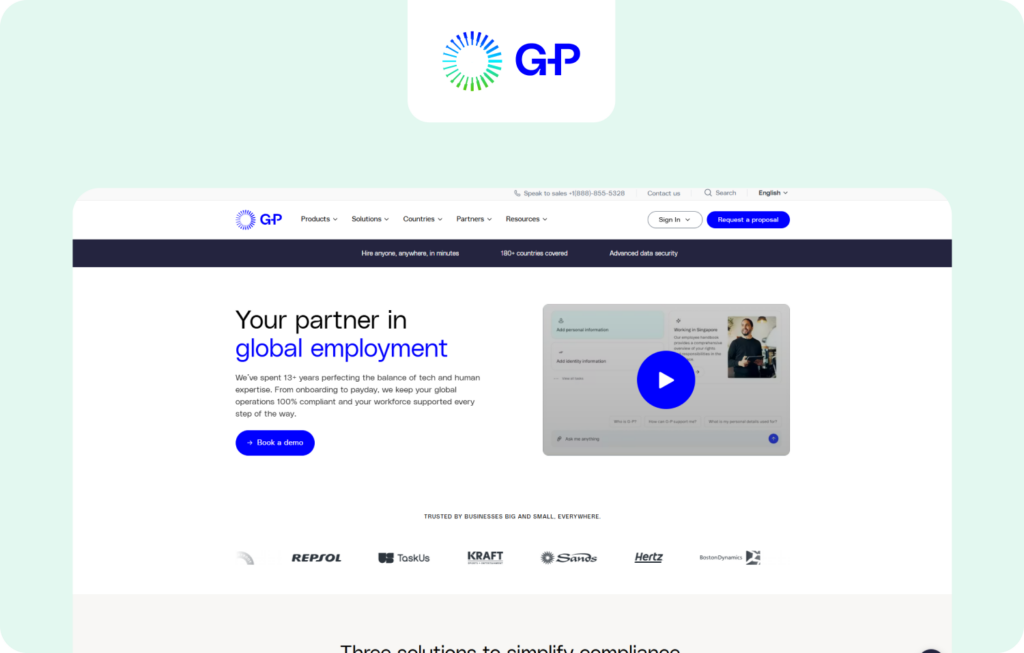
Globalization Partners (G-P) is built for enterprises that want high-touch support and broad international hiring coverage.
Main limitation: Onboarding is often slower and pricing less transparent than newer EOR platforms.
Pros
- Strong enterprise support model
- Own entities in major markets
- Broad global payroll coverage
Cons
- Premium pricing
- Slower onboarding
- Limited pricing transparency
Pricing
G-P does not publish standardized public pricing for its EOR services. You’ll need to request a custom quote based on hiring country, employee count, and service scope.
6. Oyster — Best for Distributed Teams Hiring in 180+ Countries

Oyster is a popular choice for distributed global teams that want broad international hiring coverage and a modern platform experience.
Main limitation: Oyster relies heavily on partner networks rather than fully owned entities in many countries.
Pros
- Broad country coverage
- Modern platform experience
- Good fit for distributed teams
Cons
- Relies heavily on partner networks
- Less direct entity ownership
- Support quality can vary by country
Pricing
Oyster’s public pricing starts at $699 per employee/month for EOR services and $29 per contractor/month for contractor management, while payroll services use custom pricing based on country coverage and operational complexity.
7. Pebl — Best for Companies Needing Workforce Flexibility

Pebl supports EOR, contractor management, and global hiring across 185+ countries, making it a strong fit for mixed workforce models.
Main limitation: Pricing transparency and support consistency can vary depending on country coverage and workforce structure.
Pros
- Strong mixed workforce support
- Broad international hiring coverage
- AI-driven onboarding workflows
Cons
- Limited pricing transparency
- Support experience varies by region
- Limited public entity ownership detail
Pricing
Pebl’s public EOR pricing starts at $399 per employee/month, with final pricing varying depending on country coverage, workforce structure, and compliance requirements.
8. Rippling — Best for U.S. Companies Managing HR and IT Together
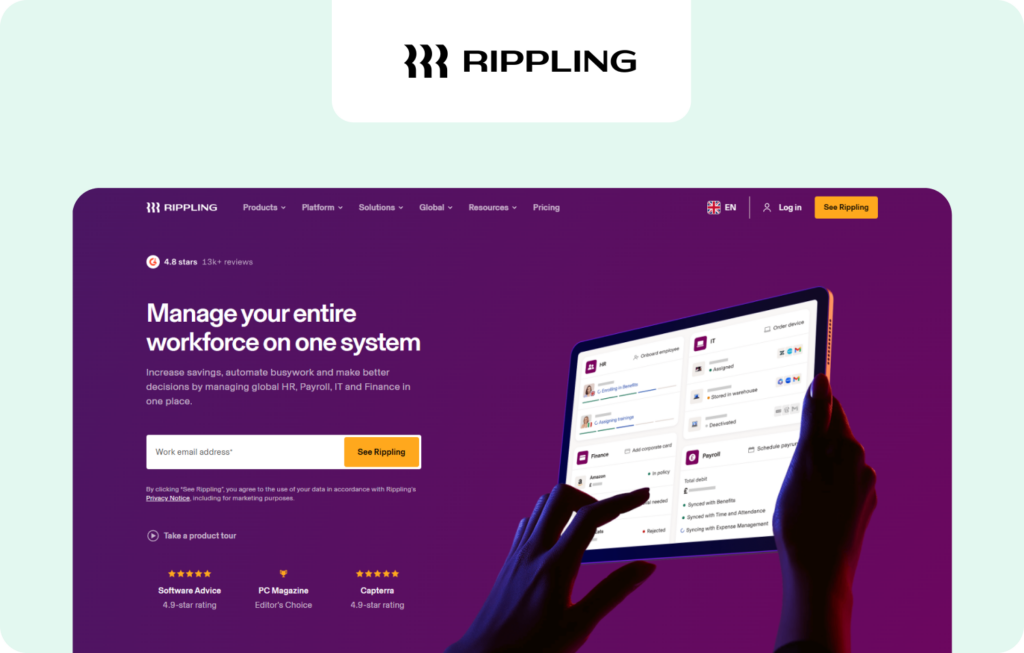
Rippling is primarily a U.S.-focused HR and IT management platform with international hiring added through global employment partnerships.
Main limitation: Rippling relies heavily on third-party partners for international EOR coverage rather than operating native EOR infrastructure directly.
If you’re expanding into Europe and navigating local compliance requirements, these Rippling alternatives compare differences in entity ownership, onboarding structure, and payroll compliance.
Pros
- Strong HR and IT integration
- Centralized employee management
- Broad workforce management features
Cons
- Relies heavily on EOR partners
- Less specialized in international payroll
- Pricing can become complex
Pricing
Rippling does not publish standardized public EOR pricing. Costs vary depending on modules, international coverage, payroll and HR requirements, and workforce size.
9. Multiplier — Best for Startups Needing a Low-Cost EOR Entry Point
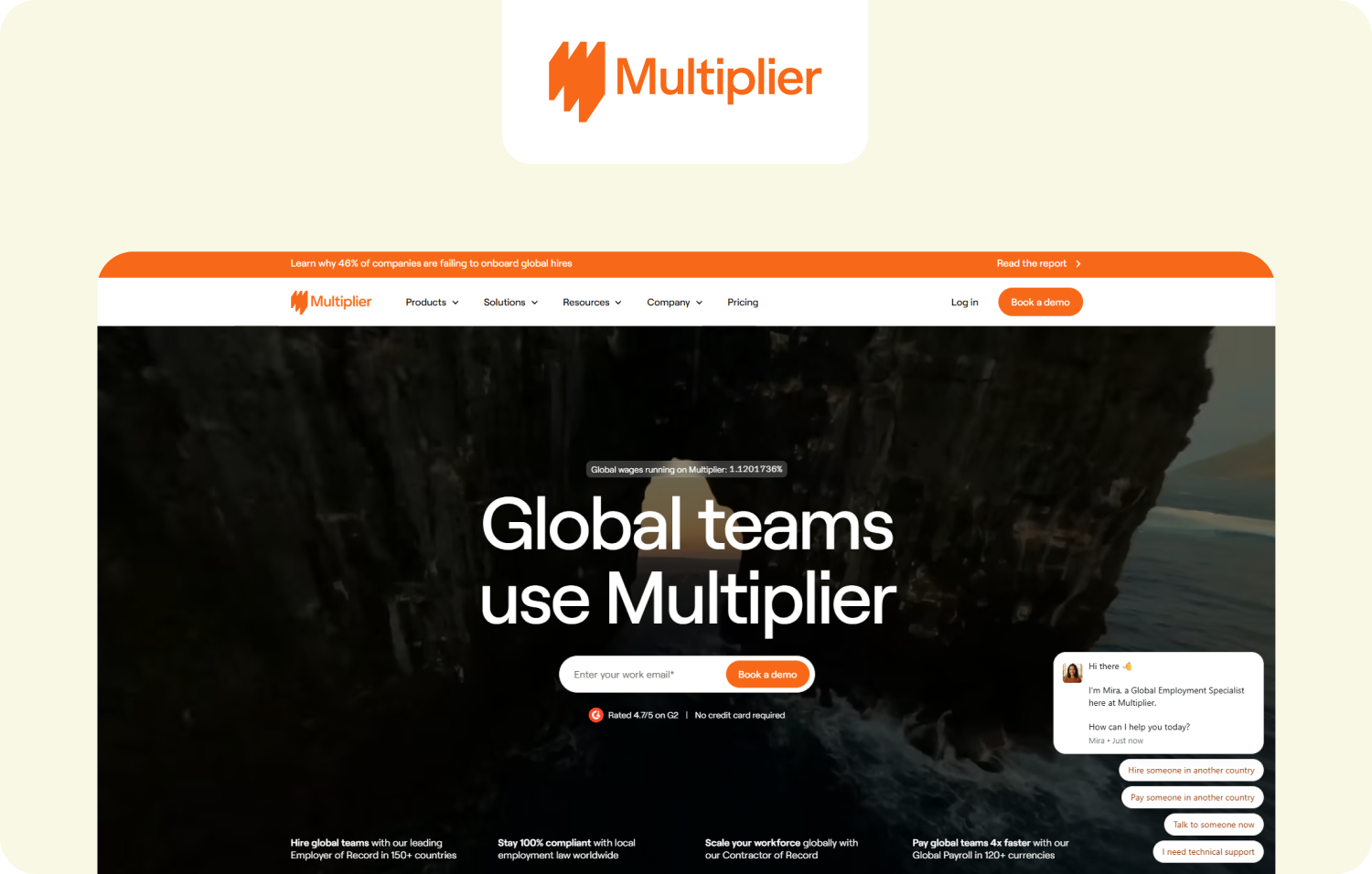
Multiplier is positioned as a startup-friendly global payroll and EOR platform with competitive pricing and broad hiring coverage.
Main limitation: Compared to longer-established providers, Multiplier has a newer platform and less proven compliance infrastructure.
If you’re comparing newer EOR platforms against more established providers, our guide to the best Multiplier alternatives breaks down the key differences.
Pros
- Competitive pricing
- Startup-friendly positioning
- Broad country coverage
Cons
- Newer platform
- Less proven compliance infrastructure
- Limited enterprise support depth
Pricing
Multiplier’s public pricing starts at $400 per employee/month for EOR services and from $40 per contractor/month for contractor management.
10. ADP Global Payroll — Best for Enterprises Already Using ADP Domestically

ADP extends domestic payroll operations into international markets through its global payroll products and partner network.
Main limitation: Onboarding is typically slower than modern EOR platforms and often assumes local entities are already in place.
Pros
- Strong enterprise payroll infrastructure
- Good fit for existing ADP customers
- Broad payroll coverage
Cons
- Slower onboarding timelines
- Often assumes existing entities
- Older platform experience than newer providers
Pricing
ADP does not publish standardized pricing for its global payroll services. Businesses need to request custom quotes based on country coverage, employee count, payroll complexity, and integration requirements.
Side-by-Side Comparison: Key Criteria at a Glance
| Provider | Best for | Entity ownership | Compliance certification | Onboarding speed | Pricing transparency |
|---|---|---|---|---|---|
| WorkMotion | SMEs hiring in Europe | ✓ | ✓ | ✓ | ✓ |
| Deel | Fast onboarding and self-serve workflows | ◐ | N/A | ✓ | ◐ |
| Remote | Mid-market HR + payroll consolidation | ◐ | N/A | ✓ | ◐ |
| Papaya Global | Enterprise multi-country payroll | ◐ | N/A | ◐ | ✓ |
| Globalization Partners (G-P) | Enterprise white-glove support | ✓ | N/A | ◐ | ◐ |
| Oyster | Distributed global teams | ◐ | N/A | ✓ | ✓ |
| Pebl | Mixed workforce models | ◐ | N/A | ◐ | ✓ |
| Rippling | U.S.-based teams adding global hires | ◐ | N/A | ◐ | ◐ |
| Multiplier | Startup-friendly EOR | ◐ | N/A | ✓ | ✓ |
| ADP Global Payroll | Enterprises with existing entities | ◐ | N/A | ◐ | ◐ |
While the table above gives you a good idea, the biggest differences between these providers usually become apparent after onboarding begins.
Entity ownership, compliance accountability, onboarding speed, and pricing transparency often have a larger operational impact than feature lists alone.
Need support with global payroll, EOR, or hiring across Europe? Book a demo to see how WorkMotion handles payroll, onboarding, and compliance in one platform.
What Global Payroll Actually Costs
Global payroll costs vary widely depending on where you hire, how you structure employment, and which services you need.
A software engineer in Poland, a sales manager in Germany, and a support specialist in Spain will all have different salary expectations, employer taxes, and local compliance costs. That’s why international payroll pricing is rarely one fixed number.
Most global payroll services include five main cost components:
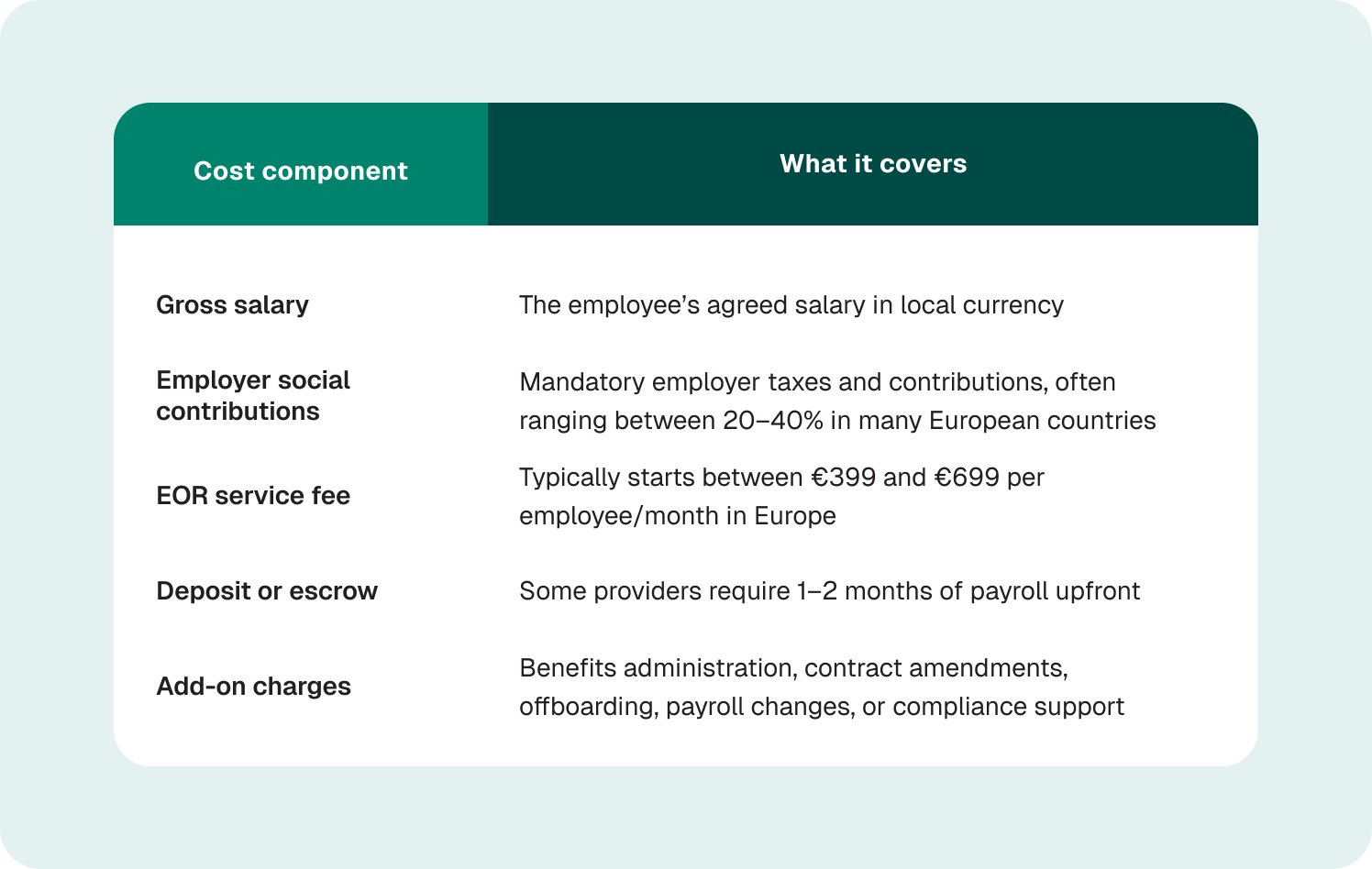
Costs also vary depending on:
- Local tax laws
- Benefits requirements
- Payroll outsourcing structure
- Currency handling
- Compliance obligations
For businesses managing payroll across multiple countries, these differences can significantly affect payroll operations and long-term workforce costs.
If you want a rough estimate of hiring costs, employer contributions, and payroll expenses in different countries, try WorkMotion’s Employment Cost Calculator.
How to Switch Global Payroll Providers Without Payroll Errors
Switching global payroll providers is usually risky when payroll calendars, employee data, and local compliance requirements aren’t properly aligned during the transition.
Most providers follow a four-phase onboarding process.
| Phase | Timeline | What happens |
|---|---|---|
| Contract signing and data collection | Day 1–2 | Employee data, payroll history, existing contracts, benefits elections, and bank details are collected |
| Payroll enrollment and contract setup | Day 3–5 | New employment contracts are generated, and employees are enrolled into payroll systems |
| Payroll cutover coordination | Day 5+ | The new provider aligns payroll calendars, tax payments, and international payroll processing with the previous provider |
| First payroll run | After cutover | Payroll operations officially move to the new provider |
The biggest source of payroll errors during migration is incomplete or inconsistent payroll data. Delays around local tax registration, benefits administration, or payroll compliance reviews can also slow implementation.
For global teams managing payroll across multiple countries, careful cutover planning is usually more important than platform features alone.
What to Ask Before You Sign
Global payroll providers can look very similar during a sales demo. The operational differences often appear later during onboarding, payroll processing, or compliance reviews.
Before signing with any payroll service provider, your team should ask:
- Do you own your entities, or do you use a partner network?
- What licensing do you hold in the target country?
- Do you have an independent compliance certification?
- What’s included in the monthly fee versus extra charges?
- What’s the realistic onboarding timeline for this country?
- What deposit or escrow is required upfront?
These questions help uncover how the provider actually handles local compliance, payroll administration, and international payroll operations behind the platform interface.
If you want to see how these workflows operate in practice, you can take a WorkMotion product tour to review onboarding, payroll, and compliance workflows in more detail.
Which Global Payroll Provider Is Right for Your Team?
The right provider depends on your hiring structure, compliance needs, and operational complexity.
WorkMotion is best suited to SMEs with 50–500 employees hiring into Europe that need certified compliance, own-entity coverage, transparent pricing, and faster onboarding.
Globalization Partners and ADP are stronger fits for enterprises managing large-scale international payroll operations with more complex support needs.
If your priority is lower-cost international hiring, Multiplier may be a better fit for startup teams with simpler compliance requirements.
WorkMotion is built for SMEs hiring into Europe that need certified compliance, own-entity coverage, and transparent pricing. If that matches your situation, book a demo today.


















![idWjC-9cC6_logos 1 [Vectorized]](https://workmotion.com/wp-content/uploads/2026/02/idWjC-9cC6_logos-1-Vectorized.svg)