

Payroll used to be a predictable back-office function. HR collected attendance. Finance calculated deductions. Salaries were paid at the end of the month. That structure worked when teams operated in a single country under a single legal system. It no longer works in a borderless workforce.
Now, companies hire internationally by default. Remote’s 2025 Global Workforce Report found that 73% of HR leaders expect more than half of their new hires to be based outside their primary country by the end of 2026. A single organisation may employ developers in Poland, sales teams in Singapore, and contractors in Brazil. Each worker falls under different tax systems, social contributions, statutory benefits, and reporting standards. Payroll is more of a global compliance engine than an administrative task.
That complexity is exactly why AI for global payroll has grown so fast. Companies must automate payroll because manual systems can no longer keep up with global expansion, multiple currencies, jurisdictions, and employment structures at once.
AI handles the volume while people still handle the judgment.
Why Payroll Became a Strategic Risk
Global payroll complexity is rooted in regulation. Every country defines its own employment laws, tax brackets, and contribution rates. Employers must manage income tax withholding, statutory benefits, pension contributions, paid leave mandates, termination rules, and payroll regulations around data protection.
Even payslip formatting is legally regulated in some regions. A payroll mistake can result in fines, employee disputes, or exposure to permanent establishment. Keeping up with evolving payroll regulations across every market is one of the core payroll challenges international teams face.
Payroll now intersects with multiple domains at once:
- Labour law compliance
- Cross-border taxation
- Banking and FX regulations
- Employee classification rules
- Data privacy obligations
Manual Payroll vs Automated Payroll
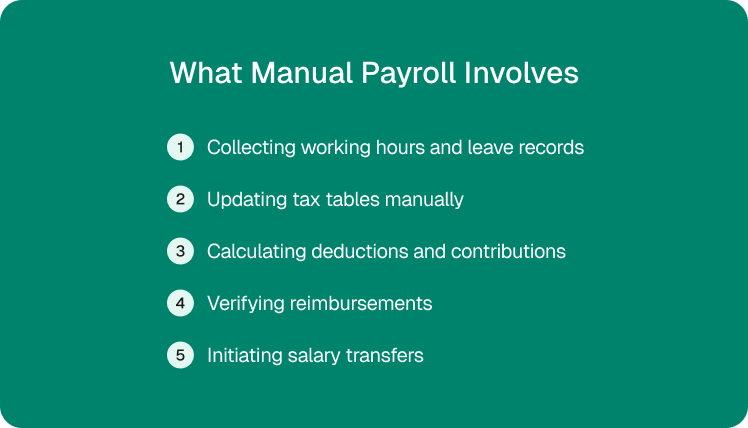
Relying solely on manual payroll no longer works for global teams. Manual payroll depends heavily on human intervention. HR collects data, finance applies payroll calculations, managers verify bonuses, and accountants process payments. The process often involves spreadsheets and repetitive validation checks. While it may work for small local teams, it becomes risky at scale.
Manual payroll typically involves:
- Collecting working hours and leave records
- Updating tax tables manually
- Calculating deductions and contributions
- Verifying reimbursements
- Initiating salary transfers
This process is slow, vulnerable to human error, difficult to audit, and hard to scale internationally.
On the other side of the debate, global payroll automation transforms payroll into a rule-driven, system-integrated process. Data flows automatically from HR systems. AI calculates deductions using up-to-date regulations. Alerts flag anomalies before payments are released. Reports are generated automatically. This shift creates consistency, speed, and audit readiness.
How AI Is Transforming Payroll Operations
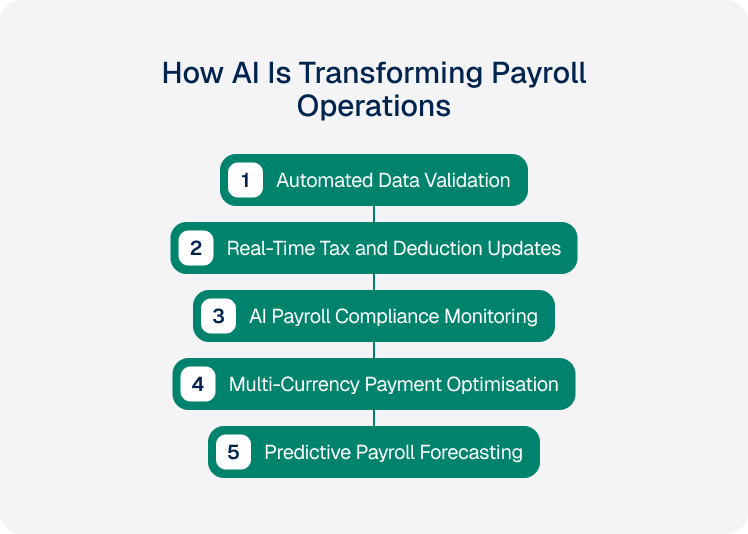
AI’s impact on payroll processing is much more than faster calculations. AI fundamentally changes how payroll decisions are made.
Automated Data Validation
One of the strongest use cases for AI in payroll processing is anomaly detection. Payroll errors often originate from incorrect inputs. AI tools scan payroll data patterns and flag irregularities such as unusual overtime spikes, sudden salary changes, duplicate payments, or inconsistent tax codes.
Instead of discovering payroll discrepancies after payment, organisations prevent them before payroll closes.
Real-Time Tax and Deduction Updates
Traditional payroll processes tax calculations at the end of a cycle. But artificial intelligence in payroll processing applies rules dynamically. Tax brackets, contribution changes, and tax deductions are automatically updated in the system.
Finance teams gain visibility into payroll costs throughout the month rather than after finalisation. It improves forecasting and budgeting accuracy.
AI Payroll Compliance Monitoring
Compliance remains the most valuable area of transformation. AI payroll compliance systems monitor regulatory changes across jurisdictions. They update withholding requirements, contribution rates, and reporting standards in real time.
This reduces penalties, late filings, compliance violations, and reporting errors. Organisations shift from reactive compliance management to proactive oversight of regulatory compliance and compliance requirements.
Multi-Currency Payment Optimisation
Global payroll involves currency conversion and international transfers. AI-powered payroll systems analyse exchange timing and transaction costs. They optimise payment flows and reduce banking friction.
The result is predictable payroll spending and faster salary disbursement across borders.
Predictive Payroll Forecasting
One of the key payroll automation benefits is forecasting capability. Machine learning models help teams simulate hiring scenarios, predict compensation costs, and evaluate expansion plans. By learning from historical data, AI improves forecast accuracy over time. Payroll becomes a strategic planning tool rather than a monthly administrative obligation.
How AI in Payroll Processing Affects the Employee Experience
Payroll is more than a finance process. It’s one of the clearest signals of trust between an employer and an employee. People rarely notice HR systems when they work well, but they always notice payroll. Employees expect correct pay, clear deductions, and payments that arrive on time in the right currency. Even a small delay can damage confidence in the organisation.
With payroll automation powered by AI, companies move from reactive payroll corrections to predictable payroll delivery. Modern AI-powered payroll platforms automatically calculate salaries, taxes, benefits, and reimbursements while validating employee data before payment.
This reduces common employee frustrations like incorrect deductions, missing overtime, and delayed expense reimbursements. Employees also receive clearer payslips because AI in payroll processing structures earnings and deductions consistently across locations.
Conversational AI and self-service portals let employees ask payroll-related questions without taking time away from human resources. Reliable AI payroll systems, therefore, improve not only operational efficiency but also employee satisfaction.
Limitations of AI in Payroll
AI is clearly beneficial to payroll systems, but it’s important to understand the real limitations. Payroll still requires legal interpretation, contextual judgment, and an understanding of employment. AI relies on defined rules. Employment law often contains grey areas.
The most complex area is worker classification. Determining whether someone is an employee or contractor depends on supervision, dependency, and working relationship. Artificial intelligence can analyse work patterns and payment frequency, but it can’t interpret legal intent. Human HR and legal review remain necessary for labour compliance.
Exception handling also creates payroll automation challenges. Payroll systems perform best with standardised data. However, real organisations produce non-standard cases such as:
- Cross-border relocation
- Equity compensation or stock grants
- Retroactive salary changes
- Off-cycle payments
- Multi-country taxation scenarios
These situations require interpretation and coordination. AI can support calculation, but can’t independently resolve the legal outcome.
Data quality is another limitation. Automated processes amplify input errors. If incorrect employee status, salary structure, or tax residency is entered, AI payroll automation produces incorrect results quickly. Organisations must maintain strong HR data governance, ensure proper data preparation, and regularly review payroll outputs.
Compliance Risks in Automated Payroll
Compliance risks in automated payroll stem from over-reliance on technology rather than from failures in the technology itself. This introduces new operational risks.
Major risk areas include:
- Outdated integrations
- Insufficient human oversight
- Incomplete employment data
- Cross-border reporting mistakes
- Incorrect system configuration
A misconfigured tax rule can affect hundreds of employees simultaneously. Automated processes execute rules consistently, but that consistency can also magnify international payroll mistakes and cause compliance issues. This is particularly important for global payroll operations, where a single platform handles multiple jurisdictions.
Data privacy is another risk. Global payroll processes handle sensitive personal data, including identification numbers, bank account details, and compensation information. Labour regulations and local data protection laws require careful handling.
Even with AI payroll software, the employer remains legally responsible for regulatory requirements. Regular audits and payroll reviews are still required.
Will AI Replace Payroll Professionals?
The question comes up constantly: Will AI take over payroll jobs? The realistic answer is no. AI changes payroll work, but it shouldn’t eliminate the human side. On a broader view, Gartner predicts that by 2028, agentic AI will make at least 15% of day-to-day work decisions autonomously, even as fewer than 1% of jobs are lost to AI.
The pattern is consistent across the workplace. AI absorbs the structured, rule-following tasks and raises the value of the judgment-requiring tasks that remain. Tasks are replaceable; jobs aren’t. Routine processing like data entry, standard filings, and payslip generation is increasingly automated. But multi-state and international compliance, system integration, and compensation analytics keep demand for skilled professionals high.
So instead of processing spreadsheets, payroll teams act as compliance advisors and workforce analysts. Automation reduces manual workload while increasing the value of expertise.
The Future of AI Global Payroll
The next phase of AI global payroll is continuous payroll processing. Rather than running payroll once a month, systems will update dynamically as workforce data changes. Salary adjustments, tax updates, and employment changes will reflect instantly.
McKinsey’s HR Monitor 2026 finds that only 11% of organisations take a strategic, long-term approach to workforce planning. Large-scale AI adoption remains limited for the time being, as most companies are still in pilot mode.
But the developments expected in AI for global payroll include:
- Real-time payroll cost dashboards
- Predictive compliance alerts
- Automated regulatory monitoring
- Integrated compensation planning
- Workforce management analytics insights
As AI capabilities mature, AI agents will increasingly handle Tier 0 and Tier 1 queries, supported by natural language processing that lets employees ask payroll questions in plain language.
Payroll will then function as an operational intelligence layer within HR. Leaders will understand workforce costs instantly across regions. Expansion decisions will rely on real payroll data rather than estimates. In this model, payroll is no longer a reporting activity. It becomes a strategic initiative powered by AI.
How WorkMotion Enables Compliant AI-Driven Payroll
Technology alone can’t solve the complexity of global employment. Payroll depends on compliant legal employment structures, which is what WorkMotion provides. WorkMotion is a global HR platform that lets companies hire and manage talent across borders without establishing local entities. It centralises compliance, onboarding, contracts, and payroll management in one interface.
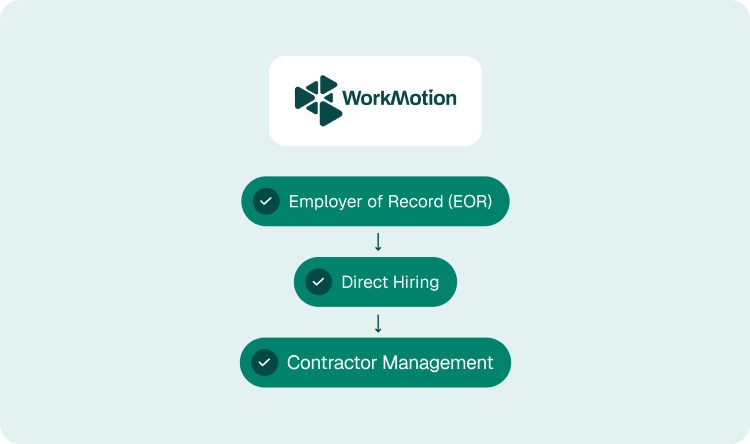
WorkMotion’s solutions cover the three main ways companies engage global talent:
- Employer of Record (EOR): WorkMotion becomes the legal employer on paper while you manage day-to-day responsibilities. EOR service includes compliant contracts, local tax handling, statutory benefits administration, and global payroll coordination. This allows rapid international expansion without creating subsidiaries.
- Direct Hiring: For companies that want to employ people directly, WorkMotion’s Direct Hiring supports compliant contract generation and onboarding workflows across its owned-entity markets. You retain control while reducing administrative burden.
- Contractor Management: For companies engaging independent contractors, WorkMotion reduces misclassification risk by managing compliant agreements, documentation, and coordinated payments.
WorkMotion also brings AI directly into the workflow. Wanda AI, WorkMotion’s context-aware AI partner, answers labour regulations and compliance questions using your real employee and organisational data. HR teams get precise guidance instead of generic answers, and can stay compliant across countries without constant manual research.
Automation handles calculations, people handle responsibility, and WorkMotion brings both together in one compliant global employment platform. Book a demo to see how WorkMotion’s solutions work alongside Wanda AI to run accurate, compliant payroll across borders.


















![idWjC-9cC6_logos 1 [Vectorized]](https://workmotion.com/wp-content/uploads/2026/02/idWjC-9cC6_logos-1-Vectorized.svg)