
You’ve hired a senior engineer in Germany. Your first salesperson just relocated to Spain. Your finance lead wants to work remotely from Portugal. Each hire triggers the same question: Do we need a local entity?
For most companies, the answer is no — not if you use an Employer of Record. But two of the platforms you’re already evaluating (Rippling vs Workday) are not true EORs. They manage domestic HR infrastructure. They don’t become the legal employer in-country like WorkMotion does. That’s the gap this comparison addresses.
Workday vs Rippling vs WorkMotion At A Glance
Before taking a look at the detailed reviews, here’s a quick look at what WorkMotion, Workday, and Rippling offer.
| Feature | WorkMotion | Rippling | Workday |
|---|---|---|---|
| Best for | SMEs hiring internationally, especially into Europe | US companies consolidating HR, IT, payroll, and finance | Large enterprises needing deep HCM and financial planning |
| International EOR | Yes | Yes | No |
| Entity model | Own entities in key markets, EOR partners in special use cases | Hybrid (owned + partner network) | N/A — not an EOR |
| IEC compliance certified | ✦ IEC Gold | No | No |
| EOR pricing | €499/mo | Custom quote | N/A |
| Implementation timeline | 3–5 business days per hire | Weeks to a few months | 6–12 months with systems integrator |
| Trustpilot rating | 4.8 / 5 | 4.6 / 5 | 1.1 / 5 |
Rippling vs Workday vs WorkMotion: What Each Platform Is — And What It Isn’t
The reason this comparison gets confusing is that Rippling and Workday aren’t solving the same problem, and neither is solving the international employment problem that WorkMotion addresses. Understanding what each one is, and what it isn’t, is the right place to start before comparing features.
WorkMotion: The Compliance-First Employer of Record
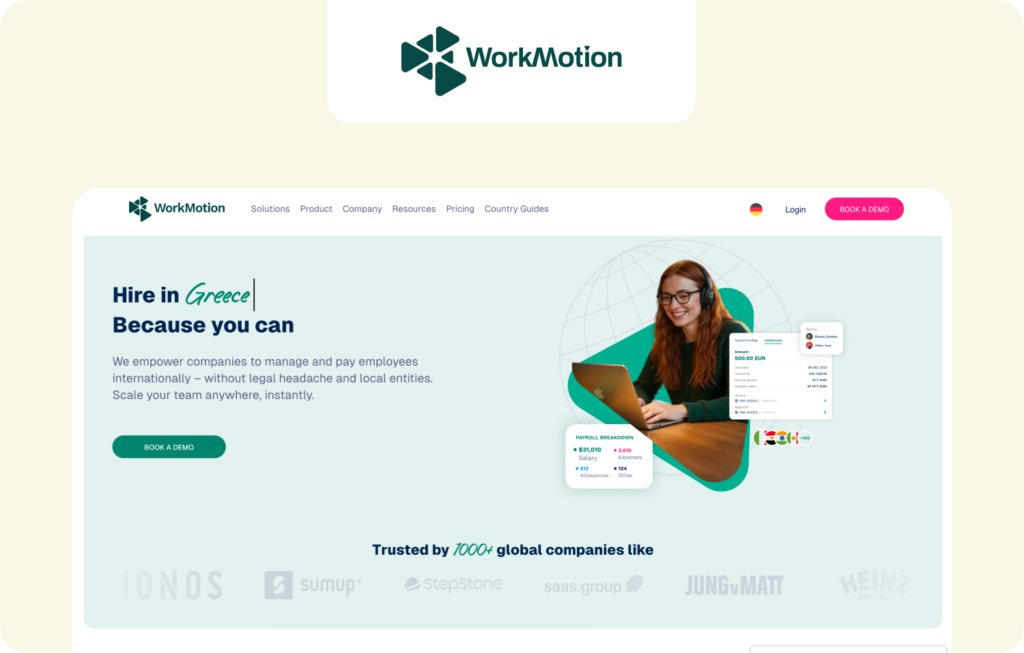
WorkMotion is an Employer of Record built in Europe for companies hiring across borders. When you use WorkMotion, it becomes the legal employer in the destination country — handling contracts aligned to local labor law, payroll in local currency, and statutory benefits. You keep operational control of the work. WorkMotion carries the compliance responsibility.
Rippling and Workday are built for domestic HR. International employment is an add-on, not the foundation. WorkMotion covers 160+ countries and in 2025 became the first EOR provider in the industry to receive IEC Gold Compliance Certification. The independent audit covered 1,000+ checkpoints across licensing, payroll accuracy, labor law adherence, and data protection.
It’s also worth noting that WorkMotion isn’t a full HR migration. Companies typically keep their existing HRIS for domestic headcount and add WorkMotion as the international employment layer on top. No ripping out Rippling or replacing Workday. Just a purpose-built layer for the hires your current stack wasn’t designed to handle.
If you’d like to explore the platform before engaging with sales, take a product tour of WorkMotion.
Rippling: The U.S. Mid-Market Consolidation Platform
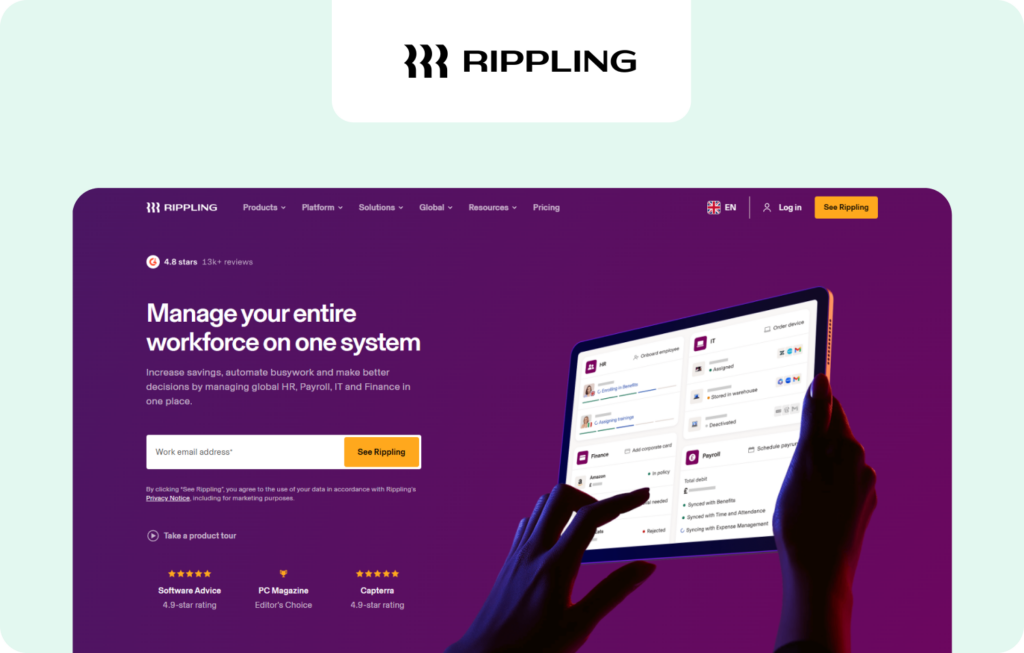
Rippling brings HR, payroll, IT management, and spend management into one system. It’s an appealing option for U.S. companies scaling quickly. When you hire someone, their laptop ships, their software provisions, their benefits enroll, and their payroll starts. For tech-forward operations teams managing domestic headcount, that kind of automation reduces admin overhead meaningfully.
The tradeoff shows up when hiring internationally. Rippling offers EOR services in almost half as many countries (85+) as WorkMotion. For companies where international hiring is occasional or incidental, Rippling’s speed and automation may be sufficient. For companies hiring regularly into markets with strict EOR licensing requirements, understanding the compliance accountability structure matters.
Workday: The Enterprise Workforce Planning System
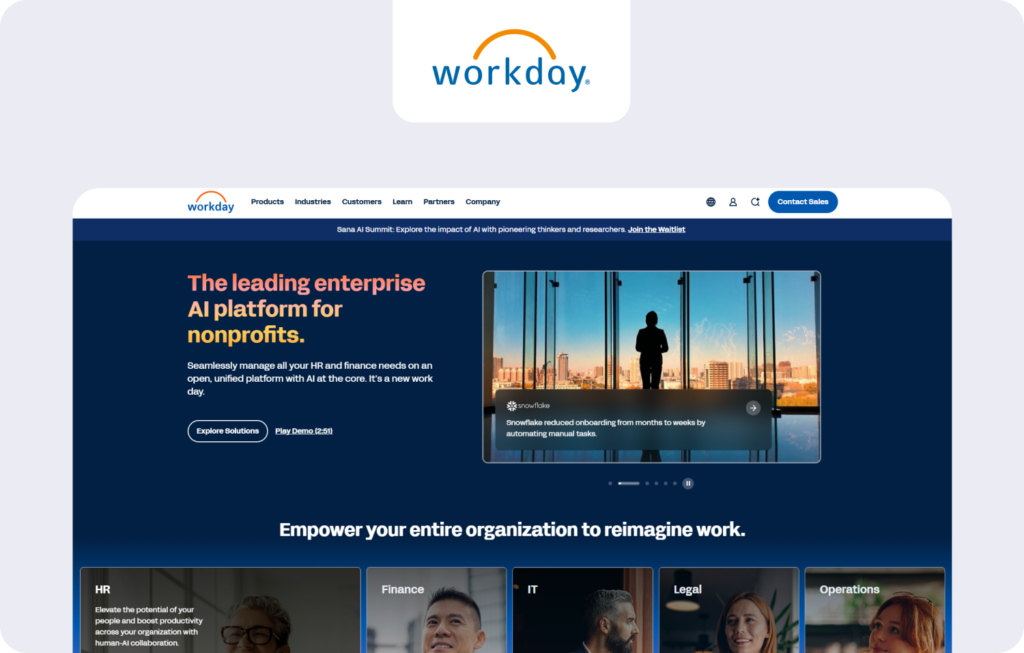
Workday is an enterprise HCM suite built for large organizations that need HR, financial management, workforce planning, and analytics in one place. Workday’s strengths lie in its reporting and workforce analytics, financial planning integrated with HR data, and configurability at scale. It has a long track record with large enterprise customers and the depth to match.
The tradeoff for smaller companies is practical. Workday implementations typically run six to twelve months, require a systems integrator, and come with enterprise quote-based pricing on multi-year contracts. The platform is calibrated for HR teams with dedicated HRIS administrators, not for a three-person people function trying to make a hire in the Netherlands next month.
Workday isn’t an Employer of Record. It doesn’t act as the legal employer in any market. Companies using it to manage global headcount still need a separate EOR provider in every country where they don’t have a legal entity. Workday manages the HR processes. The EOR handles the locally compliant contracts, in-country payroll, and statutory obligations that vary by jurisdiction. Those are two different problems, and Workday solves only one of them.
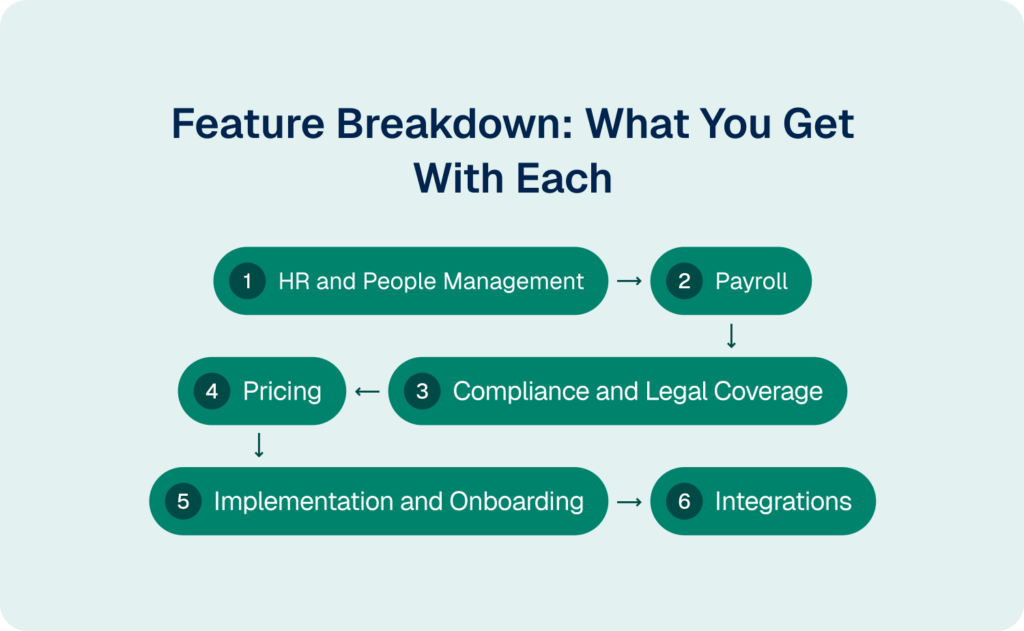
Feature Breakdown: What You Get With Each
The three platforms solve different problems. Here’s what each one actually does across HR, payroll, compliance, pricing, implementation, and integrations. This way, you can evaluate them on the dimensions that matter for your situation.
HR and People Management
WorkMotion handles the employment relationship for international hires. Rippling and Workday manage the broader HR lifecycle for domestic teams.
WorkMotion
WorkMotion functions as the HR system of record for international hires. It covers everything tied to the legal employment relationship, including employment contracts, onboarding, PTO, payslips, and expense management.
You can generate locally compliant contracts in 10 minutes and fully onboard an employee within just four days.
Rippling
Rippling covers the full HR lifecycle for domestic teams: onboarding, offboarding, org management, performance reviews, compensation planning, benefits administration, and self-service.
The intuitive interface is modern, workflow automation handles repetitive tasks like approvals and status changes, and the administrative overhead is lower than enterprise HCM for companies under 500 employees.
Workday
Workday delivers deep HCM functionality at enterprise scale with workforce planning, succession management, learning programs, compensation benchmarking, advanced org design, and analytics.
It’s built for organizations where HR complexity requires dedicated HRIS administrators to configure and maintain the system effectively. The configurability supports multi-dimensional org structures and global compliance scenarios.
Payroll
Payroll requirements look different depending on whether you’re running domestic multi-state operations, international employment through a legal employer, or enterprise-scale payroll across multiple countries and currencies.
WorkMotion
WorkMotion runs payroll as the legal employer in each country, not as a processing layer sitting on top of a third-party arrangement. Employer contributions, tax withholding, and statutory deductions are calculated and filed against local law, not approximated. Payroll runs with 99% accuracy across all markets.
Under EOR, WorkMotion carries full payroll accountability directly through its own entities. Under Direct Hiring, WorkMotion registers the company as a foreign employer, then runs payroll and prepares payment instructions for salary, taxes, and social security contributions on the company’s behalf — without requiring a full local entity.
For contractors, WorkMotion manages payments in local currency across 160+ countries with automated invoicing and built-in misclassification monitoring.
Rippling
Rippling handles U.S. payroll accurately, with multi-state compliance, automatic tax code updates, and straightforward payroll runs. For international employment through its EOR service, payroll lead times are five days to payday in popular markets and 12 days in less common markets.
The platform auto-calculates payroll inputs including hours worked, expense reimbursements, and time off to speed up payroll runs.
Workday
Workday’s payroll engine is built for enterprise scale with unlimited pay groups, unlimited pay runs, automatic tax updates, and full coverage for U.S. and Canadian companies.
For international markets, Workday delivers payroll via its Global Payroll Network, which consists of third-party payroll partners, not Workday-native infrastructure.
Compliance and Legal Coverage
Compliance is where the differences between these platforms matter most. It’s also where the consequences of getting it wrong are most significant.
WorkMotion
WorkMotion is the first EOR in the industry to hold the IEC Gold Certificate, something WorkMotion’s competitors can’t compete with.
The audit covered 1,000+ checkpoints across 10+ legal and operational categories, validating labor leasing licenses, payroll accuracy, data protection, and process maturity.
WorkMotion also holds necessary labor leasing licenses where legally required and EU data residency is standard for European clients.
If compliance accountability matters, book a demo to see how WorkMotion’s coverage works in the markets you’re hiring into.
Rippling
Rippling manages U.S. compliance well for mid-market teams. International compliance support comes through the EOR module. Rippling provides local HR and legal experts with 10+ years of local experience for compliance guidance. However, the platform doesn’t hold IEC Certification.
Workday
For international operations, compliance depends on certified payroll partner arrangements. Workday is not an Employer of Record in any market. Companies using Workday for global headcount still need a separate legal employer or need to work with a different partner in each country.
Pricing
Each platform prices for a different problem. Understanding what’s included, and what compounds over time, matters before you commit.
WorkMotion
WorkMotion charges a transparent per-employee per-month fee that includes the service charge, employer social contributions, and mandatory benefits. Plus, WorkMotion’s Employment Cost Calculator gives finance teams a line-by-line breakdown of total employer costs so you know exactly what each hire costs before you commit.
Keep in mind that WorkMotion is priced for international employment. Rippling and Workday are priced for domestic HR infrastructure. A company using all three isn’t paying for competing tools, but rather for different problems. Rippling or Workday handles domestic headcount. WorkMotion handles the hires their existing stack wasn’t built to support.
Pricing plans:
- Employee of record: From €499/talent/mo
- Direct hiring: €399/talent/mo
- Contract management: €29/talent/mo
Rippling
Rippling uses modular pricing, meaning you pay for what you activate. Exact base fees and per-module costs are not publicly listed. Due to this, flexibility is possible, but total cost of ownership can be harder to forecast as modules accumulate.
Workday
Workday uses quote-based enterprise pricing with multi-year contracts. There’s no public pricing as budget conversations happen directly with sales. Hidden costs can emerge through customization work, integration projects, and productivity impact during adoption. For enterprises with the scale to absorb it, the depth is there. For most companies under 500 employees, the investment is difficult to justify.
Implementation and Onboarding
How long it takes to get up and running, and what’s required to do it, varies significantly across the three platforms.
WorkMotion
WorkMotion onboards international hires in 3–5 business days in most European markets. That speed comes from operating through its own entities in most scenarios, using pre-built country-specific contracts, and requiring no third-party sign-off.
For companies already running Rippling or Workday for domestic headcount, WorkMotion sits alongside the existing stack as the international employment layer. There’s no full migration needed.
Rippling
Rippling implementation is faster than Workday for mid-market companies — typically weeks to a few months depending on which modules are activated. Teams can start with core functionality and expand over time.
Configuring IT provisioning and workflow automation adds time, but the platform is admin-configurable and designed to be set up without heavy professional services involvement.
Workday
Enterprise implementations typically run 6–12 months with a systems integrator, requiring significant internal resources from HR, IT, and finance teams. Six months is generally the floor for a standard deployment.
For organizations with the infrastructure to absorb that process, the depth of what Workday delivers at the end of it is genuine. But for most companies under 500 employees, that implementation curve is a significant commitment before a single international hire is made.
Integrations
Integration depth determines how easily each platform slots into your existing tech stack without disrupting current workflow tools.
WorkMotion
WorkMotion integrates with systems like BambooHR, Personio, and Workday. It’s designed to sit alongside your existing stack as the international employment layer, not replace it. Companies can keep using Rippling or Workday for domestic headcount and connect WorkMotion for international hires without any disruption to existing workflows.
Rippling
Rippling offers 600+ integrations, connecting HR, IT, payroll, and finance systems. The integration library features major HRIS platforms, including Workday.
Workday
Workday connects to major ERP, finance, and payroll systems with API access available for technical teams. Integrations typically require more configuration than Rippling for standard connections, and most implementations involve dedicated IT resources to set up and maintain.
Pros and Cons
Every platform has a specific buyer it’s designed for. These lists are intended to help you identify gaps and your best fit — not rank the platforms against each other.
WorkMotion
Pros
- Own entities in 32 European countries: If something goes wrong, compliance accountability sits with WorkMotion directly, not with a partner two steps removed.
- IEC Gold Certificate: The only provider in this comparison with independently audited compliance certification.
- 3–5 business day onboarding: From signed contract to payroll enrollment in European markets.
- Money-back guarantee: If the service falls short, you get your money back.
- 93.05% TSAT score: WorkMotion measures employee satisfaction alongside client satisfaction, one of the few EOR providers that tracks both.
- Transparent pricing: Per-employee per-month fee with country-specific cost breakdowns.
- 4.8 TrustPilot rating: Users especially praise WorkMotion’s customer service: “An excellent customer service experience from the first sales call all the way through to contract signing,” says one TrustPilot reviewer.
- No migration required: Easily connects to Rippling and Workday as the international employment layer.
Cons
- International employment only: Domestic HR still needs a separate tool. WorkMotion is the international layer, but not a full HRIS replacement.
- Smaller brand footprint: Less visible in competitive evaluations outside Europe than Rippling or Workday.
Rippling
Pros
- HR and IT consolidation: The strongest all-in-one play for U.S. mid-market teams.
- Modular structure: Companies activate what they need and expand over time without switching platforms.
- Faster implementation: Weeks to a few months versus six to twelve months for enterprise Workday.
- Integration ecosystem: 600+ integrations and native IT provisioning make it well-suited for tech-forward operations teams.
Cons
- Third-party EOR in European markets: International employment in many European markets might operate through partners rather than Rippling’s own entities.
- Not enterprise HCM: Complex org structures, succession planning, and advanced workforce analytics are outside its core design.
- Compounding costs: Modular pricing adds up as more products are activated.
Workday
Pros
- Enterprise HCM depth: Offers workforce planning, compensation benchmarking, succession management, and advanced analytics at a scale few platforms match.
- Enterprise track record: Has a long-established customer base with strong internal compliance and audit capabilities for large organizations.
- Finance and HR unified: Consolidates financial management and HR in one platform.
Cons
- Enterprise cost and timeline: Quote-based pricing, multi-year contracts, and a 6–12 month implementation with a systems integrator make it difficult to justify for most companies under 500 employees.
- Not an Employer of Record: International hiring requires a separate EOR provider in every country where the company has no entity.
- Requires dedicated administration: It’s not a platform teams can self-serve. Effective use depends on dedicated HRIS administrators to configure and maintain the system.
- 1.1 TrustPilot rating: 97% of TrustPilot reviewers gave Workday a one-star rating, most coming from employees using the application.
When Each Platform Fits
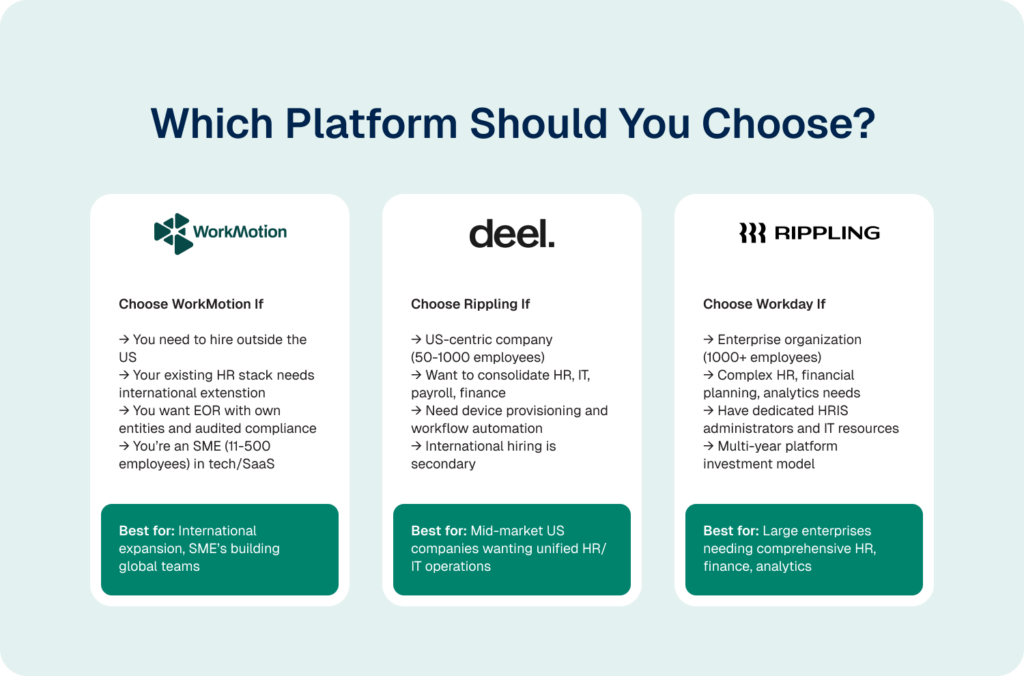
The right platform depends on your company size, hiring geography, and what problem you’re actually trying to solve. Here’s how to think about fit across all three.
| Good fit if | Not a fit if |
|---|---|
| You’re hiring into Europe without setting up local entities | You only hire domestically and don’t anticipate international expansion |
| You need compliance accountability flowing directly through your EOR, not a third-party partner | You need a full HRIS to replace your existing domestic system |
| You want onboarding measured in days, not weeks | Your hiring is concentrated outside WorkMotion’s core European coverage |
| You’re already running Rippling or Workday and want to add international hires without migration | You have the scale and budget for a full enterprise HCM rollout and don’t need a specialised EOR layer |
When To Use WorkMotion Alongside Rippling or Workday
If you already run Rippling or Workday for domestic headcount and need to add international hires without migrating your HR stack, WorkMotion is designed for exactly that situation. Domestic and international employees run in parallel — existing workflows stay intact, and the international employment layer sits alongside rather than inside your current HRIS.
Here’s an example workflow:
- A U.S. company uses Rippling for its 200 domestic employees (HR, payroll, IT management, benefits).
- The company hires a senior engineer in Germany and a salesperson in Spain.
- WorkMotion becomes the legal employer in Germany and Spain, handling contracts, payroll in local currency, statutory benefits, and ongoing compliance.
- WorkMotion integrates with Rippling, syncing employee data bidirectionally.
- The U.S. company manages day-to-day work for all employees through one system.
Get started with WorkMotion
Neither Rippling nor Workday was designed to act as a global Employer of Record. For companies hiring outside their home market, both require a separate solution, and WorkMotion is built for exactly that.
If you’re hiring into Europe without setting up local entities, need compliance accountability that flows directly through your EOR rather than a third-party partner, and want onboarding measured in days rather than weeks, WorkMotion is worth a closer look. It sits alongside your existing Rippling or Workday stack, with no migration required.
Looking to hire internationally with compliance confidence? Book a demo with WorkMotion to see how global hiring becomes faster, safer, and more predictable.

















![idWjC-9cC6_logos 1 [Vectorized]](https://workmotion.com/wp-content/uploads/2026/02/idWjC-9cC6_logos-1-Vectorized.svg)