

A company shortlisting Deel, Remote, and Oyster for a European hire cannot always confirm which provider actually holds the labor-leasing license required in the target market. All three can help you hire internationally without setting up a local entity, but the real question starts when an HR director or COO asks who is actually employing this person in-country if something goes wrong.
In regulated European markets, that answer affects far more than legal accountability. It influences payroll management, tax management, multi-currency payroll, global payments, timely payments, legal-reviewed agreements, and the quality of the ongoing support employees receive throughout their employment. EOR platforms generally offer tailored benefits packages that meet local requirements, but the provider’s legal employer model determines who is ultimately responsible for administering those benefits compliantly. It can also directly impact compliance, the employee experience, and your ability to scale global mobility initiatives with confidence.
This guide compares Deel, Remote, Oyster, and WorkMotion through that lens. Whether you’re hiring your first international employee or managing contractors globally, we’ll compare their entity models, pricing, onboarding, employee management capabilities, payroll infrastructure, and platform breadth to help you identify the right fit for your business.
Hiring into Europe and want a single accountable legal employer? Book a demo or take a product tour to explore the platform.
Deel vs Remote vs Oyster vs WorkMotion at a Glance
Deel, Remote, Oyster, and WorkMotion are Employer of Record providers, which is why they appear on the same shortlist.
But they don’t operate on the same infrastructure. If you’re hiring into Europe, the important differences aren’t cosmetic.
They sit behind the contract: entity ownership, licensing, compliance accountability, and the level of due diligence you need to do yourself before signing.
| Criteria | WorkMotion | Deel | Remote | Oyster |
|---|---|---|---|---|
| Best for | SMEs hiring into Europe that want a compliance-first EOR with owned entities and independently verified compliance | Teams that want EOR, contractors, payroll, and HRIS in one platform | Teams that prioritize a fully owned-entity model and IP-sensitive hiring | Teams that value ease of use and broad hiring coverage across many countries |
| Entity model | Owned entities across key European markets, plus partner coverage for broader reach | Mix of owned entities and local partners, depending on market | Fully owned-entity model in documented employee markets | Mix of owned entities and local partners |
| IEC compliance certified | Yes, IEC Gold Compliance Certification | No publicly documented IEC-equivalent certification | No publicly documented IEC-equivalent certification | No publicly documented IEC-equivalent certification |
| Country coverage (EOR) | 160+ countries overall, with strongest depth in Europe | 150+ countries | 90+ countries for EOR employees | 120+ countries |
| Onboarding speed | 3–5 business days in typical cases | Often 2–3 business days in many markets | Typically 3–7 business days, depending on country | Can be as fast as 48 hours in supported markets |
| EOR pricing | From €499/talent/month | From $599/employee/month | From $699/employee/month on annual billing | From $699/employee/month |
| Contractor pricing | From €29/talent/month | From $49/contractor/month | From $29/contractor/month | From $29/contractor/month |
| Key strength | Compliance-first European hiring with independently audited certification and owned licensed entities in key markets | Broadest platform footprint, especially for contractor payments and HR consolidation | Clean accountability chain through a fully owned-entity model; strong IP protection angle | Simple user experience with broad global coverage |
| Key limitation | Not the best fit if you want a domestic HR suite replacement or the cheapest possible provider | Buyers hiring into regulated European markets should verify entity structure and licensing market by market | Narrower EOR country coverage than Deel; no independent compliance certification | Less Europe-specific owned-entity depth than WorkMotion and more reliance on partners in some markets |
| TrustPilot rating* | 4.9 | 4.6 | 4.6 | 4.0 |
What Each Platform Is – and What It Isn’t
Before comparing features side by side, it helps to understand each provider’s core model, where it fits best, and what tradeoffs come with that approach.
WorkMotion

WorkMotion is a compliance-first Employer of Record built for international hiring, with particular depth in Europe.
When WorkMotion acts as the legal employer in-country, its local entity signs the employment contract, runs payroll in the local currency, administers statutory benefits, and maintains compliance with labor law as it changes
It combines owned entities across key European markets with partner coverage for broader global reach, and it’s the only provider in this comparison with IEC Gold Compliance Certification, independently audited across 1,000+ checkpoints.
Best understood as: The option for SMEs that need a single accountable legal employer in Europe with independently verified compliance.
Deel

Deel is the broadest platform in this group. It combines EOR, contractor management, global payroll, and a built-in HRIS in one system, which is a genuine advantage for teams trying to consolidate international workers, payroll, and HR operations into one platform.
Deel is also especially strong on contractor payments and contractor-to-employee workflows.
However, while broad in both country coverage and platform features, Deel can lack the local employment advisory and knowledge that region-focused EOR providers do.
Best understood as: The consolidation option for teams that want contractors, EOR, payroll, and HRIS in one place.
Remote

Remote‘s clearest differentiator is its fully owned-entity model across its employee markets. That gives buyers a cleaner accountability chain than a partner-led model and makes Remote a strong fit for teams that care about direct entity ownership and IP-sensitive hiring. It also has a reputation for clean UX and predictable pricing.
The tradeoff is that buyers hiring into regulated European markets still need to confirm market-specific licensing coverage, and Remote’s EOR country coverage is narrower than Deel’s.
Best understood as: the owned-entity option for teams that prioritize direct infrastructure and IP protection.
Oyster

Oyster is a compliance-focused EOR known for a clean, self-serve experience and straightforward approach to international hiring. It supports employment across a broad range of countries, alongside contractor management, and has invested in recognised compliance standards, including SOC 2 and ISO 27001 certifications.
The trade-off is that, like many global EOR providers, Oyster combines owned entities with partner networks to deliver international coverage. For organisations hiring into regulated European markets, it’s worth confirming which entity will act as the legal employer in your target country.
Best understood as: A strong choice for organisations that value simplicity and broad international coverage, particularly if they prioritise an intuitive user experience over Europe-specific compliance infrastructure.
Feature-by-Feature Comparison
The right EOR is the one whose infrastructure matches your compliance requirements, hiring geography, and operational setup, rather than the one with the longest feature list.
If you’re interested in European hiring, that usually means starting with the legal employer question, then working outward into pricing, onboarding speed, contractor management, and platform breadth.
Compliance and Entity Ownership
When a compliance issue appears abroad, the legal employer carries the accountability. That’s why the first question to ask any EOR isn’t how many countries it lists on its website. It’s which entity signs the contract in the target market, whether that entity holds the necessary local licenses, and how much of the compliance process is actually controlled by the provider.
WorkMotion
This is where WorkMotion is strongest. It owns entities across key European markets and positions those entities as the legal employer in-country, rather than pushing the accountability into an opaque partner layer. The more important point is not just entity ownership, but licensing and proof.
WorkMotion is the only provider in this comparison with IEC Gold Compliance Certification, an independent audit covering licensing, employment law, payroll, benefits, data protection, employee lifecycle controls, and more. For buyers hiring into Europe, that reduces the amount of guesswork after signature.
Deel
Deel deserves credit for the breadth of its platform and its global hiring reach. It is often the first provider buyers look at because it combines EOR, payroll, contractors, and HRIS in one system.
The tradeoff is that buyers hiring into regulated European markets should still do direct diligence on which Deel entity or partner will act as the legal employer in the specific target country, and whether the required local licensing is held there. Deel has invested heavily in compliance tooling, but it does not publish IEC Gold-style independent compliance certification.
Remote
Remote’s owned-entity model is one of the strongest structural arguments in its favor. If your priority is a clean accountability chain, Remote is easier to understand than a mixed partner model because the provider owns the employing entities in its employee markets. That said, entity ownership is only one part of the compliance picture. Buyers still need to verify local licensing requirements in their target countries, and Remote does not publish the same kind of independently audited compliance certification that WorkMotion does.
Oyster
Oyster’s compliance story is built more around ease of use and broad coverage than around Europe-specific owned-entity depth. It operates through a mix of owned entities and in-country partners, which is common in the category but still worth understanding before you sign. If your hiring plan spans many countries and you value a lighter self-serve experience, that model may be acceptable. If you’re hiring into regulated European markets and want the legal employer, the entity, and the compliance posture to sit under one directly accountable provider, Oyster requires more diligence.
| Platform | Entity model | IEC compliance certified | Compliance posture |
|---|---|---|---|
| WorkMotion | Owned entities in key European markets, plus partner coverage for wider reach | Yes, IEC Gold | Independently audited compliance, licensed entities in key markets, Europe-focused accountability |
| Deel | Mixed owned-entity and partner model | No publicly documented IEC-equivalent certification | Broad platform, but buyers should verify entity and licensing market by market |
| Remote | Fully owned-entity model | No publicly documented IEC-equivalent certification | Clean entity ownership model, but no independent compliance certification published |
| Oyster | Mixed owned-entity and partner model | No publicly documented IEC-equivalent certification | Compliance-focused platform, but less Europe-specific owned-entity depth |
Get a country-specific breakdown for hiring an employee abroad so you can see the full employment cost, not just the headline fee.
Pricing
Headline EOR pricing matters, but it’s rarely the number that decides the real cost.
Employer contributions, statutory benefits, deposits, payroll changes, and invoice transparency usually matter more once Finance starts asking for a proper forecast.
A $599 monthly fee can still turn into a difficult budgeting exercise if the provider doesn’t make the full employment cost visible before you sign.
WorkMotion
WorkMotion’s pricing is built around country-specific cost visibility rather than just a flat headline fee. Key pricing points:
- Employer of Record (EOR) service starts from €499 per talent per month
- Direct Hiring starts from €399 per talent per month
- Contractor Management starts from €29 per contractor/freelancer per month
The more important difference is that WorkMotion positions its cost breakdown upfront, including the service fee, employer social contributions, and statutory employment costs by country. For CFOs and COOs, that’s more useful than a generic “from” price because it lets you model the full cost of hiring in Spain, Germany, or Poland before approving the role.
Deel
Deel’s EOR pricing starts at $599 per employee per month on its Standard plan, with higher pricing for enterprise tiers and additional modules depending on how much of the broader platform you adopt.
Contractor pricing is a separate line item starting at $49 per contractor per month.
The all-in cost of Deel can increase as you add payroll, HR, and compliance workflows, which can lead some users to feel they have more than they need.
However, Deel can still make sense if you’re deliberately consolidating multiple use cases in one platform and have the budget to do so. But if you only need compliant EOR hiring into Europe, it’s worth looking beyond the sticker price and checking the total operating model around it.
Remote
Remote is relatively straightforward on pricing. Its EOR service starts at $699 per employee per month on annual billing, with a higher month-to-month rate, and contractor management starts from $29 per contractor per month.
Remote is often shortlisted by buyers who want a cleaner pricing story and a fully owned-entity model without a long list of optional modules. The right question is whether its coverage and compliance posture match the countries you actually plan to hire in.
Oyster
Oyster’s EOR pricing typically sits at the upper end of the mainstream EOR range, with $699 per employee per month often used as the headline figure. Contractor management starts from $29 per contractor per month, with additional protection products available separately.
Oyster is not unusual in this regard – many EOR providers separate the service fee from other employment costs. The budgeting question is how predictable the invoicing stays month to month and how transparent the provider is about deposits, benefits, and country-level employer costs before signature.
Here’s how Deel, Remote, Oyster and Workmotion compare for EOR and Contractor pricing.
| Platform | EOR pricing | Contractor pricing |
|---|---|---|
| WorkMotion | From €499/talent/month | From €29/talent/month |
| Deel | From $599/employee/month | From $49/contractor/month |
| Remote | From $699/employee/month | From $29/contractor/month |
| Oyster | From $699/employee/month | From $29/contractor/month |
Onboarding Speed
If you’re trying to hire a sales lead in France or a developer in Poland this quarter, onboarding speed becomes more than a convenience metric. It affects whether the candidate signs, whether your hiring manager can plan realistically, and whether the role actually starts producing value when expected. EOR onboarding speed is partly a workflow issue, but it’s also an infrastructure issue. Providers with owned entities and prebuilt local processes usually have fewer dependencies than those routing through third parties.
WorkMotion
WorkMotion positions onboarding in three to five business days in typical cases, with locally compliant contract generation and payroll setup handled inside the service model.
This estimate is based on the average time it takes for the employee to sign; the contract is typically sent out in just over 24 hours. It’s unclear whether other platforms measure onboarding speed the same way.
Deel
Deel is widely seen as one of the faster providers in the category, especially for companies that value self-serve flows and fast contract generation.
If speed is your only decision criterion, Deel will stay competitive in most comparisons. The question is whether the same market where you’re onboarding quickly is also one where you’re comfortable with the legal-employer structure behind the contract.
Remote
Remote usually lands in the middle of the range on onboarding speed. It isn’t framed as a speed-first product in the same way Deel sometimes is, but it benefits from the operational simplicity of a fully owned-entity model.
If your team values predictability and direct ownership more than absolute speed, that tradeoff can be reasonable.
Oyster
Oyster often positions itself as capable of onboarding quickly in supported countries (even claiming to onboard as fast as within 48 hours), and its user experience is clearly designed to reduce friction for HR teams.
Where Oyster’s timeline becomes harder to generalize is in markets where local partner arrangements affect the process. For a broad international hiring plan, that may be acceptable. For a compliance-first European shortlist, it’s still worth checking country-specific timelines before committing.
| Platform | Typical EOR onboarding timeline |
|---|---|
| WorkMotion | 3–5 business days, depending on how long it takes the employee to sign |
| Deel | Often 2–3 business days in many markets |
| Remote | Often 3–7 business days, depending on country |
| Oyster | Can be as fast as 48 hours in supported countries |
Contractor Management
Even if your immediate decision is about EOR, contractor management still matters because many SMEs don’t scale internationally in a straight line.
They may start with a contractor in one country, convert that person later, and use EOR for employees in other countries. If you already run a mixed workforce, the quality of the contractor product becomes part of the buying decision.
WorkMotion
WorkMotion offers contractor management across 160+ countries, but it does not position itself as a contractor-payments-first company. The contractor product is built around compliant onboarding, country-specific contracts, and misclassification checks rather than just paying invoices. That makes it useful for SMEs that want a cleaner bridge between contractors, EOR hires, and eventual direct employment in Europe.
Deel
This is Deel’s strongest area, and it operates across 150+ countries. If your company already works with a large number of international contractors, Deel is one of the hardest providers to ignore because contractor payments, contractor onboarding, and contractor-to-employee conversion are deeply built into the platform. This is the clearest legitimate reason to choose Deel over a more compliance-specialized European EOR.
Remote
Remote offers contractor management within its 90+ country EOR footprint with a stronger IP and compliance angle than some lighter contractor tools. If you want one provider that can cover both employee hiring and contractor workflows under an owned-entity brand, Remote remains a credible option.
Oyster
Oyster also offers contractor management across 120+ countries and contractor-to-employee workflows, which can be useful for globally distributed teams that don’t want separate systems for different worker types. The more relevant question is whether Oyster’s contractor product is the main reason you’re buying, or whether your real decision is still about who should employ your European hires.
| Platform | Contractor coverage | Contractor angle |
|---|---|---|
| WorkMotion | 160+ countries | Compliance-focused contractor onboarding with checks and a path into EOR or Direct Hiring |
| Deel | 150+ countries | Strongest contractor product in this comparison; ideal for contractor-heavy teams |
| Remote | 90+ countries | Contractor management with IP-sensitive positioning |
| Oyster | 120+ countries | Easy-to-use contractor workflows with employee conversion options |
Integrations, HRIS and Platform Breadth
This is the section where buyers often over-correct. A broad platform can be genuinely useful, but only if you actually want your EOR provider to become your operating system for HR and payroll. Many SMEs already have a domestic HRIS and only need an international employment layer on top of it.
WorkMotion
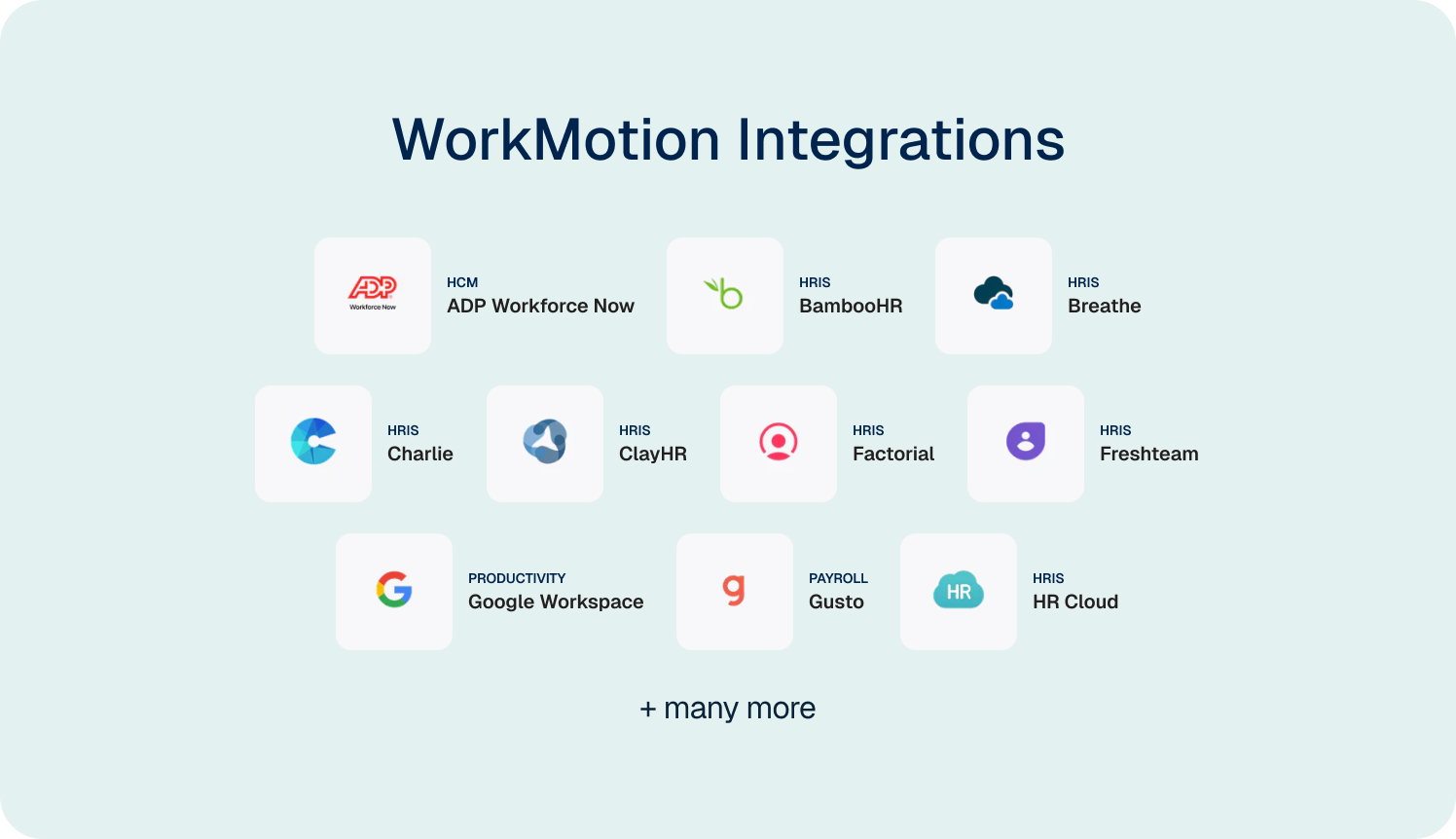
WorkMotion is deliberately not trying to replace your domestic HR stack. It integrates with common HRIS and payroll systems and positions itself as the international employment layer behind the tools you already use. For companies with Personio, BambooHR, HiBob, or Workday in place, that can be a cleaner operating model than forcing a parallel global HR suite into the business.
Deel
Deel is strongest on platform breadth. If you want EOR, contractors, payroll, and HRIS under one roof, Deel has the most compelling story in this group. That doesn’t make it the default choice for every European EOR decision, but it does make it the best fit for teams explicitly trying to consolidate global workforce operations into one platform.
Remote
Remote sits between the two. It offers integrations, API access, and a broader platform story than a narrow EOR specialist, but it doesn’t lean into the “all-in-one global HR stack” message as heavily as Deel. For some buyers, that’s a positive.
Oyster
Oyster is a platform-led EOR, but not a full HR suite replacement. If your team values a cleaner user experience and doesn’t need a built-in HRIS, Oyster can still be a good operational fit. The tradeoff is that it isn’t the deepest option for platform breadth or the strongest option for Europe-specific compliance proof.
| Platform | Platform breadth | Best fit on this dimension |
|---|---|---|
| WorkMotion | Focused global employment layer with integrations into existing HRIS/payroll tools | Companies that already have an HR stack and need international employment infrastructure behind it |
| Deel | Broadest suite: EOR, contractors, payroll, and HRIS | Teams consolidating multiple global workforce workflows into one platform |
| Remote | Mid-range breadth with integrations and API access | Teams that want owned-entity infrastructure without a full HR-suite commitment |
| Oyster | Platform-led EOR with simpler breadth than Deel | Teams prioritizing usability over platform consolidation |
Which Provider Fits Your Situation
At this point, the right choice depends less on which provider looks strongest in isolation and more on what kind of hiring problem you’re actually solving. The shortlist changes if you’re hiring your first employee in Spain, trying to consolidate 60 contractors, or entering a new market with a finance team that wants every cost line visible before approval.
| Situation | Best fit | Why |
|---|---|---|
| SME hiring into Europe, compliance-first | WorkMotion | Best fit if you want owned entities across key European markets, independently audited compliance, and a single accountable legal employer for European hiring |
| Team consolidating EOR + contractors + payroll + HRIS into one platform | Deel | Strongest breadth in the group; especially compelling for contractor-heavy teams that want one system for multiple workforce models |
| IP-sensitive hiring where a fully owned-entity model matters most | Remote | Strong option if your main priority is a clean owned-entity model and a straightforward accountability chain |
| Team prioritizing ease of use across a broad country range | Oyster | Best fit if platform simplicity and broad hiring coverage matter more than Europe-specific compliance depth |
A few practical rules help narrow it down faster:
- Choose WorkMotion if you’re hiring into Europe and want the legal employer, the entity, and the compliance posture to sit under one accountable provider with independently verified certification.
- Choose Deel if contractor management and platform consolidation matter more than Europe-specific compliance depth.
- Choose Remote if your main concern is a fully owned-entity model and a clean ownership chain.
- Choose Oyster if your team values a lighter user experience and broad coverage, and you’re comfortable doing more diligence on country-specific infrastructure.
Get Started With WorkMotion Today
If you’re hiring into Europe, the shortlist decision shouldn’t stop at country count or headline EOR pricing. The higher-risk question is simpler: who is the legal employer in-country, and can they stand behind the contract with their own licensed entity and independently audited compliance process?
That’s where WorkMotion separates itself in this comparison. It combines owned entities across key European markets with IEC Gold Compliance Certification, giving buyers a level of third-party compliance proof that isn’t publicly available from the other providers in this set. It also keeps the buying process practical: onboarding in days rather than months, transparent pricing with country-specific employment cost breakdowns before you commit, and a service model designed for SMEs that need to hire internationally without building local entities.
If your company is hiring into Europe and you want the party signing the contract to be the party accountable when payroll, benefits, or labor law questions arise, WorkMotion is worth a closer look.
WorkMotion owns its European entities and holds its compliance credentials independently, so the party you contract with is the party accountable when it matters. Book a demo and see how it works for your next hire.

















![idWjC-9cC6_logos 1 [Vectorized]](https://workmotion.com/wp-content/uploads/2026/02/idWjC-9cC6_logos-1-Vectorized.svg)