

A remote role gets posted, and within days the inbox fills with CVs that all look polished and qualified. However, many also look suspiciously AI-generated. There’s no reliable way to confirm quality from fabrication at the application stage. So the hiring team moves forward on trust, and that trust extends further than it should.
Identity, location, and work eligibility stay unverified until after the contract signs. At this point, payroll is running, statutory benefits are enrolling, and any disputes are playing out under employment law the hiring team may not have accounted for.
What started as a screening problem is now a compliance and financial exposure that outlives the hiring process itself. This article delivers seven best practices across the hiring funnel, plus the one move that removes most of the risk before it starts.
What Candidate Fraud Looks Like in Remote Hiring
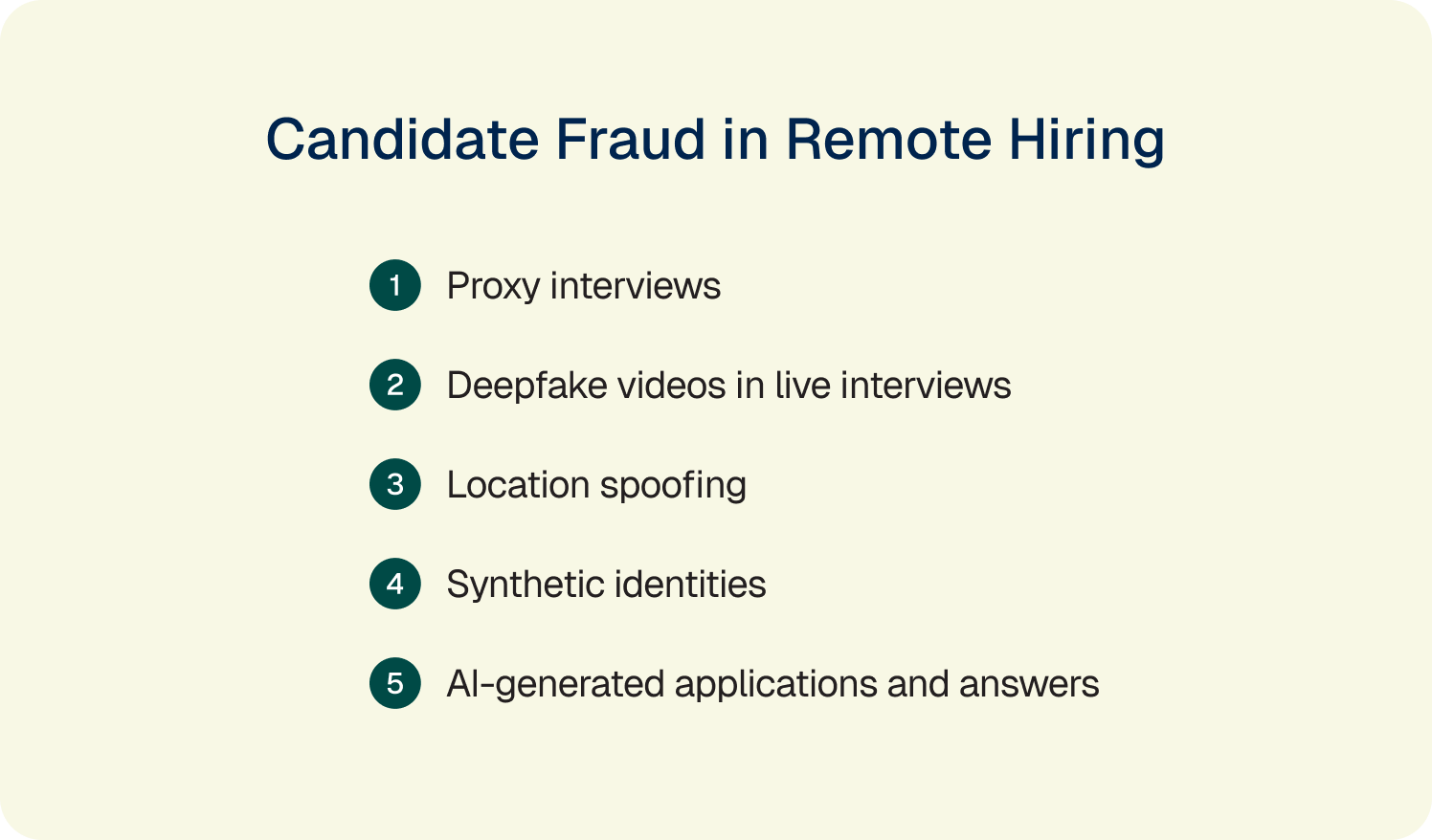
Candidate fraud is the deliberate misrepresentation of identity, location, qualifications, or work eligibility during the hiring process. It’s different from resume embellishment, which exaggerates real experience. Fraud is intentional deception, and in a remote work hiring context, it’s becoming industrial in scale.
Gartner predicts that by 2028, one in four candidate profiles globally will be fake, and not just embellished, but synthetically created. Huntress, a cybersecurity firm, flagged 23.2% of applicants as fraud risks in just three months of monitoring. And remote roles are 10 times more likely to receive fraudulent applications than in-office roles.
The remote-specific fraud types each undermine a different assumption in the hiring process:
- Proxy interviews: One person is assessed, another does the job. Fake candidates pay for underground services to take their place in the interview process.
- Deepfake or manipulated video: Real-time face-swap tools overlay a synthetic face onto a live video call. One in four job seekers has used an AI-generated avatar in a video interview.
- Location spoofing: VPNs and false residency claims mask where the candidate actually is, creating right-to-work and tax complications before the person interviewing ever sets foot on payroll.
- Synthetic identities: Fabricated profiles assembled from real and stolen details, sometimes backed by nation-state actors.
- AI-generated applications: Resumes, cover letters, and assessment responses created or heavily polished by tools like ChatGPT, often tailored to match a specific job description.
Each type undermines a different assumption, which is why single-point checks miss them. The practices below map to the whole hiring lifecycle.
Why Remote Hiring Creates Candidate Verification Gaps
Remote hiring removes the in-person identity anchor that quietly verifies who someone is. When a candidate shows up at an office, in a known location, ID in hand, identity verification happens naturally. In a fully remote process, that anchor disappears.
Cross-border hiring adds new fraud surface area that a standard background check was never designed to cover. Location verification, right-to-work validation, and locally compliant contract generation all become part of the fraud prevention challenge.
A domestic criminal-record check or reference check says nothing about whether a candidate has the right to work in Germany or whether they actually reside in Spain.
In Germany, that means confirming a non-EU candidate’s residence permit with work authorisation before their first day. In Spain, it means verifying that a candidate’s NIE is backed by a valid visa or residence permit, not just a tax ID number. A standard background check doesn’t surface any of this.
Plus, a fraudulent candidate who passes screening doesn’t just waste recruiter time. They also gain access to company systems, intellectual property, and potentially trade secrets.
41% of IT and security leaders have confirmed their organisation hired and onboarded a fraudulent candidate. The candidate fraud detection practices below close this gap at each stage, and practices 5 and 6 address the cross-border dimension specifically.
The 7 Best Practices for Detecting Candidate Fraud
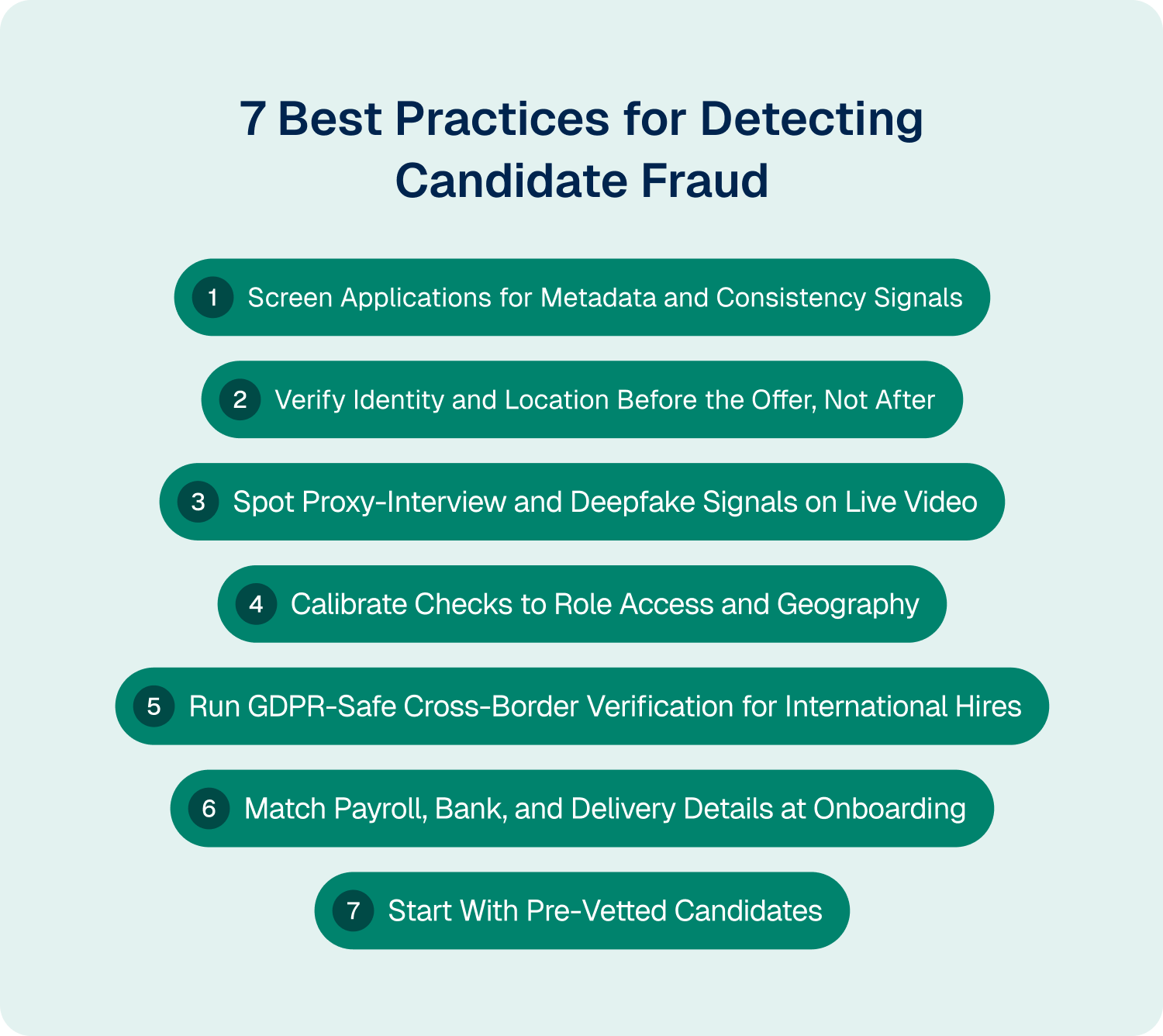
These practices follow the hiring funnel from the first application to the first week on payroll. The first six harden each stage while the seventh removes most of the risk before the funnel begins.
1. Screen Applications for Metadata and Consistency Signals
The application stage is where fraud enters the hiring funnel. It’s also where the volume is highest. 80% of hiring teams have encountered AI-generated or AI-assisted applications, with AI-generated cover letters and fake resumes being the most common use case.
You don’t need to catch every fake application, but this is how you can filter out the obvious ones before they waste your interviewer’s time.
Signals That Suggest a Fabricated Application
- Resume file metadata that contradicts the stated author or timeline.
- Near-identical CVs arriving in bulk, a sign of automated submission from the same IP address.
- Profile mismatches across LinkedIn, GitHub, and the application, such as a senior title with no corresponding employment history or activity that doesn’t match claimed experience.
How to Verify Before Advancing the Candidate
- Cross-check the CV against at least two independent public sources before scheduling.
- Confirm named employers and dates align across profiles.
- Treat unverifiable reference contacts, such as personal email only with no traceable company domain, as a reason to pause.
2. Verify Identity and Location Before the Offer, Not After
One of the most common structural mistakes in remote hiring is leaving identity and location verification to onboarding. By then, the offer is built on assumptions that may be incorrect.
Why Timing Is the Point
Every downstream control depends on knowing who and where the candidate is. An offer prepared for the wrong jurisdiction means the wrong contract, wrong tax treatment, and wrong statutory benefits, all live the moment the contract is signed. Verifying first means the offer is built on confirmed facts.
How to Confirm Identity and Location Upstream
- Require government-ID verification and a location check before contract generation, not after.
- Confirm the candidate’s stated country against the jurisdiction the offer is being prepared for.
- Validate right-to-work documentation for that country before anything is signed.
3. Spot Proxy-Interview and Deepfake Signals on Live Video
The interview stage is where fraud gets even more sophisticated. 31% of hiring managers have personally interviewed candidates later revealed to have used fake identities, and 35% confirmed a proxy attended a virtual interview in their organisation.
What to Watch for on Camera
- Camera-off requests without a clear accessibility reason.
- Audio lagging noticeably behind video, or unnatural lighting and edge artefacts around the face.
- Eye movement suggesting the candidate is reading answers, or answers that don’t match the seniority and specifics on the CV.
- Assessment-stage signals like rapid task completion inconsistent with stated skills, code metadata showing a different author, or refusal to complete live exercises.
How to Structure Interviews to Surface Fraud
- Use structured, follow-up-heavy questioning that forces candidates off script. Expand on a specific project, then probe two levels deeper. Fabricated histories fall apart under specific inspection.
- Include a short live exercise where appropriate. A genuine expert handles improvisation while a proxy or scripted answer breaks down under specifics.
- Switch video platforms mid-process. A real candidate transitions without hesitation; a proxy using pre-configured tooling often resists.
- Have at least two interviewers compare notes across multiple interview stages. If the notes are mismatched and it doesn’t feel like they spoke to the same person, that’s one of the strongest fraud signals available.
4. Calibrate Checks to Role Access and Geography
Running the same checks on every hire slows down low-risk roles while still leaving high-risk ones exposed. The fix is to scale verification to match the role.
Here’s how four tiers map out:
| Tier | Example roles | Verification depth | Re-verification trigger |
|---|---|---|---|
| Low access | Content, junior marketing | Baseline ID + reference check | On role change |
| Customer data access | Support, sales | ID + location + right-to-work | On scope expansion |
| Privileged IT | DevOps, infrastructure | Full ID + location + right-to-work + enhanced background | Periodically |
| Finance approvals | Finance, payroll | Highest depth + payment-detail verification | On any change |
The more access a role grants to company systems or sensitive data, the deeper the verification needs to be, and the more frequently it should be re-verified.
5. Run GDPR-Safe Cross-Border Verification Process for International Hires
Cross-border hiring adds a layer of complexity that domestic checks simply can’t address. It’s a level above verifying identity. You’re confirming right-to-work in a specific jurisdiction, validating claimed location, and doing it all within the bounds of local data-protection law.
What to Verify, Country by Country
Requirements differ by jurisdiction. The examples below are illustrative rather than definitive legal advice.
Germany
Employers must verify nationality and residence permit before employment begins, and keep copies for the duration of employment plus three years. From 1 January 2026, employers must also inform third-country nationals on their first working day about their right to seek free advice on labour and social law matters.
Spain
Every foreign employee needs an NIE (Número de Identidad de Extranjero), a unique identification number required for payroll, social security registration, and tax purposes.
The NIE alone doesn’t grant work rights; it must pair with a valid visa or residence permit. The employer must register the employee with Social Security within the legal window post-entry.
Poland
The employer applies for the work permit on behalf of the foreign national. Self-sponsorship isn’t possible. The single permit combines residence and work authorisation in one procedure, valid for one to three years. From April 2026, all applications must be submitted online via the MOS 2.0 portal.
Staying GDPR-Compliant While You Check
- Lawful basis: For active candidates, legitimate interest (Article 6(1)(f)) is the usual basis, not consent. At the offer stage, contractual necessity applies.
- Data minimisation: Collect only the minimum data needed for each check, and state the purpose clearly.
- Retention: Define and enforce retention periods. Unsuccessful applicant data should be deleted within 6-12 months, depending on the jurisdiction.
- Document everything: Record the lawful basis, purpose, and data category for each processing activity.
There’s a way to reduce the verification workload before it even begins. Pre-vetted, legitimate candidates from Synmatch AI arrive with their identity, location, and eligibility already confirmed, so the verification burden shrinks before it starts.
6. Match Payroll, Bank, and Delivery Details at Onboarding
Onboarding is the last structured checkpoint before a fraudulent applicant is fully inside the business. This is where post-hire fraud often surfaces, because the person who starts working isn’t always the same person who was interviewed.
The Checks That Catch Post-Hire Fraud
- Match the bank account name against the legal name on identity documents.
- Verify the address used for statutory benefit enrolment.
- Confirm the equipment delivery address is consistent with the stated location.
- Monitor first-week system access for anomalies, such as logins from an unexpected country.
Where Compliant Employment Closes the Gap
Many of these controls sit naturally with the employer of record (EOR) that runs payroll and contracts. WorkMotion handles compliant onboarding, locally correct contracts, and payroll setup across borders.
Verification done during hiring carries through into how the person is actually employed, rather than restarting. The result is a single chain from screening to employment, with no gap where fraud can re-enter.
7. Start With Pre-Vetted Candidates
You can’t out-screen the sheer volume of unqualified and AI-generated applications. The most effective control is not receiving them in the first place.
Synmatch AI is WorkMotion’s newly launched done-for-you recruitment service that sources candidates, runs AI interviews, and delivers a shortlist of the most qualified, interview-ready people, typically 5–10 per week. Since vetting happens before the candidate reaches you, the fraud surface that practices 1–6 defend against is largely closed at source.
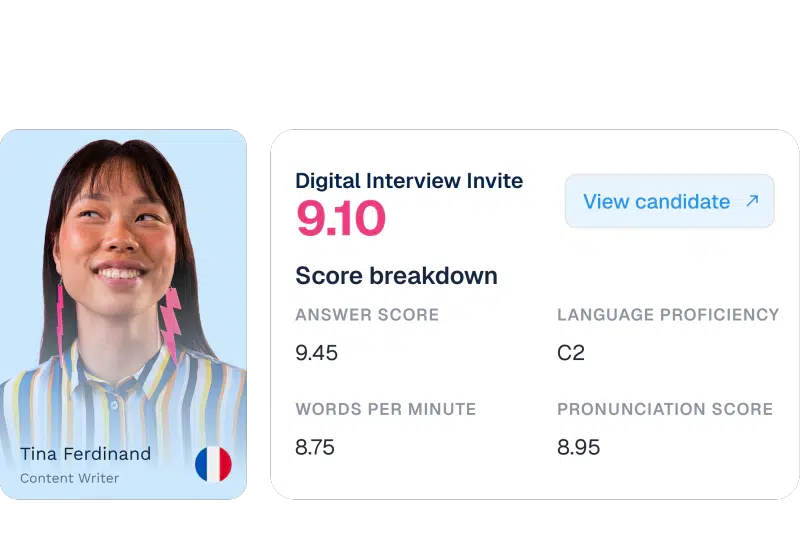
Synmatch AI costs a fraction of a traditional agency’s fee, and it’s free for WorkMotion customers. Synmatch AI finds and vets the talent, and once a candidate has been selected, they can be compliantly employed from anywhere in the world via WorkMotion. Sourcing plus compliant employment in one chain is something no standalone recruitment service offers.
Candidate Experience Guardrails: Reduce False Positives Without Losing Talent
Strong candidates tolerate reasonable checks. But they will walk from processes that feel accusatory or invasive. The goal is to detect fraud without losing qualified candidates or applying checks in a discriminatory way.
Here’s how to keep both intact:
- Explain why each check exists. Candidates accept verification they understand.
- Offer alternative verification paths for accessibility needs, such as camera-off with a documented reason.
- Apply the same standard consistently so no group is singled out.
- Document verification requirements in advance rather than improvising mid-process.
When to Escalate: A Decision Framework for Suspicious Signals
A single suspicious signal rarely proves fraud on its own. But a pattern does. A framework prevents both over- and under-reacting.
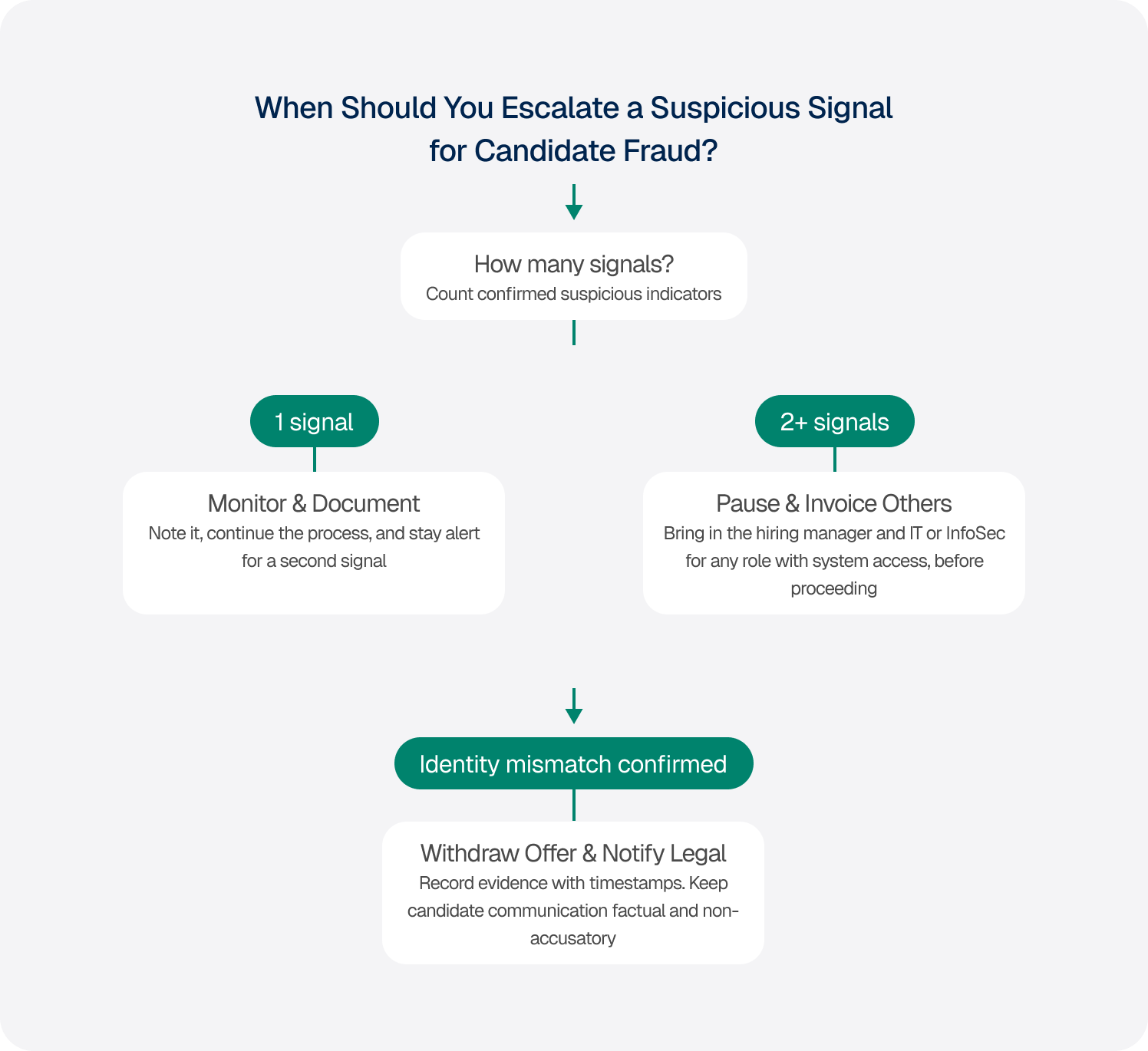
The Full Chain: Screening Plus Compliant Employment
Practices 1–6 close the fraud gap at each stage of the hiring funnel. Practice 7 removes it from the start. But screening only closes the fraud gap. The legal exposure gap, wrong jurisdiction, non-compliant contract, mishandled data, only closes when the employment itself is compliant.
Synmatch AI delivers highly qualified, AI-interviewed talent. Then, if you decide to bring them on board, WorkMotion can employ them compliantly across borders, on locally correct contracts, and you can have a new employee in your organization in 3–5 business days.
WorkMotion’s compliance posture is independently verified through its IEC Gold Compliance Certification, a first in the EOR space. Backed by a 4.9/5 Trustpilot rating, WorkMotion delivers exceptional customer service, an intuitive, easy-to-use platform, and transparent pay.
“As [a] Head of People, I’ve used several global employment platforms in the past, and while WorkMotion’s tool is easy to use, what truly makes the difference is the quality of the team behind it,” says one Trustpilot user.
Book a demo to see how Synmatch AI and WorkMotion can help your organization hire and grow your team from anywhere in the world.

















![idWjC-9cC6_logos 1 [Vectorized]](https://workmotion.com/wp-content/uploads/2026/02/idWjC-9cC6_logos-1-Vectorized.svg)