

The EU Pay Transparency Directive brings turnover-based fines, uncapped back-pay, and a reversed burden of proof. It pulls smaller companies into scope, and it applies whether or not your country has passed a law.
For an HR lead running teams across Germany, Italy, and two other markets, that means one job advert can trigger four different compliance obligations. One country demands the salary range in the ad itself, another lets you disclose it later, and a third hasn’t passed a law at all.
WorkMotion recently unpacked these challenges in a joint webinar with Factorial, and the picture for multi-country HR teams is a demanding one. Read on to learn what the Directive changes, what to do now, and how it plays out across borders, using Germany as a worked example.
This article reflects WorkMotion’s understanding of the legal position and its practical experience. It isn’t legal advice. National implementation of the Directive is still developing, so several points below remain open and will be settled by national law or the courts.
What the EU Pay Transparency Directive Changes
The core aim of the Directive is equal pay for equal work or work of equal value between female and male workers. The European Union has long held the principle of equal pay as a founding value, enshrined in the Treaty of Rome in 1957 and now codified in Article 157 TFEU. But existing equal pay laws haven’t adequately addressed the gap.
In Germany, men earn on average around €4.10 more per hour than women with the same qualifications. Part of this gender pay gap can be explained by different roles or working hours. But a large part can’t be explained, and it’s that unaccounted-for portion the new pay transparency rules are designed to expose and close.
The old regime gave employees a right to ask about pay. The new transparency directive actively involves the employer. Previously, employees often didn’t dare to ask, fearing it would count against them at work. The reversed burden of proof removes much of that risk. Now, the employer must demonstrate there’s no unjustified pay gap, not the employee to prove one exists.
This matters because direct or indirect discrimination in pay is often structural, not intentional, and the old rules made it nearly impossible for individuals to bring an equal pay claim.
Directive vs Act: What’s the Difference?
The reporting obligation threshold also drops. In Germany, it falls from 200 to 100 employees, now shedding light on many smaller companies. To clarify the terminology, at the EU level, this is a Directive. That means each member state must pass its own implementing law.
Germany’s existing law is the Pay Transparency Act (Entgelttransparenzgesetz), sometimes called the EU pay transparency act, but the new EU pay transparency directive will require national legislation that goes well beyond it.
That’s why we’re speaking about the “Directive” throughout, since that’s the instrument driving the change. In Germany specifically, no implementing law has been passed yet.
Here’s how the key positions shift:
| Previous position | New position under the Directive |
|---|---|
| Reporting obligations started at 200 employees. | Reporting obligation starts at 100 employees, bringing many more smaller companies into scope. |
| The burden of proof sat with the employee, who had to prove a gender pay gap existed. | Reversed burden of proof. The employer must demonstrate there’s no unjustified pay gap. |
| Sanctions and damages existed but were rarely enforced. | Significantly tightened and enforced far more consistently. |
| No duty to disclose pay in job adverts. Effectively only a right to ask. | Duty to disclose salary ranges before the interview, with a minimum and maximum for the role. |
The Consequences of Non-Compliance
The Directive introduces real teeth for the first time. Here’s what failing to comply can look like:
- Full compensation: Back-payment of all pay owed, including bonuses and benefits in kind, with no upper limit where a breach is proven. This covers complementary or variable components, not just base salary.
- Fines calculated as a percentage of annual turnover: For the first time, there are real financial consequences. Member states must establish penalties that are effective, proportionate, and dissuasive.
- The 2025 German Federal Labour Court ruling (BAG 8 AZR 300/24): One employee “negotiating better” than another is no longer an objectively justified reason for pay differences. A pairwise comparison with a single colleague of a different gender is sufficient to trigger the presumption of pay discrimination, which can lead to pay discrimination claims.
- Exclusion from public procurement: Employers who’ve failed to ensure equal pay or who have an unjustified gap above 5% may be excluded from EU public contracts and grants.
If it’s not clear by now, the enforcement mechanisms are no longer theoretical, and the financial risk extends well beyond base salary.
How to Prepare for the EU Pay Transparency Directive
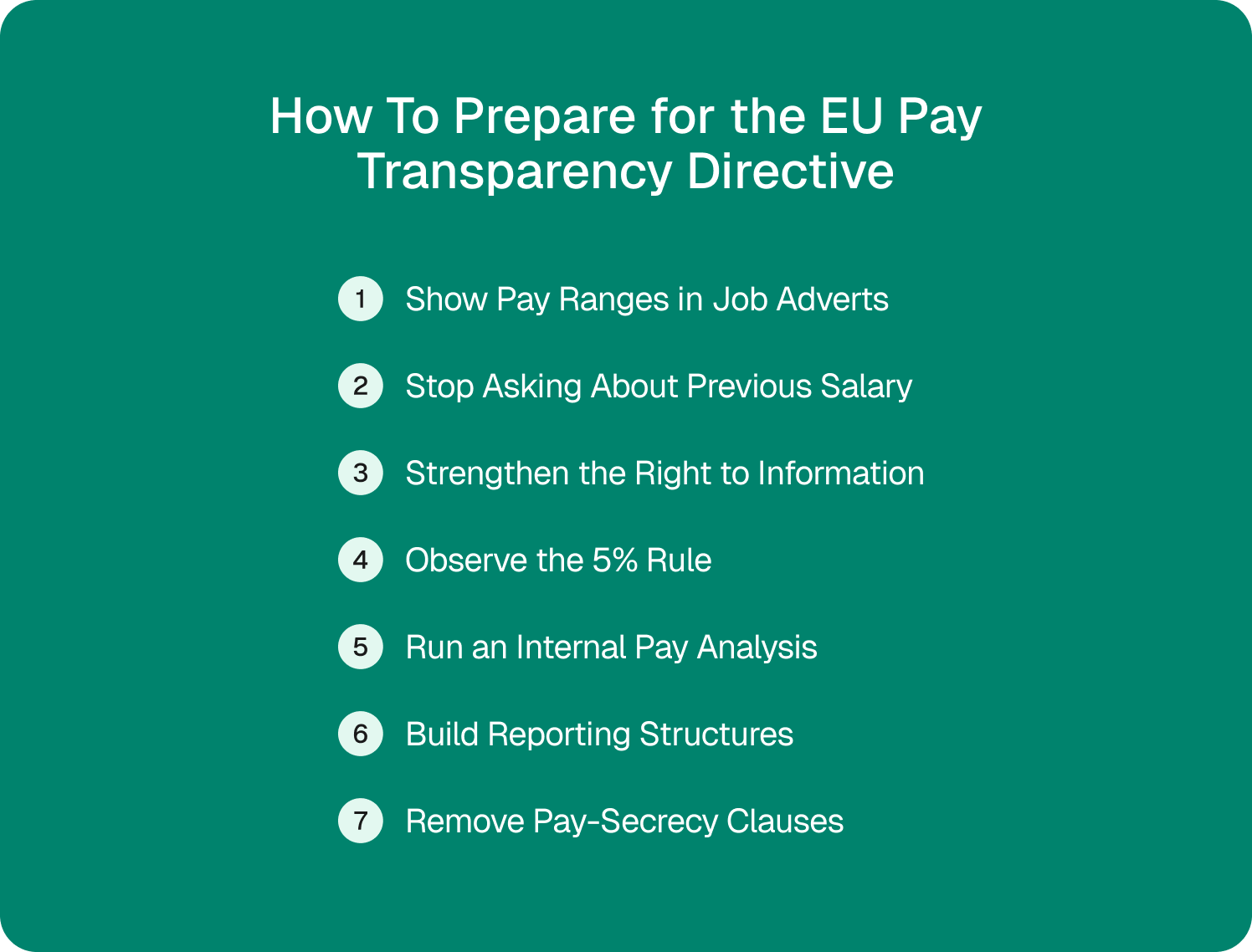
1. Show Pay Ranges in Job Adverts
State the minimum and maximum salary for the role in every job vacancy notice. The Directive requires that job vacancy notices include or provide pay information before the interview stage.
If you’re posting on LinkedIn, include the pay range directly in the listing. The Directive requires that job applicants receive this information before the interview rather than during it. This pre-employment transparency obligation applies to all employers regardless of size.
Some countries, like Italy, already require the range in the advert itself, and many may follow because it’s the easiest approach to document. Updating your recruitment processes and recruitment practices now ensures you’re not caught out when national laws land.

2. Stop Asking About Previous Salary
Questions about prior earnings, like a candidate’s salary history, are prohibited. The point is to ensure that past underpayment doesn’t follow a candidate through their career.
You can still ask about salary expectations, which can differ entirely from what someone earned previously. The pay history ban protects candidates, and the expectation question helps you align on a realistic range.
Review your current pay practices to make sure no interview templates or ATS fields still capture previous salary data.
3. Strengthen the Right to Information
Employees can request written information about pay data broken down by gender, and the employer must answer within a reasonable period. The Directive says you can’t take more than two months to deliver this information.
Don’t wait for an employee to ask to establish a process. Do it now so requests can be routed to the right parties and answered within the window. This right to information covers the employee’s own pay levels and the average pay data for comparable activities, broken down by sex. Providing clear pay information proactively helps improve pay transparency and reduces the risk of disputes.
4. Observe the 5% Rule
If a gender pay gap above 5% is identified in any worker category, the employer must review it with employee representatives or trade unions and take corrective measures.
The 5% threshold applies per worker category, not company-wide. Even if your overall average gap is 2%, a 5.1% gap in one category triggers the mechanism. If the gap can’t be justified by gender-neutral criteria and isn’t corrected within six months, a joint pay assessment must be conducted.
5. Run an Internal Pay Analysis
Check whether a gap above 5% exists and correct any unjustified pay gaps. Define objective, gender-neutral criteria for determining pay:
- Competencies and skills
- Areas of responsibility (team size, budget)
- Workload
- Working hours
These pay criteria also shape pay progression, like how an employee moves to a higher pay level, so documenting pay progression criteria now ensures future raises are defensible.
This is the foundation that makes everything else comprehensible. The comparison group is formed from the company as a whole, not from departments or sites, so it may include people from finance, marketing, and legal if their work is of equal value.
6. Build Reporting Structures
Produce regular gender pay gap reporting and submit it to the relevant authorities. Automate the process so it isn’t a manual, time-consuming job each cycle.
The reporting requirements now apply from 100 employees, with staged frequency: 250+ employees report annually from June 2027, 150-249 every three years from June 2027, and 100-149 every three years from June 2031.
Reports must cover the median gender pay gap, quartile pay band distribution, the proportion of female and male workers receiving variable pay, and the gender pay gap by category of workers.
7. Remove Pay-Secrecy Clauses
Contracts may no longer prohibit employees from discussing or disclosing their pay. Review existing contracts to see if you need to remove any pay-secrecy clauses.
This applies to all employers regardless of size. These pay transparency measures are among the employer obligations that apply immediately. They don’t depend on reporting thresholds.
The EU Picture: Country by Country
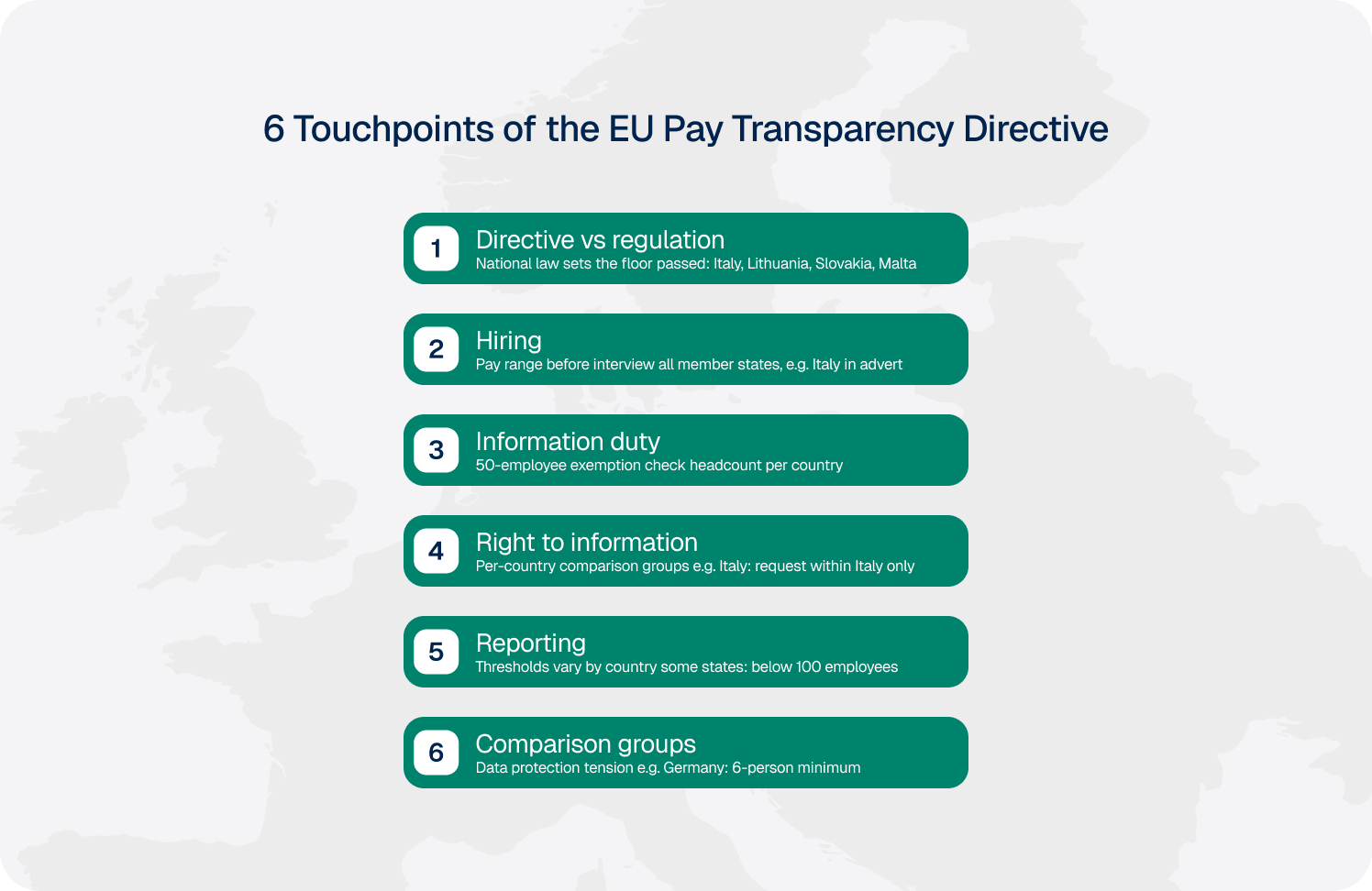
For multi-country employers, the Directive must be met on a market-by-market basis. Each member state must be assessed individually because rules diverge.
There are six main touchpoints where the transparency obligations apply, and this transparency legislation creates different employer obligations in each country.
Hiring
A job advert should generally relate to one country since rules differ. To reach candidates across Europe, you can post for several countries or all of Europe.
The Directive requires pay ranges to be disclosed before the first interview. But the exact point at which you disclose (for example, in the advert itself) is left to national law. Pay bands must differ realistically by country, and you must at least account for the strictest applicable rule.
The Information Duty
The Directive allows an exemption for companies with fewer than 50 employees. Check headcount per country, then any national exemptions. A group may run one process across all European entities for simplicity.
The Right to Information
The right to information applies per country, which means you need to build average pay levels and comparison groups for each market separately. An employee in Italy can request pay data for their comparison group in Italy, not for the entire European group.
The comparison group is defined by equal work or work of equal value, and it spans the whole company in that country. There’s also a data protection tension that arises when comparison groups are very small, which we cover in more detail below.
Reporting
Similar to the right to information, reporting thresholds must be reviewed per country, since each member state sets its own rules within the Directive’s framework. A European group may choose to report at group level across all countries, regardless of individual national legislation, since this can simplify the process for multi-country employers.
But national legislation can also go below the Directive’s threshold, meaning some countries may require reporting from companies with fewer than 100 employees. Check the specific threshold in each country where you have employees.
Comparison Group Size and the Data Protection Tension
Germany’s current Act requires a comparison group of at least six people. The Directive can trigger a right to information with just two. If a two-person team does equal work, exercising the right effectively reveals the other person’s pay. This is a direct conflict with data protection.
It also isn’t yet resolved and will be settled by national law or ultimately the courts. Some companies may lean toward data protection for now, given its high turnover-based fines.
Directive vs Regulation: Why National Law Matters
An EU regulation applies directly in every member state on the same date. A directive sets minimum standards, and each member state must pass its own national legislation to implement them.
That national law must at least meet the directive’s requirements, but it can go further, which is a practice known as “over-implementation.” For multi-country employers, it means the same directive can produce different obligations in different countries, and you need to check the specific national law in each market where you hire.
So where do things stand? Four EU member states (Italy, Lithuania, Slovakia, and Malta) passed a law within the deadline. Italy over-implemented by saying pay bands must already appear in the job advert, not only later before the interview. Germany has no law yet.
How Does the EU Pay Transparency Directive Apply in Germany?
The existing Entgelttransparenzgesetz (Pay Transparency Act) is the baseline. It’s weaker than the Directive, with obligations many employers haven’t met because sanctions were rarely enforced. That’s why the €4.10/hour average gap between men and women at equal qualifications remains the reality.
Germany doesn’t even have a draft bill yet. And given the government’s aim to cut bureaucracy, Germany may implement only the minimum. A finished law is unlikely before next year, and reporting obligations could slip accordingly, potentially to 2028.
But that doesn’t mean nothing applies. For public employers, the Directive applies directly through what’s called “vertical effect.” This means the state can’t rely on its own failure to legislate.
For private employers, it can apply indirectly through directive-compliant interpretation. If a case reaches a labour court, the court must apply the existing Pay Transparency Act and may interpret specific provisions in line with the Directive, though it can’t act as a substitute legislator.
For a closer look at these nuances, check out WorkMotion and Factorial’s joint webinar below.
Pay Transparency and Cross-Border Hiring: EOR and Direct Hiring
For companies hiring across borders, the pay transparency question gets more complex. Knowing who’s the actual employer and who carries the compliance obligation are crucial.
Two common models dominate cross-border hiring, and they create very different responsibility profiles under the Directive.
Employer of Record (EOR)
Under an EOR model, a provider employs a candidate on the client’s behalf via a local entity in the worker’s country. The client directs the work, the EOR holds the employment contract and handles payroll, and the employee works locally under local rules.
The employment relationship is local, not cross-border. WorkMotion delivers this through its own entities in core European markets. This way, the party that holds the in-country licence is the same party the client contracts with.
Direct Hiring
Direct hiring is when the provider helps the client register as a foreign employer in the target country. It creates a direct employment relationship between the client and the employee, with payroll support.
This is particularly relevant for companies planning to hire in Germany from abroad or open their own entity in the long run. WorkMotion supports this through its Direct Hiring registration process, but the client remains the legal employer throughout the process.
Who Is Responsible for Making Sure You’re Compliant With the EU Pay Transparency Directive?
| Structure | Who is responsible |
|---|---|
| Your own entity abroad | You are responsible for meeting the obligations directly. |
| Direct hiring | You (the client) are responsible. WorkMotion helps with registration, but the relationship is direct between you and the employee. |
| Employer of record | Responsibilities are shared and to be coordinated between the EOR and the client. |
The Open Questions When Using an EOR
The table above shows that EOR responsibilities are shared, but what that actually looks like in practice isn’t yet clear. The Directive doesn’t address the EOR model specifically, and because each member state is writing its own implementing law, the answers will depend on how national legislation treats employee leasing in each country.
Here are the key questions that remain open:
- Who informs employees about the right to information, the EOR or the client?
- Who fulfils the request, and using whose data?
- Who reports on the gender pay gap?
- How are thresholds calculated? Do leased employees count toward the EOR, the client, or both? By analogy with German works-council headcount rules, likely both.
- How is the comparison group formed? The equal pay principle in temporary-agency law suggests leased employees probably count alongside the core workforce.
WorkMotion doesn’t give legal advice or design the specific measures, but it offers practical guidance on national legislation via its Help Center and support, and, for the EOR product, close coordination on how obligations are split to stay compliant.
“The genuinely interesting question is the EOR model, and I’ll be upfront. We don’t yet know all the answers. Who informs the employee, who fulfils the request, who reports the gap, these will be settled as national laws develop.” — Moritz Merkenich, Legal, WorkMotion (from the joint webinar with Factorial)
The answers will come country by country as national laws take shape. WorkMotion’s country teams are already tracking these developments across every market we operate in, so our customers have the information, tools, and support to navigate whatever shape the national legislation takes.
What Are the Benefits of the EU Pay Transparency Directive?
The Directive shouldn’t be viewed as a compliance burden. Greater pay transparency brings clear advantages, and the pay transparency measures required by the Directive also serve as pay setting guardrails that reduce pay inequalities across the organisation:
- Around six in ten candidates are less likely to apply when no salary is stated, because they can’t judge where they stand. Roughly six in ten are more likely to apply when a stated range fits their expectations.
- More qualified applications, because candidates self-select against a realistic range and can set a salary expectation aligned to the role.
- Stronger employer branding and better retention through a culture of trust and fair pay, which is particularly valuable amid skills shortages.
- Fine avoidance, which matters especially for companies with 150-300 employees.
- Equal pay rights are strengthened, and employees who feel they’re paid fairly are more likely to stay, reducing costly turnover.
Pay for equal work shouldn’t be an aspiration. It should be a verifiable reality, and the equal pay rights the Directive enforces make that possible.
How WorkMotion Can Help You Be Compliant Throughout Europe
The Directive must be met on a market-by-market basis, and that’s where WorkMotion’s value becomes clear. WorkMotion operates its own entities in core European markets rather than working with third-party partners. With deep employment-law expertise, WorkMotion takes the cross-border compliance load off multi-country HR teams.
Whether you’re hiring through an EOR or using Direct Hiring, WorkMotion’s compliance-first model means you have a partner who understands how pay transparency obligations interact with local employment law in each country. For companies navigating cross-border compliance challenges, that practical guidance is what turns a regulatory headache into a manageable process.
If you’re preparing for the Directive across multiple EU member states, book a demo and talk to the WorkMotion team about how cross-border hiring works with WorkMotion.

















![idWjC-9cC6_logos 1 [Vectorized]](https://workmotion.com/wp-content/uploads/2026/02/idWjC-9cC6_logos-1-Vectorized.svg)