

Imagine: a finance director blocks a German hire because the expected employment cost doesn’t match the latest invoice. A legal team pauses a Spanish offer because it cannot confirm whether the EOR provider holds the required license directly or through a partner. These are the kinds of questions that turn a shortlist into a compliance review.
For HR Directors, VPs People, and COOs hiring into Europe, the decision that matters after signature is who the legal employer is in-country when something goes wrong, and whether that party owns the entity and holds the license directly or routes through a third-party partner.
This guide compares Deel vs Papaya vs WorkMotion on entity model, pricing, onboarding, payroll infrastructure, and European execution to help you identify the right fit for your business.
The pressure to build international teams is only increasing. According to Deloitte’s 2025 Global Human Capital Trends report, 85% of business executives say organisations need more agile ways of organising work to adapt quickly to changing market conditions. As businesses expand into new countries, choosing an Employer of Record is no longer just an operational decision; it has become a strategic one that affects compliance, cost, and the ability to scale internationally with confidence.
“Most organisations begin by comparing pricing or country coverage. Those are important, but they rarely determine whether an international hiring programme succeeds over time. The more important questions are who becomes the legal employer, how compliance is maintained as regulations evolve, and whether your provider has the infrastructure to support long-term growth in your target markets.” — Bastian Eichler, VP of Marketing at WorkMotion
Deel vs Papaya vs WorkMotion at a Glance
These three providers often appear on the same EOR shortlist, but they are built for different buyers. Deel focuses on workforce consolidation, Papaya focuses on global payroll intelligence, and WorkMotion focuses on compliance-first employment infrastructure in Europe.
| Criteria | WorkMotion | Deel | Papaya Global |
|---|---|---|---|
| Best for | European SMEs prioritizing compliance and owned entities | Teams consolidating EOR, contractors, payroll, and HRIS | Enterprise finance teams needing payroll consolidation and analytics |
| Entity model | Owned entities in key European markets + partner coverage | Hybrid: owned entities + partners | Fully partner-based |
| Independent compliance certification | IEC Gold | Not publicly verified | Not publicly verified |
| Country coverage (EOR) | 160+ countries | 150+ countries | 160+ countries |
| Onboarding speed | 3–5 business days | 2–3 business days in many markets | Typically 5–10 business days |
| EOR pricing | From €499/talent/month | From $599/employee/month | From ~$650+/employee/month |
| Contractor pricing | From €29/talent/month | From $49/contractor/month | Varies by package |
| Key strength | Owned European entities + independent certification | Broadest platform footprint | Payroll intelligence and workforce analytics |
| Key limitation | Not positioned as a full HR suite replacement | Entity structure varies by market | Partner-based liability chain in all markets |
| TrustPilot rating | 4.9 | 4.6 | 4.1 |
What Each Platform Is, and What It Isn’t
Although WorkMotion, Deel, and Papaya all provide Employer of Record services, they were built with different priorities.
Understanding each platform’s core focus, where it excels, and the trade-offs behind its employment model provides the context you need before comparing specific features, pricing, and compliance capabilities.
WorkMotion

WorkMotion is a compliance-first EOR built for international hiring with particular depth in Europe. When WorkMotion acts as the legal employer in-country, its local entity signs the contract, runs payroll in local currency, administers statutory benefits, and maintains compliance as labor law changes. It combines owned entities across key European markets with partner networks that extend coverage to more than 160 countries.
Best understood as: the option for SMEs that need a single accountable legal employer in Europe with independently verified compliance.
Deel

Deel is the broadest platform in this comparison, combining EOR, contractor management, global payroll, and a built-in HRIS in one system. Its genuine strength is workforce consolidation: teams can manage employees, contractors, payroll, and HR operations from a single platform. The tradeoff for European hiring is that the model is hybrid, so buyers should still confirm the entity structure and licensing arrangements in their specific target markets.
Best understood as: the consolidation option for teams that want everything on one platform.
Papaya Global

Papaya Global is a finance-led global payroll and workforce analytics platform that also delivers EOR. Its strongest differentiator is payroll intelligence: real-time cost reporting, FX visibility, predictive cost modeling, and a regulated payments layer. Papaya delivers EOR through a fully partner-based network, so the local partner is the employing entity in each market.
Best understood as: the payroll-consolidation and analytics option for enterprise finance teams, rather than an owned-entity employer.
Feature-by-Feature Comparison
Choosing an Employer of Record isn’t about finding the platform with the longest feature list. It’s about understanding how each provider’s infrastructure affects compliance, cost, accountability, and the day-to-day experience of hiring internationally.
The sections below compare WorkMotion, Deel, and Papaya across the factors that typically determine whether an implementation runs smoothly or creates unexpected legal, financial, or operational complexity after contracts have been signed.
Compliance & Entity Ownership
When an employment dispute, payroll error, or regulatory investigation occurs, the legal employer, not the software platform, is responsible for resolving it.
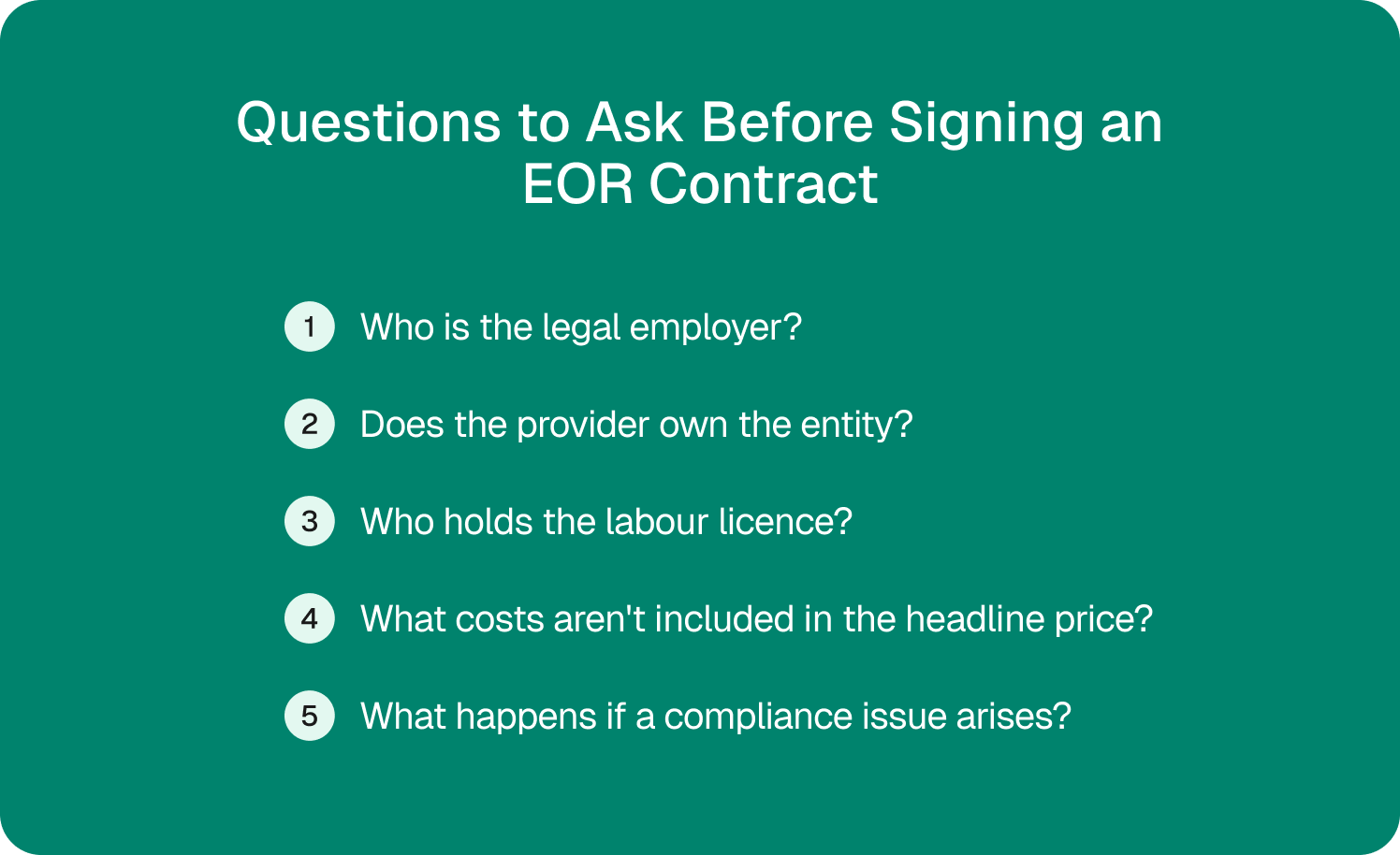
That makes the underlying employment model just as important as the features sitting on top of it. Before comparing pricing or onboarding speed, establish who is legally employing your workers and whether that organisation owns the local entity and licence or relies on an in-country partner.
WorkMotion
WorkMotion owns entities across key European markets, including Germany, Spain, France, and Poland.
The contracting party is the legal employer, with licenses held directly, including the AÜG labor-leasing license in Germany. It is also the only provider in this comparison with an independently audited compliance certification (IEC Gold).
Deel
Deel operates through owned entities in many markets and partners in others. Its in-house Compliance Hub is a genuine strength, but buyers hiring into regulated European markets should still confirm whether the employing entity in the target country is a Deel entity or a partner.
Papaya Global
Papaya delivers EOR through a fully partner-based network. The local partner is the legal employer in every market, adding an additional layer of accountability when issues arise in-country.
| Platform | Entity Model | Independent Certification |
|---|---|---|
| WorkMotion | Owned entities in key European markets | IEC Gold |
| Deel | Hybrid owned + partner model | Not publicly verified |
| Papaya Global | Fully partner-based | Not publicly verified |
Key takeaway: If legal accountability and direct entity ownership are central to your procurement process, verify the employing entity in each target country, not just the software platform you’re buying.
Pricing
Headline subscription fees rarely reflect the true cost of hiring internationally. Employer social contributions, statutory benefits, currency conversion, payroll administration, security deposits, and country-specific compliance obligations all influence the final cost of employment.
Comparing the advertised monthly fee alone rarely provides finance teams with enough information to budget accurately.
WorkMotion
WorkMotion separates the platform fee from the underlying employment costs by providing country-specific cost breakdowns before a contract is signed.
Rather than presenting a single headline price, customers receive visibility into employer social contributions, statutory benefits, and mandatory local employment costs alongside the service fee.
This makes it easier for HR and Finance teams to model hiring costs accurately before expanding into a new market.
Current pricing includes:
- Employer of Record: from €499 per employee/month
- Direct Hiring: from €399 per employee/month
- Contractor Management: from €29 per contractor/month
The free Employment Cost Calculator further supports budgeting by providing a line-by-line estimate for individual countries.
Deel
Deel’s pricing is competitive at the entry level, particularly for organisations already using its contractor products.
Employer of Record services start from approximately $599 per employee/month, while Contractor Management begins at $49 per contractor/month. Organisations should also consider optional HR modules, payroll services, and any market-specific deposits or employment costs that may apply, particularly when consolidating several workforce products into one platform.
Papaya Global
Papaya positions itself towards enterprise organisations with complex international payroll requirements. Employer of Record pricing typically starts at approximately $650+ per employee/month, reflecting the platform’s emphasis on payroll analytics, regulated payments, and financial reporting. While these capabilities can deliver significant value for multinational enterprises, smaller organisations should consider whether they’ll use enough of the finance functionality to justify the premium.
Key takeaway: Compare the total employment cost, not just the monthly subscription fee. A provider with a lower advertised price may ultimately prove more expensive once statutory contributions, payroll administration, and additional services are included.
Hiring in Europe
Onboarding speed is often presented as a competitive metric, but the number of days alone doesn’t tell the full story.
The underlying employment model has a significant impact on how quickly contracts are approved, payroll is configured, and statutory registrations are completed.
Understanding where delays typically occur helps set realistic expectations before hiring begins.
WorkMotion
WorkMotion typically completes onboarding within three to five business days. However, this range includes the time it takes for employees to sign the contract. The contract is usually with the talent in just over 24 hours. It’s unclear if Deel or Papaya factor this in.
Because it operates through owned entities across key European markets, employment contracts and payroll enrolment can often proceed without additional approval layers from third-party providers. Country-specific employment templates and local compliance expertise further reduce administrative delays.
Deel
Deel is recognised as one of the fastest onboarding providers in the market, often completing implementations within two to three business days.
Its self-service workflows, digital document handling, and pre-built employment templates contribute to this speed. Where employment is delivered through partner entities, organisations should confirm whether additional country-specific approval steps apply.
Papaya Global
Papaya generally reports onboarding timelines of five to ten business days, with more complex jurisdictions sometimes taking longer. Its enterprise-focused implementation process often includes greater coordination between payroll specialists, finance teams, and local employment partners. Larger organisations may value this structured approach, while smaller HR teams may prefer a lighter implementation process.
| Platform | Typical Onboarding | Main Advantage | Potential Delay |
|---|---|---|---|
| WorkMotion | 3–5 business days | Owned European entities | Contract updates |
| Deel | 2–3 business days | Digital self-service | Partner markets |
| Papaya | 5–10 business days | Enterprise implementation | Partner coordination |
Key takeaway: Fast onboarding is valuable, but consistency matters more. Ask what factors could extend implementation in your specific hiring markets before making a decision.
Still deciding?
If your shortlist has come down to Deel and Papaya, ask yourself these three questions before moving forward:
- Do you know who will legally employ your workforce?
- Have you modelled the full employment cost rather than comparing subscription fees?
- Does your provider own the employing entity in your target market?
If the answer to any of these is “not yet”, it’s worth resolving those questions before signing a contract.
Integrations, HRIS and Platform Breadth
Most organisations evaluating an Employer of Record already have HR, payroll, and finance systems in place. The goal is rarely to replace those platforms entirely. Instead, the right EOR should fit into your existing technology stack while minimising duplicate administration and maintaining accurate employee records across systems.
WorkMotion
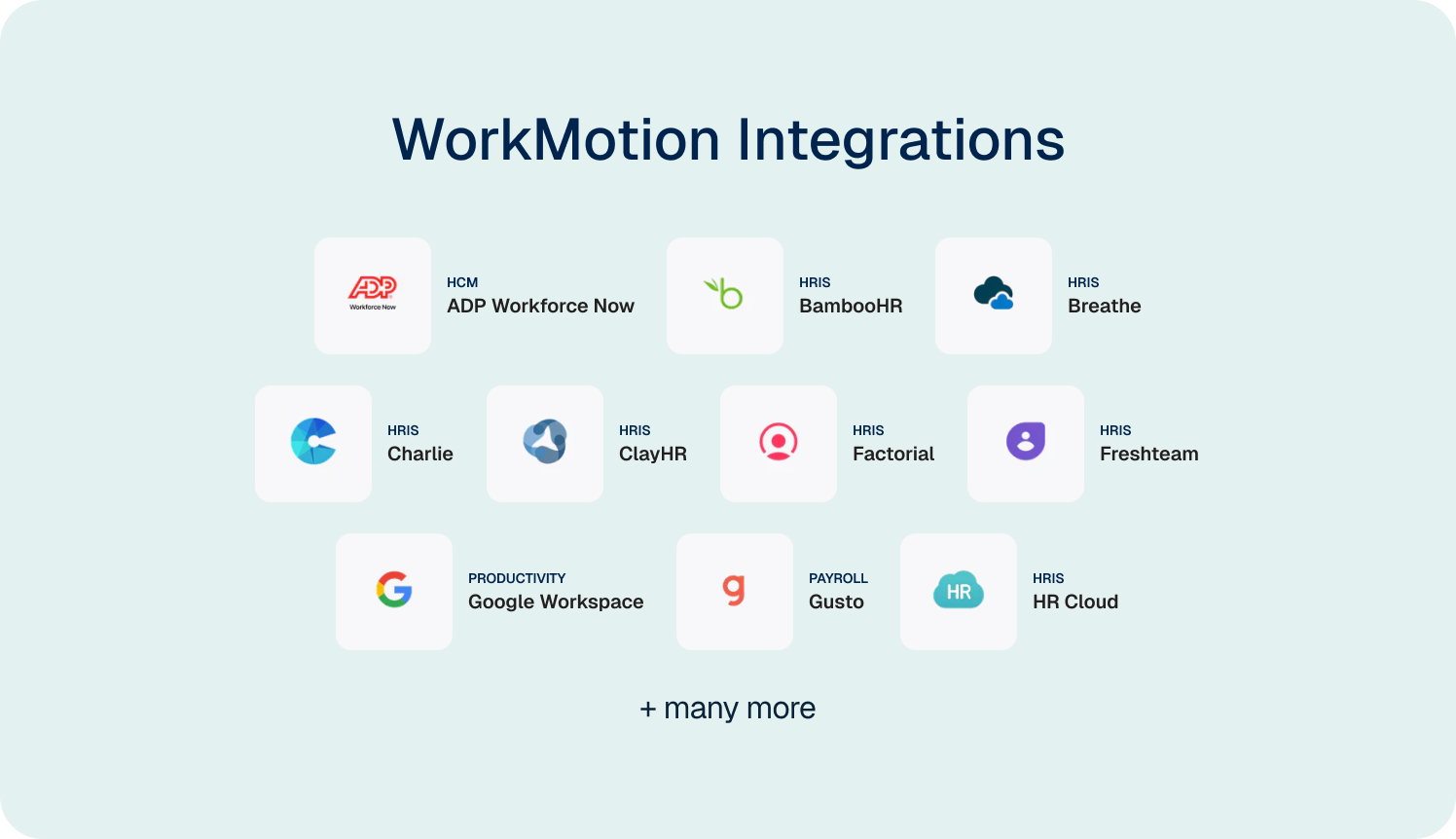
WorkMotion integrates with leading HRIS, HCM, and payroll platforms including Workday, HiBob, Personio, BambooHR, ADP Workforce Now, and Gusto.
Rather than acting as an all-in-one HR suite, it positions itself as the compliant global employment layer that connects with the systems organisations already use, allowing HR teams to preserve existing workflows while managing international employment through a single provider.
Deel
Platform breadth is one of Deel’s biggest competitive strengths. In addition to Employer of Record services, it includes contractor management, global payroll, immigration support, equity administration, and a built-in HRIS. Combined with an extensive integration ecosystem, public API, and workflow automation tools, Deel is particularly attractive for organisations looking to consolidate multiple workforce products onto a single platform.
Papaya Global
Papaya integrates with a wide range of HR, ERP, accounting, and payroll systems, reflecting its finance-first positioning. Its standout capability is consolidating workforce cost data from multiple countries into unified reporting dashboards that support budgeting, forecasting, and board-level financial oversight. Organisations primarily focused on payroll visibility may find this especially valuable, while smaller HR teams may not require the same level of reporting sophistication.
| Platform | Native Integrations | API | Standout Capability |
|---|---|---|---|
| WorkMotion | Extensive HRIS and payroll integrations | Yes | Compliance layer alongside existing HR systems |
| Deel | Extensive | Yes | Broad workforce platform |
| Papaya | Extensive finance and ERP integrations | Yes | Payroll analytics and workforce reporting |
Key takeaway: Choose the platform that complements your existing HR and finance systems. If you already have an established HRIS, a focused EOR layer may offer greater flexibility than replacing multiple tools with an all-in-one platform.
Features and integrations are easier to evaluate when you can see how they work in practice. If you’d like a closer look before speaking with sales, explore WorkMotion’s interactive Product Tour to see how onboarding, compliance management, payroll, and employee administration work across the platform.
What WorkMotion Brings That Deel and Papaya Don’t
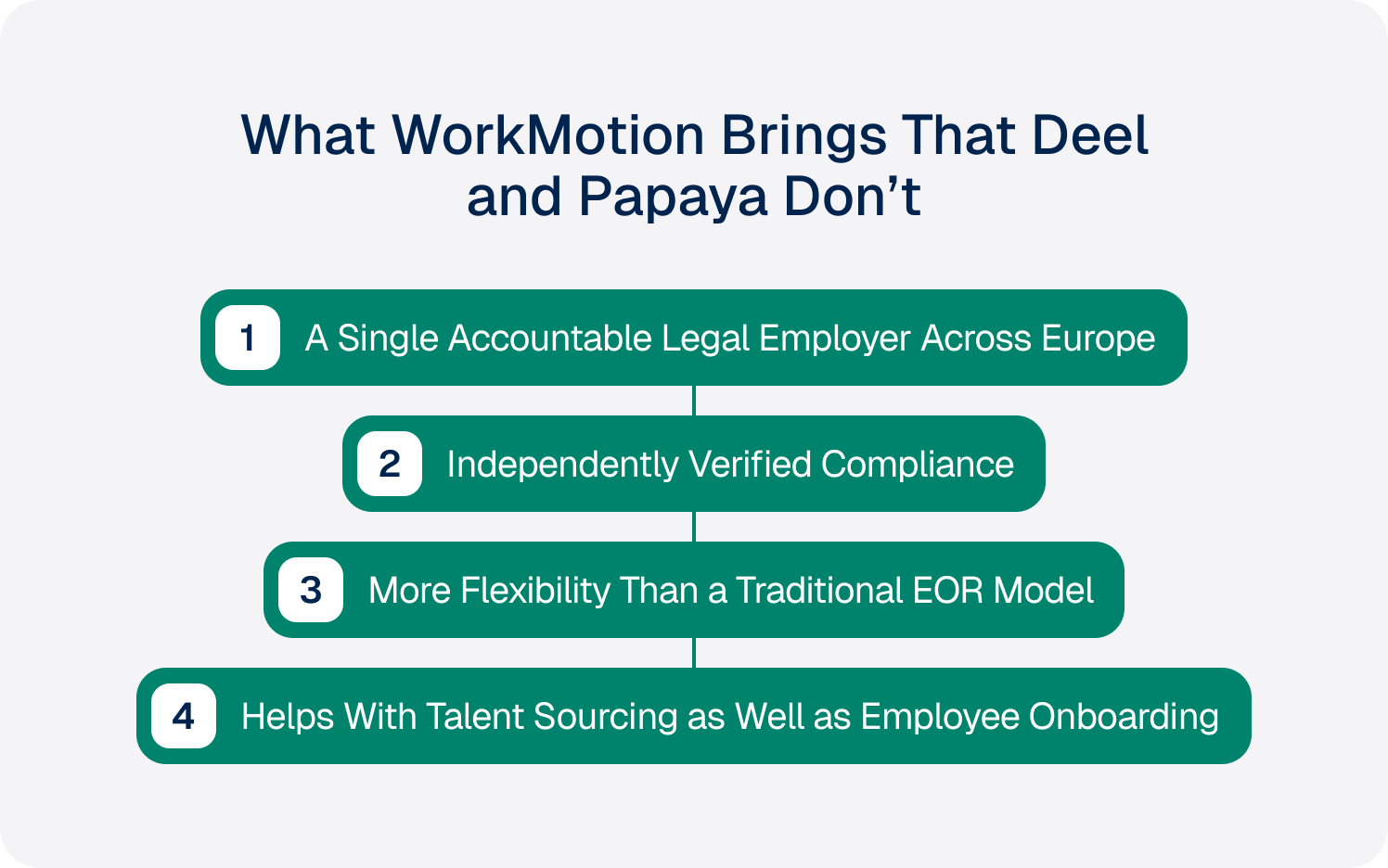
After comparing Deel and Papaya feature by feature, a clear pattern emerges. Both platforms have genuine strengths: Deel excels at workforce consolidation, while Papaya stands out for payroll intelligence and financial reporting.
However, neither is designed around the specific challenge facing many European SMEs: hiring internationally while maintaining clear legal accountability, predictable compliance processes, and direct control over the employment relationship.
This is where WorkMotion takes a different approach. Rather than competing on the number of HR features or the breadth of payroll analytics, it focuses on reducing the operational and compliance complexity that often arises after an international hire is made.
1. A Single Accountable Legal Employer Across Europe
One of the biggest challenges with international hiring is understanding who is ultimately responsible when something goes wrong. In some models, employment is delivered through a network of local partners, creating an additional layer between the customer and the legal employer.
WorkMotion addresses this through owned entities across key European markets, with licences held directly by the employing entity. This means the organisation signing the employment contract is also responsible for payroll, statutory benefits, labour law compliance, and employee administration. For HR and legal teams, that creates a clearer accountability chain and removes many of the questions that arise when employment is routed through multiple parties.
2. Independently Verified Compliance
Most Employer of Record providers talk extensively about compliance. Far fewer have their compliance processes independently assessed by a third party.
WorkMotion is the only provider in this comparison with IEC Gold Certification, an independent certification that evaluates employment and compliance processes against recognised standards. While certification does not remove the need for due diligence, it provides an additional level of transparency for organisations that want external validation rather than relying solely on vendor claims.
For companies hiring into regulated European markets, this can be particularly valuable when assessing risk and demonstrating governance to internal stakeholders.
3. More Flexibility Than a Traditional EOR Model
Many providers effectively offer a single route to international hiring: use their Employer of Record service or establish your own entity.
WorkMotion provides three distinct employment models, allowing businesses to choose the structure that best fits their growth stage and long-term strategy:
| Service | Best For |
|---|---|
| Employer of Record | Hiring internationally without establishing a local entity |
| Direct Hiring | Employing workers through your own brand while avoiding the complexity of creating a local subsidiary |
| Contractor Management | Managing international contractors compliantly across multiple markets |
This flexibility is particularly useful for organisations whose workforce strategy is evolving, allowing them to move between employment models without changing providers.
4. Helps With Talent Sourcing as Well as Employee Onboarding
For many companies, the challenge starts before employment. Finding qualified candidates in a new market can be just as difficult as hiring them compliantly.
Through its sister platform, SynMatch AI, WorkMotion extends beyond employment infrastructure into talent acquisition.
SynMatch helps businesses identify and match with international candidates, while WorkMotion provides the compliant employment framework needed to onboard and manage those hires.
SynMatch AI costs 10% of an employee’s salary, while traditional agencies charge between 20-30%. However, it’s also free for WorkMotion customers.
WorkMotion in Action
Qonto, a European fintech serving more than 600,000 businesses across eight markets, partnered with WorkMotion to address their scaling challenges.
As the company expanded its engineering team, it found that many of the best candidates were located outside the countries where it already had legal entities. Rather than limiting recruitment or creating new entities in every market,
Qonto partnered with WorkMotion to combine Employer of Record and Direct Hiring services, enabling compliant hiring across countries including Portugal, Belgium, Poland, and Romania.
“The idea was to find a partner that can support us in countries in which we don’t have a legal entity, and to be compliant and fast at the same time. We found this solution with the Employer of Record, and in particular with WorkMotion… WorkMotion knows exactly what the best practices are in those countries, and offers a complete service in each country in which we decided to hire people.” — Andrea Pavesi, People Operations Manager at Qonto
As international hiring becomes more competitive, organisations need more than an Employer of Record; they need a partner that supports the entire journey, from finding talent to employing people compliantly in new markets. That’s the broader role WorkMotion is designed to play, helping businesses reduce complexity while creating a more scalable approach to global workforce management.
If you’d like to see how WorkMotion answers those questions for your target markets, book a demo with one of our experts. We’ll walk you through the platform, explain how our employment model works, and provide country-specific guidance based on your hiring plans.
Which Provider Fits Your Situation
By now, it’s clear that there isn’t a single “best” Employer of Record. Each provider has been built with a different customer in mind, which means the right choice depends less on the length of the feature list and more on your hiring strategy, internal processes, and appetite for compliance risk.
If your priority is consolidating HR operations into one platform, your decision may look very different from an organisation whose legal team is focused on entity ownership and regulatory accountability. Likewise, a finance-led multinational managing payroll across dozens of countries will have different requirements from a growing European SME making its first international hires.
The matrix below summarises where each platform is the strongest fit based on the scenarios we’ve explored throughout this comparison.
| Business Situation | WorkMotion | Deel | Papaya Global |
|---|---|---|---|
| SME hiring into Europe with compliance as the priority | Best fit | Good option where entity structure aligns with your target markets | Suitable, but enterprise-focused and partner-based |
| Need to manage EOR, contractors, payroll, and HRIS in one platform | Focused EOR platform that integrates with existing HR systems | Best fit | Strong payroll, but not designed as an all-in-one workforce platform |
| Enterprise finance team needing multi-country payroll consolidation and workforce cost analytics | Strong compliance and payroll support | Broad payroll capabilities | Best fit |
| Need a single accountable legal employer with owned entities and independent compliance certification | Best fit | Verify entity ownership by country | Partner network means the local partner is the legal employer |
Looking at the comparison as a whole, the providers separate into three distinct categories.
- Choose WorkMotion if your organisation is hiring into Europe and wants the reassurance of owned entities across key markets, direct legal accountability, and independently verified compliance. Its strength isn’t having the broadest HR platform—it’s reducing the operational and compliance complexity that often comes with international hiring.
- Choose Deel if your objective is to consolidate multiple workforce functions into a single platform. Its combination of Employer of Record services, contractor management, payroll, and HRIS makes it one of the strongest options for organisations looking to simplify workforce operations, particularly if they’re managing a mix of employees and contractors across multiple countries.
- Choose Papaya Global if you’re a larger organisation with a finance-led operating model and payroll visibility is your highest priority. Its payroll intelligence, workforce analytics, and consolidated reporting capabilities are particularly valuable for multinational businesses that need detailed cost reporting across complex international operations.
Ultimately, the decision comes down to the problem you’re trying to solve. If you’re primarily comparing Deel vs Papaya, ask whether you need platform breadth or enterprise payroll intelligence. If your priority is compliant hiring in Europe with a clear legal employer and direct accountability, WorkMotion offers a different approach; one built around employment infrastructure rather than platform consolidation or payroll analytics.
Get Started With WorkMotion Today
While Deel excels at workforce consolidation and Papaya offers powerful payroll intelligence for enterprise organisations, WorkMotion is built around a different priority: providing a compliant employment infrastructure for companies hiring into Europe.
That means owned entities across key European markets, independently verified compliance through IEC Gold Certification, onboarding in as little as 3 to 5 business days, transparent country-specific pricing before you commit, and consistently high customer satisfaction, reflected in WorkMotion’s service metrics.
Rather than asking you to estimate the true cost of employment or verify who the legal employer will be after signing, WorkMotion puts those details at the centre of the buying process.
If you’re ready to see how WorkMotion would support your hiring plans, book a demo with one of our experts. We’ll walk you through the platform, explain how our employment model works in your target markets, and provide a tailored overview of expected employment costs.


















![idWjC-9cC6_logos 1 [Vectorized]](https://workmotion.com/wp-content/uploads/2026/02/idWjC-9cC6_logos-1-Vectorized.svg)