

Prior to 6 April 2026, it was safe for a People Ops lead to engage a UK contractor through an umbrella company, assume payroll and tax were handled, and move on. Now, new rules under the Finance Act 2026 move tax liability up the supply chain, meaning HMRC can pursue the end client directly if the umbrella defaults on PAYE.
The stakes are real, and they sit with the employer, not the contractor. This article covers what an umbrella company is, how umbrella pay works, what changed in April 2026, and how umbrella compares to direct employment and EOR for UK employers hiring contractors inside IR35.
What Is an IR35 Umbrella Company?

An IR35 umbrella company is a PAYE employer that sits between the end client and the contractor. It handles payroll, tax deductions, and statutory entitlements. For many contractors, an umbrella company UK setup is the simplest way to remain compliant when caught inside IR35.
The supply chain typically runs from end client to recruitment agency (optional) to umbrella company to contractor. The contractor becomes an employee of the umbrella and receives a net salary after all statutory and umbrella deductions are applied.
When a PSC Makes More Sense (And Doesn’t)
The alternative is the contractor’s own limited company, also known as a personal service company (PSC). This is the most tax-efficient model, letting the contractor pay themselves through salary and dividends to reduce their income tax and national insurance burden.
The trade-off is administrative responsibility such as Companies House filings, annual accounts, and self-assessment. That said, the contractor can claim certain business expense deductions. The 5% expense allowance that helped cover administration costs was removed for medium and large organisations, though it still applies for small company engagements and overseas clients.
Most contractors use an umbrella company when caught inside IR35, because the end client needs a PAYE-compliant payroll mechanism and the contractor loses the tax advantages of dividends.
For the end client, a PSC engagement outside IR35 means no PAYE obligation and no supply chain liability, but the client must still issue a Status Determination Statement (SDS) explaining why the engagement falls outside IR35.
What the Government Data Shows
IR35 became law in 2000 and was extended to the private sector in April 2021, shifting status-determination responsibility to medium and large end clients.
Government analysis estimates around 45,000 fewer new personal service companies were formed around the reform period up to March 2022, and roughly 280,000 workers moved from their own PSC payroll to being paid by another organisation’s payroll between October 2019 and March 2022. The reform drove about 40% of those moves.
It’s not as if those workers disappeared. They simply shifted into umbrella companies, agency PAYE, or direct employment.
Does IR35 Apply to Umbrella Company Employees?
Umbrella company employees are already on PAYE, so IR35 rules apply to the status determination. That means whether the engagement is inside IR35 or outside, rather than the payroll mechanism itself. Being on an umbrella doesn’t, on its own, resolve the status question.
It’s tempting to say umbrella company workers don’t need to worry about IR35. While that’s partially true, as the contractor’s PAYE status removes their personal IR35 exposure, the hiring business still carries the status determination duty.
And from 6 April 2026, that includes the supply chain liability that comes with it. For employers using an umbrella, you can’t try to outsource the status decision by routing a contractor through an umbrella.
How Umbrella Pay Works: Assignment Rate to Net Pay
Understanding how umbrella companies work means following the money from the assignment rate to the contractor’s take-home pay. The day rate is the total amount the agency pays the umbrella for the contractor’s work, and it forms the contract income from which all deductions flow.
From that rate, the umbrella deducts its margin and all employer-side costs before arriving at the contractor’s gross pay. Then employee-side deductions are applied to reach the net pay. The umbrella must deduct PAYE tax and employee national insurance at the correct amount, and the PAYE tax and tax rules that apply are the same way as for any other employee on the UK payroll.
Here’s an example using a £500/day rate, assuming 5 days per week and 48 working weeks per year (240 days):
| Line item | Annual amount | Weekly equivalent |
|---|---|---|
| Assignment rate (£500/day × 240 days) | £120,000 | £2,500 |
| Less umbrella company margin (£25/week × 48) | -£1,200 | -£25 |
| Less employer NI contributions (15% above £5,000) | -£13,161 | -£274 |
| Less apprenticeship levy (0.5% above £15,000 allowance) | -£389 | -£8 |
| Less employer pension contributions (3% of qualifying earnings) | -£1,303 | -£27 |
| Less holiday allocation (12.07% of gross pay) | -£11,192 | -£233 |
| Gross pay | £92,755 | £1,932 |
| Less employee national insurance (8% to UEL, 2% above) | -£3,866 | -£80 |
| Less income tax (20% basic, 40% higher) | -£24,532 | -£511 |
| Less employee pension (5% of qualifying earnings) | -£2,172 | -£45 |
| Net pay (take-home) | £62,185 | £1,296 |
The flat fee umbrella margin is a relatively small part of the deduction. The biggest reductions instead come from employer NI contributions and income tax.
Holiday entitlement at 12.07% is a reallocation from the day rate, not an additional cost. Some umbrellas offer salary sacrifice pension arrangements that pass employer NI savings back to the contractor, which can slightly improve take-home pay.
An umbrella company calculator can help estimate these figures, but employers should note that it doesn’t factor in supply chain liability, fraud risk, and the 2026 due diligence requirements.
What Changed on 6 April 2026?
From 6 April 2026, HMRC can recover unpaid PAYE and NI contributions from a “relevant party” in the supply chain if the umbrella company fails to pay. The liability operates on a joint and several liability basis. That means HMRC can pursue the relevant party for the full amount regardless of fault.
In most cases, the relevant party is the recruitment agency that contracts directly with the end client. Where there’s no qualifying agency in the chain, or the agency is offshore or connected to the umbrella, the end client itself becomes the relevant party. The rules apply to payments made on or after 6 April 2026, with no grace period and a four-year look-back period.
From 6 April 2026, HMRC can recover unpaid tax from the end client if the umbrella fails to pay. Document your due diligence before each engagement.The legislation is designed to tackle non-compliance in the umbrella company market, particularly mini-umbrella fraud and tax avoidance schemes. The reform has already generated significant revenue for HMRC.
According to government estimates, the additional tax, NICs, and Apprenticeship Levy generated by the reform was around £4.2 billion up to March 2023, with workers who moved to another payroll seeing an average annual increase of roughly £10,000 in combined tax and employer costs.
“£4.2 billion tells you this isn’t a soft enforcement exercise. HMRC has the data, the mandate, and now the mechanism to pursue employers directly. If you’re still treating umbrella due diligence as a paperwork exercise, you’re underestimating what’s changed.” — Ryan Cross, Market Lead UKI, WorkMotion
The 2026 extension of liability up the supply chain is a continuation of this enforcement trajectory, not a standalone measure. The government introduced these measures because non-compliant umbrellas were deducting PAYE tax from contractors but not remitting it to HMRC, which left the end user and other organisations in the supply chain exposed.
Employers need to be aware that even with thorough due diligence, you can still be liable if the umbrella defaults. The only way to mitigate exposure is to work with compliant umbrella companies that hold recognised accreditations. Or, use an alternative model like an employer of record (EOR) where the compliance obligation sits with a single accountable party.
What Umbrella Employees Are Entitled To
Because umbrella company employees are on PAYE, they receive full statutory employment rights. These include statutory sick pay, holiday pay and holiday entitlement (5.6 weeks per year, calculated at 12.07% of gross pay), workplace pension auto-enrolment, and parental leave.
An umbrella also maintains continuous employment across multiple employment contracts, which the contractor loses when moving between separate limited-company engagements.
This continuity matters for a contracting career, where gaps between assignments are common and hours worked can vary week to week. It means the contractor accrues employment protections and service-based rights even as they move between assignments.
For the end client, these entitlements are the umbrella’s responsibility, not yours. The umbrella is responsible for ensuring they’re provided. But you should confirm they’re actually being provided as part of your due diligence.
A non-compliant umbrella that skips pensions or withholds holiday entitlement is both mistreating the contractor and creating a liability that could flow back to you under the 2026 rules.
Due Diligence Checklist: Engaging a Compliant Umbrella
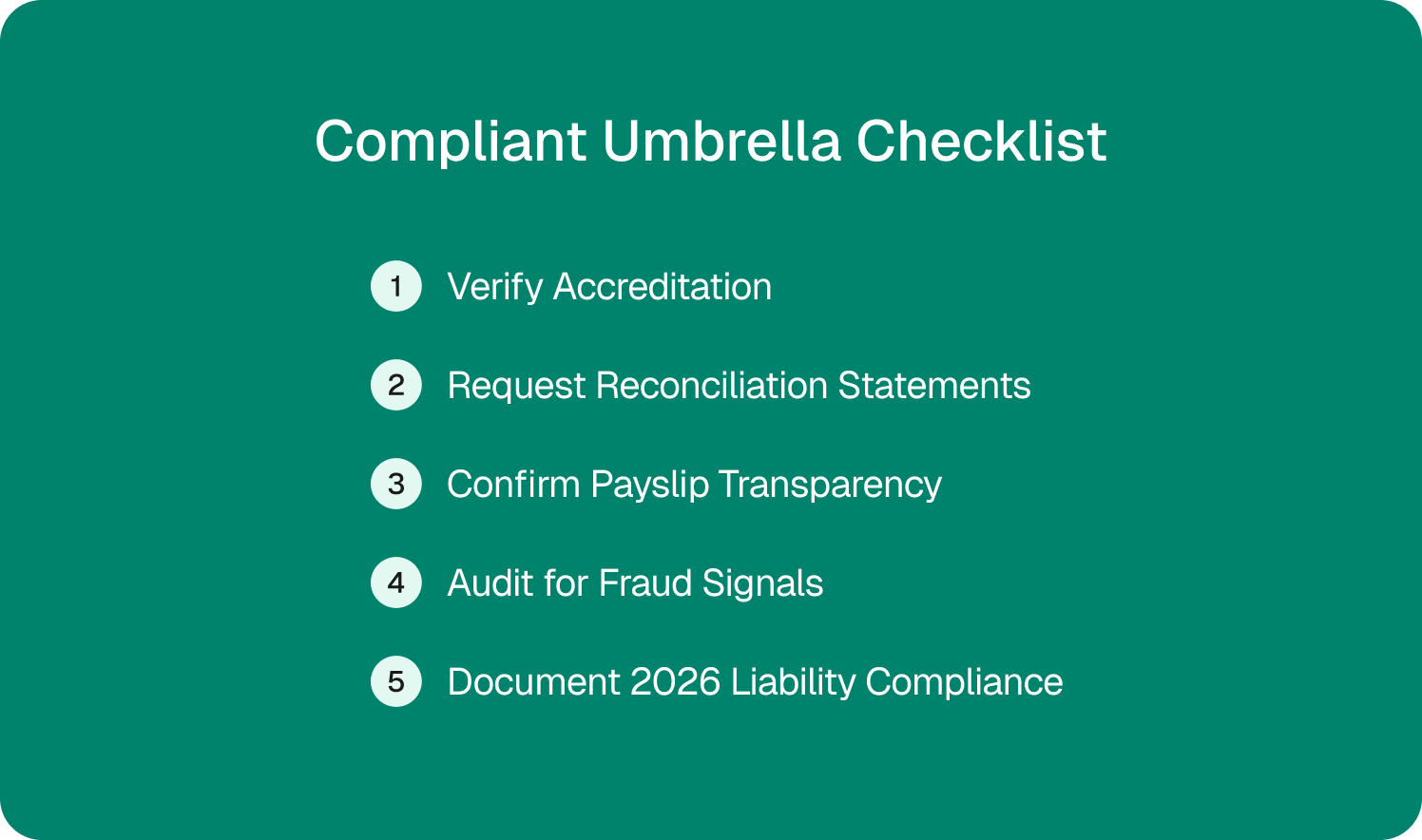
Before engaging an umbrella company, there are five steps you should run through to build a defensible compliance position:
1. Verify Accreditation
Check that the umbrella holds FCSA accreditation, SafeRec certification, or Professional Passport membership. These are the three recognised trust signals in the UK umbrella market:
- FCSA accreditation involves independent audits against published Codes of Compliance.
- SafeRec provides real-time payslip auditing verified against HMRC data.
- Professional Passport evaluates financial stability and contractual transparency.
2. Request Reconciliation Statements
Ask the umbrella to provide reconciliation statements that show how much was received from the agency or end client, how much was paid to the contractor, and how much was remitted to HMRC. This is the document that proves the umbrella is actually paying over what it deducts.
3. Confirm Payslip Transparency
Every payslip should clearly itemise the following:
- Assignment rate
- Umbrella margin
- Employer NI contributions
- Apprenticeship levy
- Pensions
- Holiday entitlement
- Gross pay
- Employee NI
- Tax
- Net salary
If any line is missing or opaque, that’s a red flag.
4. Audit for Fraud Signals
Watch for unrealistic take-home pay rates (anything above 80% is almost certainly a disguised remuneration scheme), split payments where part of the income is labelled as a non-taxable “loan” or “annuity,” and salary sacrifice arrangements that seem too good to be true.
These are tax avoidance schemes that HMRC will eventually unwind, leaving the contractor with a tax bill and potentially creating liability for the end client.
5. Document 2026 Liability Compliance
Keep records of your due diligence for each engagement. Under the new rules, HMRC can look back four years. If the umbrella defaults, your documentation is the only evidence you acted responsibly, though it won’t discharge strict liability.
Book a demo with WorkMotion to see how an EOR model eliminates the need for umbrella supply chain due diligence entirely.
Umbrella vs Direct Employment vs EOR: Which Model Fits?
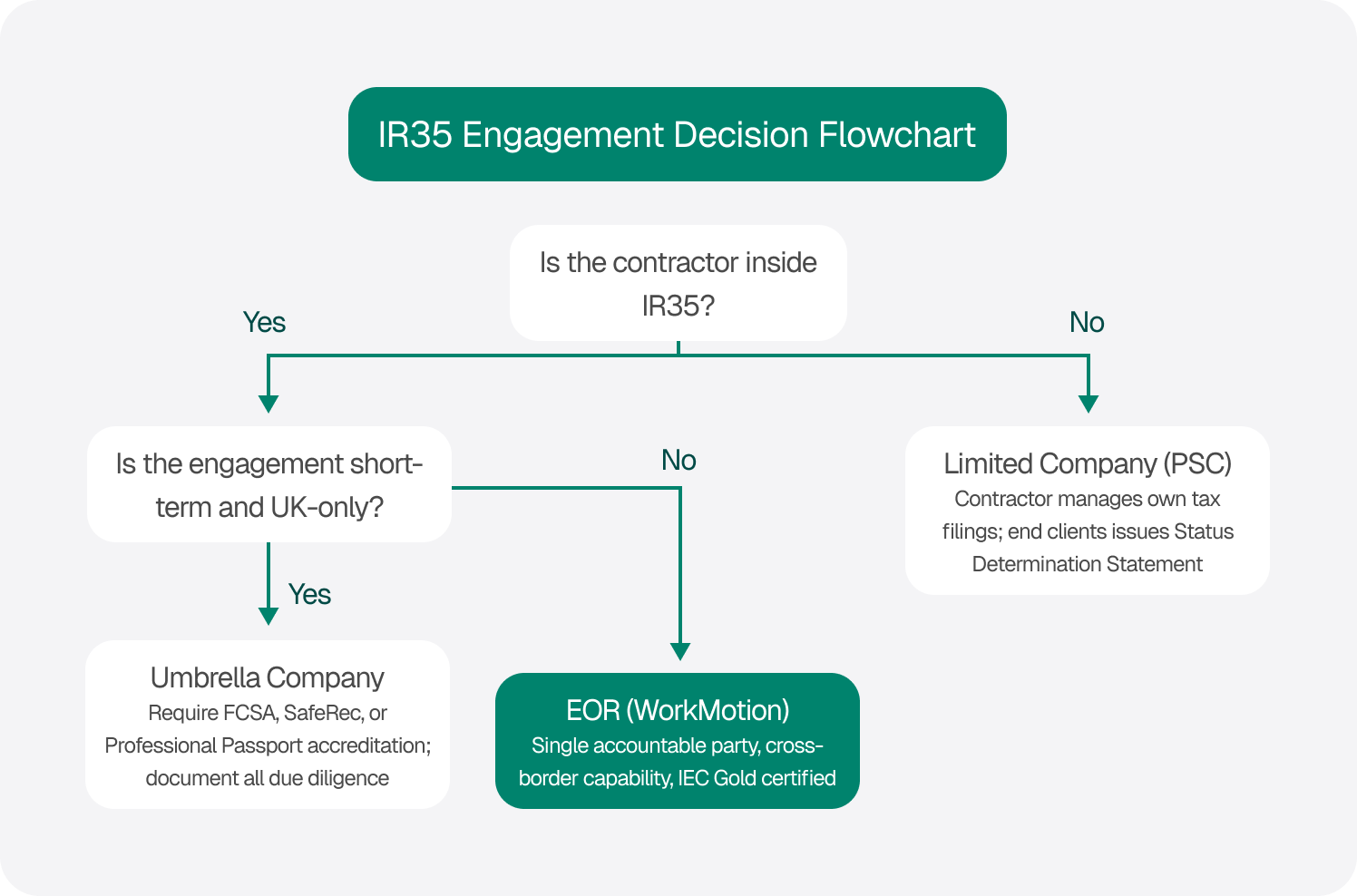
The right engagement model depends on IR35 status, engagement length, and whether you need cross-border capability. For contractors genuinely outside IR35, a PSC remains the most tax-efficient route, as covered earlier.
For inside-IR35 engagements, here’s how the three main options compare:
| Factor | Umbrella Company | Direct PAYE Employment | EOR (WorkMotion) |
|---|---|---|---|
| IR35 liability holder | Shared (umbrella + agency/end client under JSL) | You (the employer) | WorkMotion (as legal employer) |
| Employer NI responsibility | Umbrella (from day rate) | You | WorkMotion |
| Onboarding speed | Days | Weeks (PAYE setup) | 3–5 business days |
| Supply chain risk | Yes, liability can flow back to end client | None (direct relationship) | None (single accountable party) |
| Cross-border capability | UK-only | UK-only (unless you have entities abroad) | 160+ countries |
| Cost transparency | Assignment rate minus deductions | Gross salary + employer on-costs | Transparent per-employee pricing |
Workers who moved to another organisation’s payroll because of the reform faced an average annual increase of roughly £10,000 in combined tax, NICs, and Apprenticeship Levy. This was broadly split between additional taxes borne by the worker and employer-side costs like Employer NICs and the Apprenticeship Levy.
For employers weighing umbrella against EOR, that figure quantifies the real cost of the reform’s shift, not just the compliance burden.
The Limited Company (PSC) Route
When a contractor is outside IR35, they can operate through their own limited company (PSC). This is the most tax-efficient model for the contractor, who can pay themselves a combination of salary and dividends, reducing their overall income tax and national insurance burden.
A self-employed contractor operating through a PSC has more control, but that comes with more responsibility. The contractor must file annual accounts with Companies House, submit a self-assessment tax return, and manage their own payroll if they draw a salary.
For the end client, a PSC engagement outside IR35 means no PAYE obligation and no supply chain liability. But the client must still issue a Status Determination Statement (SDS) explaining why the engagement falls outside IR35.
Book a demo with WorkMotion to explore the EOR alternative for your UK contractor engagements.
How WorkMotion Handles IR35 as Your Legal Employer
When a UK contractor is engaged through WorkMotion’s EOR, WorkMotion is the PAYE-registered employer and is directly accountable for IR35. The status determination and payroll compliance sit with WorkMotion as the licensed legal employer, not with the end client through a chain of third parties.
This is fundamentally different from the umbrella supply chain model, where liability can flow back to the end client if the umbrella fails. With WorkMotion, there’s only one accountable party, and that party is the one you contract with.
WorkMotion is the first and only global EOR to hold the IEC Gold Certificate, an independently audited compliance standard from The IEC Group. The certification covers 10 audit sections, including legal licensing, employment law, tax and payroll, and data protection. It’s externally verified through independent assessment, not self-declared.
WorkMotion also operates through its own entities in key markets. This means the party you contract with is the party accountable in an IR35 dispute or audit. With 3–5 business day onboarding and a single accountable legal employer, the difference between an audited EOR model and a supply chain where you carry residual 2026 liability is clear.
IR35 is the UK’s framework, but it isn’t unique. Every country where you might hire contractors has its own version. Germany has AÜG, Spain has its labour leasing rules, Italy has staff-supply regulations, and the misclassification risk follows the same pattern in each.
WorkMotion’s compliance model applies the same principle across all 150+ countries it operates in. There’s one accountable legal employer, locally licensed, handling status determination and payroll compliance under the correct national law.
For employers weighing independent contractor vs employee status, WorkMotion’s EOR model provides a compliant path that doesn’t require you to manage the process yourself or rely on a chain of intermediaries.
Get Started With WorkMotion Today
For 1–5 UK contractors caught inside IR35 on short-term, UK-only engagements, a compliant umbrella company with proper accreditation may suffice, provided you document your due diligence.
For longer-term engagements, cross-border hiring needs, or when you want a single accountable party rather than a supply chain with residual liability, an EOR is the stronger model.
HMRC can now pursue the agency for unpaid PAYE if the umbrella defaults, with no grace period and a four-year look-back. WorkMotion’s EOR model eliminates that risk by making WorkMotion the legal employer, with IEC Gold Compliance Certification, transparent pricing, and quick onboarding.
If your company engages UK contractors inside IR35 and needs a defensible, audited compliance model, WorkMotion’s EOR and Contractor Management services are worth evaluating. Book a demo to see how it works.


















![idWjC-9cC6_logos 1 [Vectorized]](https://workmotion.com/wp-content/uploads/2026/02/idWjC-9cC6_logos-1-Vectorized.svg)