

A contractor who works only for your company, attends internal meetings, and follows your schedule may already appear to local authorities to be an employee. That’s where independent contractor vs. employee classification becomes risky, especially across Europe, where labor laws vary by country.
If authorities decide the role qualifies as employment instead of an independent contractor relationship, your business could face back taxes, penalties, workers’ compensation claims, and retroactive employee benefits.
In this article, you’ll learn how to spot risky contractor setups early, apply the right classification framework, and choose between contractor management and direct hiring before compliance problems start.
What’s the Difference Between an Employee vs Independent Contractor?
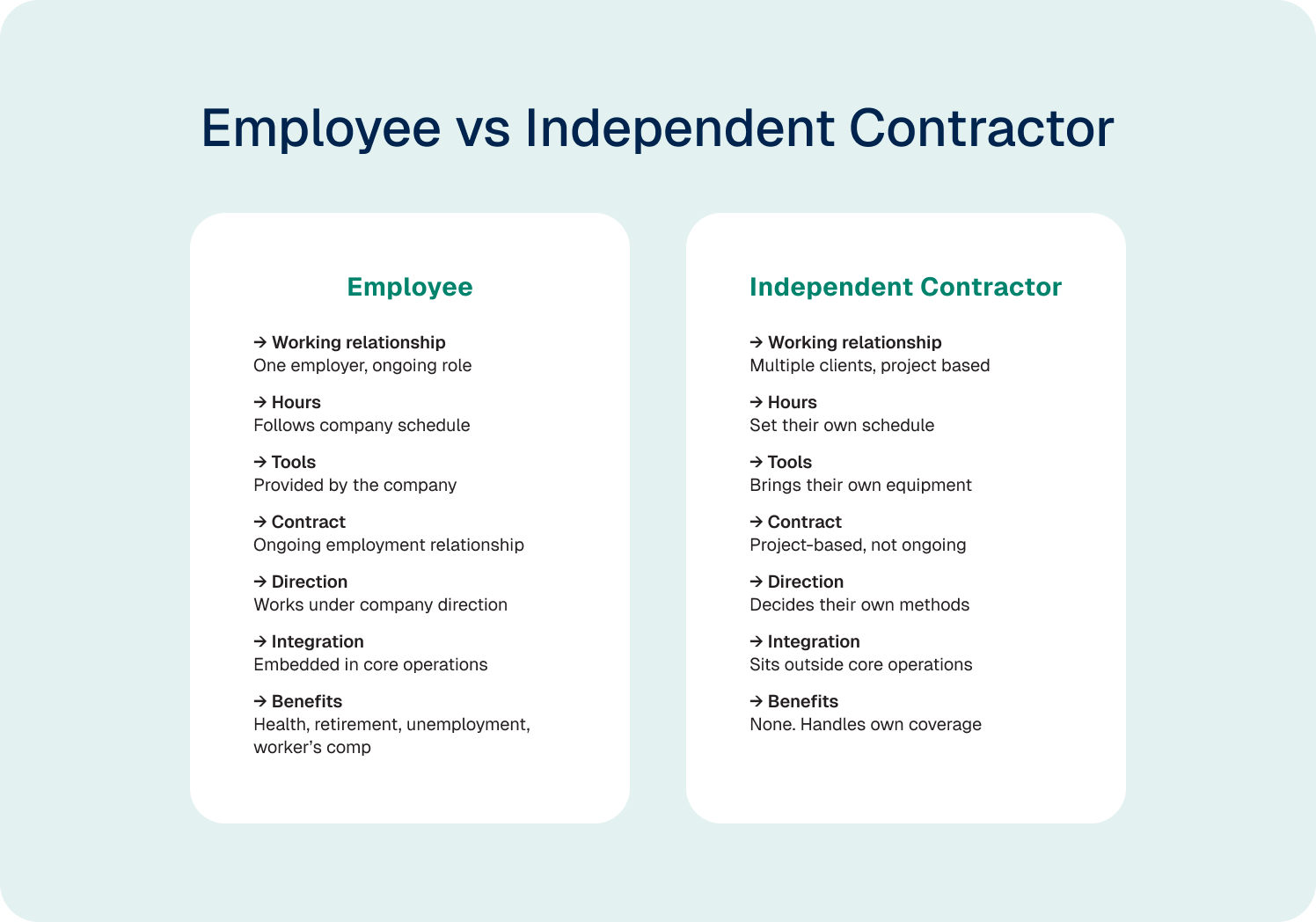
The employee vs. independent contractor decision depends on the real work relationship, not job titles or a written contract. Most countries apply some version of the economic reality test to assess control, independence, and whether the worker is economically dependent on the employer’s business.
What’s an Independent Contractor?
An independent contractor usually works independently for multiple clients. They often use their own tools, control their hours, and work under project-based contracts rather than an ongoing employment relationship. Many global businesses use contractors for flexible hiring needs.
What’s an Employee?
An employee works under a more structured employment relationship where the company controls how work is performed and integrated into business operations.
Employees typically:
- Work under company direction
- Follow internal processes and schedules
- Support ongoing business operations
- Receive benefits like health insurance, retirement plans, unemployment insurance, and workers’ compensation coverage
Businesses expanding internationally often use an employer of record for compliant hiring without setting up a local entity.
Independent Contractor vs. Employee: at a Glance
The fastest way to understand worker classification is to compare how each model handles control, taxes, benefits, and legal protections. Here’s a side-by-side breakdown of the most important differences.
| Aspect | Employee | Independent contractor |
|---|---|---|
| Control | The employer controls how, when, and where work is performed. | The contractor controls their own hours, process, and work performed. |
| Payment | Paid through payroll with taxes withheld. | Paid by invoice and manages own taxes and self-employment tax. |
| Benefits | Usually eligible for employee benefits like health insurance, retirement plans, paid leave, and unemployment benefits. | Does not typically receive benefits through the hiring company. |
| Tools and equipment | The company usually provides systems, software, and equipment. | Often uses own tools and resources. |
| Tax responsibility | The employer handles payroll taxes, social security and Medicare contributions, and employment tax reporting. | Responsible for tax filings, deductions, and tax obligations. |
| Relationship length | Often ongoing and tied closely to business operations. | Usually project-based or tied to specific services provided. |
| Integration | Becomes part of the employer’s business and internal structure. | Operates independently and may work with multiple clients. |
| Legal protections | Covered by labor laws tied to minimum wage, overtime pay, and workers’ compensation. | Usually receives fewer employment protections under local labor laws. |
This comparison is a useful starting point, but no single factor determines worker classification on its own. Many businesses also review local employment contracts and country-specific compliance requirements before onboarding international talent.
How Classification Works Differently Across Europe

Worker classification rules vary across Europe. A setup that works for an independent contractor in one country may create compliance risks in another, even when the work performed looks the same.
Germany: Strict Dependency Rules
Germany closely examines whether an employer-employee relationship exists, especially when contractors work long-term for a single client.
Authorities often review:
- Whether workers use their own tools
- Whether they control their own hours
- Whether they support the employer’s business
- Whether they rely on multiple clients for income
Even with a written contract, authorities may decide the worker is an employee if the arrangement shows too much financial control or dependency. Companies planning to hire in Germany often review contractor structures before onboarding.
Spain: TRADE and Social Security Scrutiny
Spain places a strong focus on social security enforcement and whether the contractor operates as an independently established trade.
Authorities often review:
- Whether workers provide services to other businesses
- Whether they carry business risk
- Whether they control how services provided are delivered
Misclassified workers can create back taxes, workers’ compensation exposure, and employee benefits liabilities. Businesses planning to hire in Spain should review contract terms carefully before engaging long-term contractors.
Poland: Employment Presumptions
Poland focuses on the real employment relationship, not the agreement label.
Courts often assess:
- Whether the worker follows company direction
- Whether the role supports core business operations
- Whether the worker functions like a regular employee
That can trigger employment tax liabilities, taxes withheld corrections, and workers’ compensation obligations. Companies planning to hire in Poland often compare contractor setups against local employment models before scaling teams.
United Kingdom: IR35 Off-Payroll Rules
The UK uses IR35 rules to determine whether a worker should be treated as an employee or an independent contractor for tax purposes.
Authorities usually examine:
- Control over the work relationship
- Substitution rights
- Business risk
- Independence from the company’s business
If IR35 applies, payroll taxes, self-employment tax liabilities, and social security and Medicare-style obligations may shift back to the hiring company. Businesses planning to hire in the UK should review contractor arrangements early.
Examples From Other Countries Applying Different Standards
Throughout Europe, independent contractor and employee rules differ greatly:
- France examines dependency and integration
- Italy reviews supervision and permanence
- The Netherlands focuses heavily on authority and independence
No single factor determines worker classification across Europe. A setup that qualifies in one country may fail in another, especially as teams grow or contract changes expand the role.
Real Examples: Contractor-Like vs. Employee-Like Remote Roles
Remote roles can look flexible on paper but employee-like in practice. These examples show where the signals usually shift.
| Role | Contractor-Like Signals | Employee-Like Signals |
|---|---|---|
| Engineering | Brought in for specialized skills, owns delivery, uses their own workflow, and works with other clients. | Joins daily standups, sits in team Slack channels, follows sprint planning, and works only for your company. |
| Sales | Hired to advise on market entry, build a playbook, or support a fixed project. | Owns a territory, works to a quota, uses your CRM daily, and reports to your sales manager. |
| Marketing | Delivers a defined campaign, asset, or audit with clear contract terms. | Needs approval for every task, follows internal brand workflows, and works like part of the core team. |
The issue isn’t one signal on its own. Risk builds when the role becomes permanent, closely managed, and central to daily operations.
That’s when misclassified workers can create significant legal exposure, benefits eligibility claims, and workers’ compensation questions. It’s also where cost planning matters, because pricing can change once a role moves from contractor setup to compliant employment.
If the role expands, document the change early. Clear contract changes help your team track scope, control, and the worker’s status before the relationship drifts into employment.
What Misclassification Actually Costs
Employee misclassification usually looks cheaper at first. The real costs appear later, when authorities decide the worker should have been treated as an employee from the start.
That can include:
- Back taxes and unpaid payroll taxes
- Retroactive social contributions and statutory payments
- Paid leave and employee benefits arrears
- Health insurance and pension contributions
- Workers compensation liabilities
- Penalties, audits, and legal fees
- Damage to the company’s reputation
In Germany and Spain, enforcement is especially strict when contractors work long-term for one company under employee-like conditions.
If authorities decide the worker is an employee, businesses may owe years of employment tax, taxes withheld corrections, and statutory payments retroactively.
Example: Monthly Cost Comparison for One Remote Hire
| Scenario | Estimated Cost |
|---|---|
| Contractor fee (monthly) | €5,500 |
| EOR fee + employer contributions (monthly) | €7,200 |
| Reclassification penalty + back taxes (one-time) | €35,000–€80,000+ |
Example ranges vary by country, role seniority, contract duration, and local enforcement outcomes.
The biggest risk is that these costs often arrive all at once. A contractor arrangement that seemed efficient for two years can suddenly create major financial repercussions tied to tax obligations, workers’ compensation claims, and retroactive employee-status corrections.
If you’re unsure whether a role should be structured as contractor work or compliant employment, WorkMotion can help assess the risk before hiring begins. Book a demo.
Pros and Cons of Hiring an Independent Contractor
Hiring an independent contractor can give your business flexibility and faster access to specialized skills. But the model also creates compliance risks when the work relationship starts looking like employment.
| Pros | Cons |
|---|---|
| Faster onboarding for short-term projects | Higher risk of misclassified workers |
| Flexible scaling without long-term commitments | Limited control over work performed |
| Lower upfront costs compared to employment | If misclassified, workers may later claim employee benefits or workers’ compensation |
| Access to global talent and niche expertise | May create compliance risks across different labor laws |
| Useful for project-based services provided | Long-term arrangements may trigger employee status reviews |
| Contractors often use their own tools and workflows | Less oversight over day-to-day work |
Independent contractors work best when the role stays project-based, independent, and clearly separated from daily business operations. The more integrated the contractor becomes, the harder it is to support proper worker classification in the long term.
Pros and Cons of Hiring an Employee
Hiring an employee gives your business more control, continuity, and long-term stability. It also increases costs and broadens compliance responsibilities.
| Pros | Cons |
|---|---|
| Greater control over work and business operations | Harder to scale down quickly |
| Stronger long-term team integration | More exposure to leave and termination regulations |
| Better retention for strategic roles | Higher payroll taxes and contribution costs |
| Employees may receive benefits like health insurance and retirement plans | Ongoing tax obligations and compliance requirements |
| Clearer employee status under local labor laws | More administration and reporting |
The right model depends on the role and long-term hiring goals. As contractor relationships become more permanent, businesses often reassess worker classification to reduce compliance risks and avoid back taxes later.
The Decision Pathway: Contractor Management, EOR, or Direct Hiring
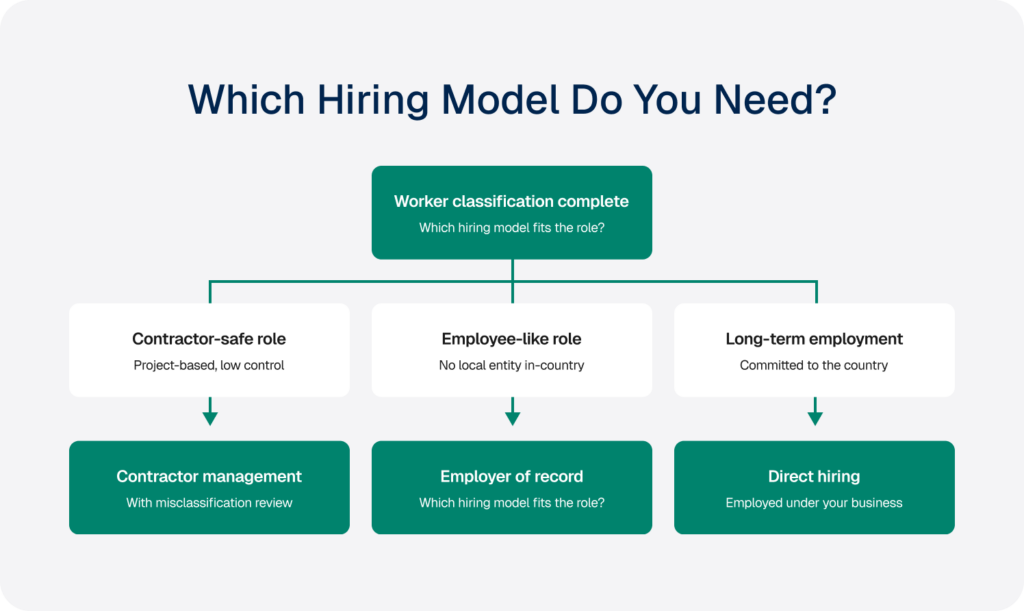
Once you determine worker classification, the next step is choosing the right hiring model.
- Contractor-safe role — Use Contractor Management with a misclassification review for project-based or low-control roles.
- Employee-like role without a local entity — Use an Employer of Record (EOR) for compliant employment and payroll handling.
- Long-term employment in Europe — Use direct hiring if you want workers employed directly under your business.
Cross-border hiring gets risky fast once contractor rules and local employment laws come into play.
If you want clarity before making your next hire, WorkMotion can help you choose the right setup for the country and role involved. Book a demo.
Start Hiring Remote Contractors or Employees With WorkMotion Today
Worker classification should happen before hiring begins, not after a dispute, audit, or reclassification claim. Once a contractor relationship starts looking like employment, the financial and operational risks grow quickly across borders.
The two biggest takeaways from this guide are simple:
- Use a country-specific classification framework, not job titles or contract labels
- Match the classification outcome to the right hiring model from the start
That means using contractors for truly independent work, EOR for compliant employment without a local entity, and direct hiring for long-term team building in Europe.
WorkMotion is built for SMEs hiring mid- to senior-level specialists in Europe, not for domestic-only hiring or low-cost outsourcing. If that’s your situation, book a 30-minute demo to find out exactly what compliant employment looks like for your next hire.


















![idWjC-9cC6_logos 1 [Vectorized]](https://workmotion.com/wp-content/uploads/2026/02/idWjC-9cC6_logos-1-Vectorized.svg)