Most organisations focus only on salaries when budgeting for a new hire, but the true cost of an employee is more than the paycheck. To accurately calculate what a hire costs, you need to factor in wages, taxes, benefits, equipment, compliance, and future workforce risks.
This matters most when you’re trying to work out the cost per employee for project pricing, client billing, or expansion planning. And if you want to know how to calculate employee cost per hour, you need every component that makes up that number.
This guide breaks down the employee cost formula, shows you how to turn it into an hourly rate, and compares the cost of hiring an employee through an EOR vs opening your own entity abroad.
What Goes Into the Cost of Employment
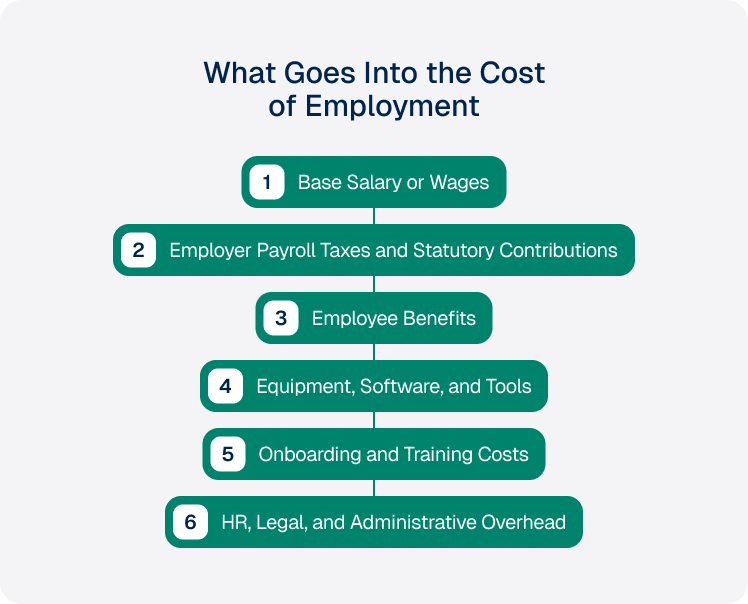
A common planning rule of thumb is that total employee cost runs 1.25 to 1.4 times base salary once taxes, benefits and overhead are included. It’s a useful benchmark, not a fixed figure. To more accurately work out how much an employee costs, you need to account for six key components. Each one adds to the full cost beyond the set salary. Add them together and you get the total annual cost, which you can then divide by productive hours to get the hourly rate an employee really costs the business.
1. Base Salary or Wages
Base compensation is the basis of calculating an employee’s cost. For salaried employees, this is the annual salary. For hourly employees, it’s the hourly wage multiplied by working hours. For example, an hourly employee earning £25 per hour with 2,080 working hours per year will have an annual base compensation of £52,000.
When calculating the employee’s base salary, include bonuses, commissions, and guaranteed allowances in the estimates for variable compensation schemes.
2. Employer Payroll Taxes and Statutory Contributions
Payroll taxes and statutory contributions make a significant portion of an employee’s actual cost and vary significantly by country. These taxes are non-negotiable and mandatory.
In the US, for example, employer taxes include Social Security and Medicare taxes, as well as unemployment insurance. These can reach thousands of dollars per employee per year. Federal taxes and government programs (like Social Security) are funded through these employer contributions. In many European countries, employers must make higher statutory contributions to social security, pensions, healthcare, unemployment insurance, and paid time off.
In international markets, mandatory contributions may vary from 15% to above 30% of the basic wage. For international hiring, local tax regulations and employer-paid taxes differ across multiple countries. Failing to factor in country-specific obligations risks violations and fines.
3. Employee Benefits
Employee benefits are one of the most significant cost drivers and an integral part of the total compensation package. Benefits may include healthcare, retirement plans, paid time off, parental leave, insurance, and wellness programmes. In various parts of the world, laws require employers to provide benefits, either partially or fully.
The average benefit costs range from 20% to 40% of an employee’s salary, depending on the country, industry, and benefit structure. For example, if the employee’s annual salary is £80,000 per year, benefits will cost anywhere between £16,000- £32,000. Health insurance premiums can make up a large share of that figure, and additional expenses like dental or vision cover add further cost.
4. Equipment, Software, and Tools
Every employee needs equipment to work efficiently, and these additional costs add up quickly. Equipment costs include laptops, accessories, and security equipment. Software costs involve productivity software, collaboration software, cloud-based solutions, and job-oriented software. Companies may also offer home allowances to remote employees, and other expenses like office supplies should be factored in.
When annualised, the cost of equipment and software can range between £3,000 and £6,000 per employee, depending on the role and the industry. You should always factor in these costs when estimating employee expenses, especially for technology-related roles.
5. Onboarding and Training Costs
Onboarding costs and training are often underrated but represent a substantial portion of overhead expenses. New hires consume time from HR and management, plus training materials and internal resources. Productivity is naturally lower during that period, making lost productivity an indirect cost.
Onboarding expenses may range from 10% to 20% in the first year, and even more for more skilled personnel. Adding these costs gives you a clearer picture of the employee’s true cost in year one.
6. HR, Legal, and Administrative Overhead
Behind every employee is a less obvious layer of administrative work. HR professionals, payroll software, lawyers, and compliance software all count as overhead costs. For global teams, these labour costs are more expensive due to complexities in labour laws and currencies.
Ignoring this overhead leads to underestimating the overall cost as teams scale. For full-time employees across borders, administrative overhead can be one of the biggest hidden layers companies spend money on.
How To Calculate Employee Cost Per Hour
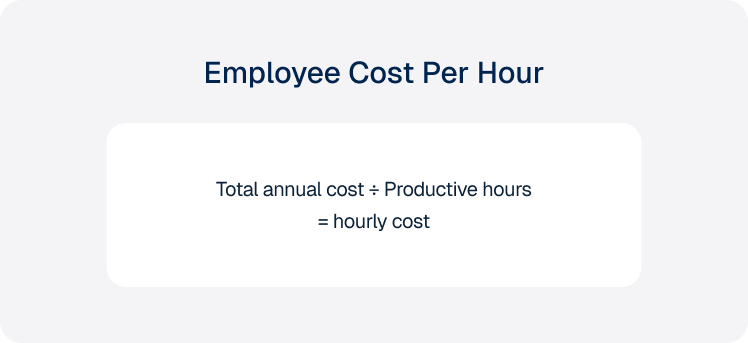
Knowing how to calculate employee cost per hour is critical for project pricing, client billing, and workforce planning. Once you have the total annual cost, it’s a straightforward formula.
Total annual cost ÷ productive hours = hourly cost
Some businesses deduct paid leave and public holidays from total hours to achieve a more precise hourly rate. For example, if the total annual cost of an employee is £126,000 and the number of hours worked in a year is 2,080, the actual hourly cost is approximately £60. This is an essential consideration in service industries, where the hourly rate directly affects profitability.
Using an Employee Cost Calculator
An easy-to-use calculator can create a more accurate estimate. WorkMotion’s employment cost calculator lets you enter a gross annual salary and bonus and instantly see the total employment cost, including taxes and fees, for a talent in any of 160+ countries.
The salary employee calculator shows recommended salary ranges by position and country, plus net pay after income tax and social security, so you can compare take-home pay for the same role across different markets.
EOR vs Opening a Local Entity: Cost Comparison
When you hire abroad, you have two main options. You can use an Employer of Record (EOR) or set up your own local entity. The cost of hiring an employee through an EOR vs opening an entity is one of the most important hiring decisions a global team makes.
Opening a Local Entity
Setting up a legal entity typically can cost anywhere from $10,000 to $50,000 upfront. This covers formation, legal counsel, registration, notarisation and capital deposit requirements. Simpler jurisdictions like the UK or Singapore sit at the lower end. Ongoing annual maintenance can run $25,000 to $75,000 per country, covering accounting, statutory audits, corporate tax filings, local legal counsel and payroll infrastructure. Setup time ranges from three to nine months, with bank account opening often the longest delay.
Using an EOR
An EOR charges a per-employee fee, typically $300 to $1,500 per employee per month, with no upfront capital requirement. Onboarding takes days rather than months. Compliance, payroll and local employment regulations are handled by the provider. That means there’s no entity to maintain or wind down if you exit the market.
When Each Makes More Sense
EOR is usually cheaper when you have a low or uncertain headcount. In that scenario, it makes more sense to buy employer infrastructure as a service rather than build it. An entity becomes cheaper per employee once you have a stable, larger team in one country. This is only after you properly account for setup, annual compliance, local advisory, and internal management time.
The crossover typically falls somewhere around 5–15 employees per country, though it depends heavily on the market, salary levels and how you cost internal time. Below that threshold, EOR wins on total cost almost every time.
WorkMotion’s Employer of Record service covers 160+ countries with transparent per-employee pricing and no entity setup, and the country explorer can help you compare markets before you commit.
Use WorkMotion’s Country Explorer to help you decide which countries to consider in the hiring process.
Global Hiring Cost Considerations
When organisations expand beyond national borders, employee costs become more complex. Every nation has its own laws, taxation, and employee termination terms. A method that works in one labour market may prove risky in another.
Alongside legal and tax aspects, employers need to account for currency exchange rates, inflation rates, local employment cycles, and mandatory benefits such as healthcare, pension plans, or sick leave. These factors create a wide gap between estimated and actual costs, and they vary significantly across regional differences.
A systematic methodology for global cost estimation involves understanding legislative requirements, benchmarking benefits against local market requirements, and ensuring ongoing legal compliance with employment legislation. It’s where the need for global human resource solutions becomes paramount, as they help organizations determine employee costs across different countries while maintaining consistency and control.
How To Calculate the Cost of Hiring and Replacing an Employee
Employment costs start accumulating before you find your ideal candidate. They also don’t stop adding up until you’ve found a sufficient replacement for a past hire.
Hiring Costs
To accurately calculate the cost of hiring an employee, you need to consider more than just their salary and employment-related expenses. The cost of hiring an employee begins even before they are employed and includes time- and money-consuming activities, such as advertising and recruitment agency fees.
The hiring cost for an employee in most organizations is typically 15% to 30% of the annual salary. For senior management, it can exceed that estimate. International hiring tends to be costlier due to legal clearances and longer hiring cycles. Cost estimation supports proper planning and budget alignment for hiring and helps avoid underestimating the cost of scaling up.
Replacement Costs
Businesses typically pay more than just recruitment costs during employee turnover. In most cases, replacing an employee requires covering all hiring and training costs while productivity remains below optimal levels for an extended period.
Replacement costs range from 50% to 200% of an employee’s salary per year. Calculating replacement costs provides a clearer picture of why retention and engagement programs represent a sound investment of capital. Turnover reduction translates to lower employment expenses in the long run.
Cost and Value: Calculating Employee Impact
Knowing the employee’s total compensation and cost is necessary, but it’s not sufficient. You should also measure an employee’s value to make effective workforce management decisions. Value can be measured through revenue per employee, profit per employee, project delivery speed, customer retention and innovation.
The measures are essential for helping businesses evaluate whether their spending on employees aligns with business results and objectives. Understanding employee value measurement ensures cost management isn’t only about cutting costs but is also strategic.
Simplifying Employee Cost Management with WorkMotion
Calculating employee costs is an essential building block for sustainable growth, particularly for today’s globalised, remote workforces. As organisations scale, the calculation becomes more complex due to varying labour regulations, taxation, benefits and other requirements.
WorkMotion helps businesses at every stage of international recruitment and employment by removing the complexity of global jobs and expense management. WorkMotion’s EOR service lets businesses directly employ full-time staff worldwide without having to incorporate local entities or worry about local employment laws and regulations.
With Direct Hiring, enterprises can efficiently manage compliant local employment and enjoy complete visibility into employment expenses. By using Contractor Management, businesses can onboard and manage contractors with confidence while ensuring regulatory compliance.
With WorkMotion, you can focus on growth while staying financially transparent and compliant across every country you hire in. Book a demo or take a product tour to fully explore the platform.