

Most companies comparing Deel vs Rippling vs Gusto are running payroll in one system, managing contractors in another, and hiring international employees through a third. The setup might be fine until you hire someone in Germany, France, or Spain. Then, the importance of compliance risks becomes extremely apparent.
Getting anything wrong can mean financial penalties, reclassification disputes, and exposure to legal action. This comparison breaks down what each platform was built to do, where each one stops, and where WorkMotion fits as a fourth option for SMEs that need compliant European employment without gambling on a platform that treats compliance as an afterthought.
Deel vs Rippling vs Gusto vs WorkMotion: At a Glance
This table covers the major differences across all four platforms: country coverage, entity model, pricing, compliance certification, and onboarding speed. Use it as a quick reference before diving into the feature-by-feature breakdown below.
| Feature | Gusto | Rippling | Deel | WorkMotion |
| Best for | US domestic payroll for small businesses | US HR, IT, and finance consolidation | Global scale and contractor management | Compliant European hiring for SMEs |
| EOR country coverage | Via Remote (75+ countries) | 80+ countries | 150+ countries | 160+ countries |
| Onboarding speed (EOR) | Not specified (via Remote) | 5–12 days to payday | Not specified | 3–5 business days (1.03 days average per live metrics) |
| Entity model | No own entities (uses Remote) | Owned entities in some markets, partners in others | Own entities and partners | Own entities in 33+ markets |
| Compliance certification | None | None | None | IEC Gold Certificate (July 2025) |
| Pricing (EOR) | ~$699/employee/month (via Remote) | Quote-based | From $599/employee/month | From €499/employee/month |
| Trustpilot rating | 2.4/5 | 4.5/5 | 4.7/5 | 4.8/5 |
| Top strength | Clean US payroll interface | Unified HR/IT/finance platform | Global scale and contractor management | Independent compliance certification |
| Key tradeoff | No native international EOR | International EOR is an add-on module | No independent compliance certification | Not a US payroll tool |
What Each Platform Is (and Isn’t)
The architecture of each platform determines what happens when a hire goes wrong. A payroll processing tool that handles 20 US employees perfectly can create legal exposure the moment someone is employed in a country where the platform has no entity. What follows is a plain description of what each platform does, what it does well, and where it stops working.
Gusto

Gusto is a US-first payroll software and HR platform for small businesses. Its core strength is a clean interface that makes domestic payroll, automatic tax filing, and benefits administration easy for US-only teams.
But its key limitation is that it has no native international employment of record (EOR). Gusto outsources international employment to Remote, which covers 75+ countries through a partnership.
Rippling

Rippling is a US-centric HR, IT, and finance platform. Its core strength is device provisioning, software access management, payroll, and HR in one system. For US-headquartered companies that want to onboard an employee and their laptop, apps, and payroll simultaneously, Rippling is a great fit.
Rippling falls short in the international EOR realm. The platform is designed for domestic US operations, and EOR was later added on. In many European markets, Rippling operates through third-party partners rather than its own entities.
Deel

Deel is an EOR-first platform. It has broad country coverage and an established contractor management network. Deel owns local legal entities and payroll engines in many markets, and its contractor infrastructure handles payments in 200+ jurisdictions.
Deel’s biggest weakness is compliance depth. Deel doesn’t hold independent compliance certification. Entity ownership varies by country, and the full employment cost isn’t always visible from the published rate.
WorkMotion

WorkMotion is an employer of record for companies that need to employ people in countries where they have no legal entity, especially in European markets. When a company hires through WorkMotion, the WorkMotion entity in that country signs the employment contract, runs payroll in local currency, handles statutory benefits, and owns the compliance relationship with local authorities. Three things separate WorkMotion from the other platforms in this comparison:
- WorkMotion is the only platform that holds IEC Gold Compliance Certification (July 2025). It has the only independently audited compliance credential among the four.
- The platform onboards new hires in an average of 1.03 days according to live Service Metrics that no competitor publishes.
- Customers report high satisfaction on both sides of the employment relationship: A 97.0 CSAT score from client companies, a 92.5 TSAT score from the employees hired through the platform, and a 4.8/5 rating on Trustpilot.
For companies that need to source talent before hiring, WorkMotion offers Synmatch AI, which screens and pre-vets international candidates with AI-driven CV reviews, interviews, and identity verification.
Want to see what your international hire actually costs? Try WorkMotion’s employment cost calculator.
Feature-by-Feature Comparison
WorkMotion, Deel, Rippling, and Gusto each do certain things genuinely well. The question is which tradeoffs fit your specific hiring situation.
Payroll and Tax Filing
Every platform here can run payroll. The differences are in where, how many countries, and whether the platform owns the payroll engine or depends on a partner.
Gusto
Gusto handles US payroll with automatic tax filing included. Every plan comes with unlimited payroll runs, including off-cycle payrolls. It supports multi-state payroll, multiple pay schedules, and direct deposit management speeds from instant to same-day. However, international payroll is not part of the platform.
Rippling
Rippling runs payroll globally in 185+ countries through a native, in-house payroll system that handles payroll calculation and processes payroll in 90 seconds. While payroll connects to HR, IT, and finance data in the same system, payroll is one independently priced module among many.
Deel
Deel runs global payroll across 150+ countries with local tax rules, statutory requirements, and filings applied automatically before payroll runs. US payroll covers all 50 states. Deel supports 120+ currencies, including crypto. But Deel’s US payroll product, while functional, wasn’t built with US small businesses as its primary focus. For US-only teams, Gusto’s interface and pricing make more sense.
WorkMotion
WorkMotion runs international payroll in local currency across 160+ countries. Payroll requests are entered directly in the platform without emails or support tickets. The payroll team validates data for accuracy and compliance before processing. Country-specific payslips include all charges and allowances, with payslip history accessible to employees.
Expense management, PTO tracking, and in-platform contract changes are all handled within the payroll flow. One drawback is that WorkMotion doesn’t run US domestic payroll. It’s designed for the international coverage that your existing US tool can’t support. That’s why many companies pair WorkMotion with a US-specific tool like Gusto.
EOR and International Employment
EOR is where these platforms’ differences become even more noticeable. Country coverage isn’t the only thing to focus on, but whether the platform owns the legal entity that employs your hire or relies on a third party.
Gusto
Gusto doesn’t offer native EOR. International employment is outsourced to Remote, which acts as the legal Employer of Record in 75+ countries. For teams hiring internationally at any scale, the lack of a native EOR product becomes a noticeable structural limitation.
Rippling
Rippling offers EOR as a module within its broader workforce platform, covering 85+ countries. EOR onboarding takes five days to payday in popular markets and 12 days in less common markets. The platform has some owned entities, but in many European markets, Rippling operates through third-party partners.
Deel
Deel’s EOR product operates in 150+ countries with owned entities and payroll engines in most markets. EOR includes locally compliant contracts, monthly local-currency payroll, employer taxes, statutory benefits, and termination management. Buyers should still ask Deel directly which entity employs their hire in countries with specific local labour laws.
WorkMotion
WorkMotion’s EOR operates through its own entities in key European markets including Spain, Germany, France, Italy, Portugal, Poland, and the UK. Outside of Europe, WorkMotion covers 160+ countries total. Major markets where WorkMotion has owned entities and pre-built country-specific contracts mean no external sign-off is required. Live Service Metrics show an average onboarding time of 1.03 days.
For companies that grow headcount in a single market over time, WorkMotion also offers Direct Hiring, which registers the client as the foreign employer without requiring local entity setup. This creates a pathway from EOR to direct employment as headcount in a market justifies the transition.
Compliance and Licensing
Compliance failures in countries can result in fines, reclassification disputes, or legal action. The main thing to figure out before entering any agreement is whether the platform carries compliance accountability directly or delegates it to a partner.
Gusto
Gusto’s compliance is US-focused, including automatic tax filing with government agencies, state tax registration in all 50 states, and multi-state payroll at one price. Time tracking with geolocation helps hourly teams stay compliant with labour rules. However, Gusto has no international compliance capability.
Rippling
Rippling’s US compliance is handled through two products: HR Services and Automated Compliance. Rippling’s international EOR compliance is handled through built-in policy guardrails and a global playbook covering 75+ countries. The tradeoff is that Rippling doesn’t hold independent compliance certification.
Deel
Deel’s compliance approach is “Continuous Compliance” with three always-on capabilities: Compliance Monitor, Workforce Insights, and an AI-powered Worker Classifier. Deel doesn’t hold IEC Gold Compliance Certification or any equivalent independently audited employment compliance certification.
WorkMotion
WorkMotion carries compliance accountability directly through its own entities in core European markets. The WorkMotion entity is the employer on record, which means the compliance relationship with local authorities belongs to WorkMotion, not an outside partner.
WorkMotion is also the first and only EOR provider with IEC Gold Compliance Certification, independently audited by The IEC Group across 10 compliance pillars and more than 1,000 checkpoints.
Curious what compliant European hiring looks like in practice? Take a product tour.
Contractor Management
Contractor management is where Deel has a big competitive strength. The question for the other platforms is whether contractor management is a core product or an afterthought.
Gusto
Gusto offers a Contractor Only plan that includes domestic contractor payments, 1099 filings, and basic support. International contractors can be paid in 120+ countries in their home currency, with no per-contractor monthly fee. But the platform doesn’t offer misclassification risk safeguards or automated compliant contract generation for international contractors.
Rippling
Rippling handles contractor management in 185+ countries with localised contractor agreements and misclassification risk guardrails. Payments are available in 50+ local currencies and invoicing is automatic. No specific contractor pricing is published on the product page as contractor management is part of a broader platform.
Deel
Deel’s contractor management is probably its biggest strength. The platform covers 200+ countries and jurisdictions, 120+ currencies, and 15+ payout options. Features include automated invoicing, built-in classification assessments, tax form guidance and document collection, and worker classification compliance.
WorkMotion
WorkMotion’s Contractor Management is one of three core services. The platform manages international contractors and freelancers with automated invoicing, tax support, and local compliance safeguards. The only tradeoff is that WorkMotion’s contractor network is smaller than Deel’s in terms of payout options and currency coverage.
Benefits Administration
Employee benefits administration looks different depending on whether you’re focusing your hiring in the US or internationally. US benefits are a Gusto strength. International statutory benefits are where EOR platforms like WorkMotion show their value across a global workforce.
Gusto
Gusto’s benefits administration is the strongest US offering in this comparison. The platform provides medical, dental, life, and vision insurance, plus HSA and FSA. The 401(k) product can be set up in nine minutes. For US small businesses, Gusto’s benefits administration is genuinely excellent and is a core reason companies choose it.
Rippling
Rippling consolidates HR, benefits, and payroll data so that payroll deductions adjust when someone switches benefit plans. One of its biggest strengths is the integration depth. Benefits connect to payroll, HR, and IT in the same system. That same benefit can also be a drawback. Companies using Rippling for benefits must use Rippling for payroll and HR as well.
Deel
Deel handles statutory benefits across 130+ EOR countries, so companies don’t need to manage local benefits packages themselves. The tradeoff is that Deel’s US benefits administration lacks the depth of Gusto’s offering. For US-only teams that need a benefits broker and health insurance marketplace, Gusto is more tailored.
WorkMotion
WorkMotion’s EOR includes statutory benefits administration, with the monthly fee covering contracts, payroll, and statutory contributions. The IEC compliance audit covers benefits and social security as one of its 10 pillars, verifying that statutory and optional employee benefits are handled correctly in each country.
Pricing
The issue with pricing is whether the pricing model lets the finance lead forecast accurately. Hidden costs or opaque quote-based pricing make it harder to model the total cost of international hiring before committing.
All pricing correct at time of publication, August 2026.
Gusto
Gusto’s pricing tiers mean it’s accessible for small US businesses. But if you want additional features, or your headcount grows, costs will also rise. The limitation is that international EOR pricing is unclear because it is set by Remote, not Gusto.
Gusto has a base monthly fee with a per-person fee:
- Contractor Only: $35/mo base + $6/mo per person
- Simple: $49/mo base + $6/mo per person
- Plus: $80/mo base + $12/mo per person
- Premium: $180/mo base + $22/mo per person
- International EOR (via Remote): Starts around $699/employee/mo
Rippling
Rippling’s pricing is modular. Modules are priced separately for HR, time and attendance, recruiting, headcount planning, identity and access management, device management, and spend management. EOR pricing is quote-based, not published on the site, making it hard for international teams comparing payroll providers and comprehensive solutions to budget accurately.
Deel
Deel publishes pricing. However, the full cost of employment, including statutory contributions, benefits, and add-ons, is not always visible from the base EOR rate.
This is more transparent than Rippling’s quote-based model but less transparent than WorkMotion’s per-employee pricing with country-specific breakdowns:
- EOR: Starting at $125/employee/month (US employees), $599/employee/mo (Standard), or $899/employee/mo (Enterprise)
- Contractors: Starting at $49/contractor/mo
- Contractor of Record: Starting at $325/contractor/mo
- Deel HR: Modular add-ons ranging from $5 to $30/employee/mo
WorkMotion
WorkMotion’s pricing includes country-specific cost breakdowns showing the service fee, employer social contributions, and mandatory benefits included. The monthly rate covers everything from contractor to payroll management and statutory contributions. WorkMotion isn’t the cheapest option in this comparison, but it earns its price with extensive compliance depth, service quality, and speed.
The pricing transparency is designed for finance leads who need to forecast international hiring costs accurately:
- Employee of record: From €499/talent/mo
- Direct hiring: From €399/talent/mo
- Contract management: From €29/talent/mo
When Each Platform Fits
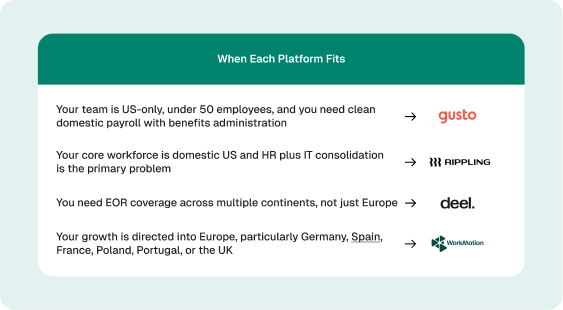
The criteria below are designed to make the right fit obvious. If a platform doesn’t match your hiring situation, that should be clear from the description.
Choose Gusto If
- Your team is US-only, under 50 employees, and you need clean domestic payroll with benefits administration.
- You’re not hiring internationally, or you’re willing to manage a separate Remote relationship for the occasional international hire.
Choose Rippling If
- Your core workforce is domestic US and HR plus IT consolidation is the primary problem.
- International hiring is infrequent, and you have confirmed that Rippling’s entity model covers the specific markets you need.
Choose Deel If
- You need EOR coverage across multiple continents, not just Europe.
- Contractor management at volume is important to you.
Choose WorkMotion If
- Your growth is directed into Europe, particularly Germany, Spain, France, Poland, Portugal, or the UK.
- You’re an SME with 11 to 500 employees in tech, SaaS, e-commerce, or green tech.
- You want an EOR provider with independent compliance certification, not just self-declared claims.
Use WorkMotion Alongside Gusto or Rippling If
- You already use Gusto or Rippling for US payroll and HR.
- You’re adding international hires, particularly in Europe, and you don’t want to migrate your entire HR stack.
US payroll stays in Gusto or Rippling while European hires onboard through WorkMotion, and both run in parallel. This is the most common deployment pattern for companies that need both domestic payroll and compliant international employment.
Get Started With WorkMotion
WorkMotion is built for SMEs hiring into Europe where compliance is a strict requirement, not a nice-to-have. If your company is not hiring internationally, or if you need a domestic HRIS replacement, WorkMotion won’t be the right fit.
But for companies that are hiring into Europe, WorkMotion is a great fit. A few things set it apart from the competitors on this list:
- Own entities in major European markets: The WorkMotion entity in each country is the employer on record, so compliance accountability sits with WorkMotion directly, not an outside partner.
- IEC Gold Certificate (July 2025): The only EOR provider in this comparison with independently audited compliance certification. Neither Deel, Rippling, nor Gusto holds this.
- Fast onboarding: Own entities and pre-built country-specific contracts mean no third-party sign-off is required. Live Service Metrics show an average of 1.03 days.
- TSAT scores: WorkMotion measures employee satisfaction alongside client satisfaction, with a current TSAT score of 92.5. Few EOR providers measure the experience of the employees hired through their platform.
- Transparent per-employee per-month pricing: €499 per employee per month for EOR, with country-specific cost breakdowns. No hidden fees or setup charges.
- 4.8 Trustpilot rating: Based on both company reviews for speed and compliance guidance, and employee reviews for onboarding and payslip clarity.
The most common deployment pattern is straightforward. The US team stays in their existing HR tool, European hires onboard through WorkMotion, and both run in parallel without migration. If sourcing the right candidate is the bottleneck before hiring, explore Synmatch AI to screen and pre-vet international candidates before they reach your pipeline.
Book a demo to see how WorkMotion handles compliant European hiring, or take a product tour to explore the platform first.

















![idWjC-9cC6_logos 1 [Vectorized]](https://workmotion.com/wp-content/uploads/2026/02/idWjC-9cC6_logos-1-Vectorized.svg)