

You’ve compared EOR demos and pricing sheets, now you need to know if compliance claims actually hold up in Germany or Spain. Your provider choice determines who’s legally responsible when a regulator asks about staff leasing licenses or a worker challenges their classification.
Most comparisons focus on Deel versus Remote. Deel offers global scale while Remote emphasizes regulatory rigor. But that binary misses a critical reference point: WorkMotion, an independently certified provider built specifically for European markets.
This comparison examines entity ownership, regulatory depth, licensing, pricing, and onboarding speed across Deel, Remote, and WorkMotion.
Deel vs Remote vs WorkMotion: At a Glance
Before taking a thorough look at each tool, here’s what WorkMotion, Deel, and Remote offer at a glance.
| Feature | WorkMotion | Deel | Remote |
|---|---|---|---|
| Entity model | Own entities | Own entities | Own entities |
| IEC compliance certified | ✦ IEC Gold | No | No |
| Labour leasing licenses | 94% of entities | <20% of entities | ~50% of entities |
| EOR pricing | €499/mo | $599–$899/mo | €645/mo |
| Contractor pricing | €29/contractor/mo | $49/mo | €27–€91/contractor/mo |
| Country coverage | 160+ countries | 150+ countries | 100+ employees, 200+ contractors |
| Onboarding speed (Europe) | 3–5 days | 3–5 days | 3–6 days |
| Trustpilot rating | ★ 4.8 / 5 | ★ 4.7 / 5 | ★ 4.6 / 5 |
Remote vs Deel vs WorkMotion: What Each Platform Is — And What It Isn’t
When choosing an EOR, operating model is more useful than feature parity. The regulatory infrastructure a provider operates through determines who carries legal accountability during disputes or audits.
A comparison based purely on country count or headline pricing misses the structural question: When a regulatory inquiry happens, which entity employs your hire within the jurisdiction?
WorkMotion

WorkMotion is a compliance-first Employer of Record (EOR) built specifically for companies hiring internationally, with particular focus on European markets.
As an EOR, WorkMotion becomes the employer of record locally. Its German entity employs your German hire, its Spanish entity employs your Spanish hire. You manage the work and WorkMotion handles contracts, payroll in local currency, statutory benefits, and ongoing labor law alignment.
Three differentiators set WorkMotion apart in the global employment space:
- Own entities in key markets: WorkMotion operates through directly owned legal entities, not third-party intermediaries. Direct accountability flows through WorkMotion’s infrastructure rather than an unknown partner. This matters when regulatory questions arise or when labor law changes require immediate contract updates.
- First compliance-certified EOR: WorkMotion holds the IEC Gold Certificate, the first independent compliance certification in the employer of record category. No other EOR provider has passed this test. For buyers evaluating regulatory posture, this is verifiable proof rather than provider assurance.
- Labor leasing licenses: Many countries require EOR providers to hold specific staff leasing or temporary employment licenses to legally employ workers on behalf of client companies. And many EOR providers operate in these markets without holding the required licenses. WorkMotion holds labor leasing licenses in 94% of relevant entities — including the AÜG license in Germany, one of the most strictly enforced in Europe.
WorkMotion serves approximately 75% SME customers (11–500 employees) across tech companies, SaaS, ecommerce, fintech, and green tech sectors. The platform is rated 4.8 on TrustPilot, with customer feedback consistently highlighting fast contract turnaround (3–5 business days in European markets), regulatory guidance quality, and responsive support.
Hiring into Europe and need certified compliance? Book a WorkMotion demo to see IEC-certified EOR in action.
Deel

Deel is a global employment platform built for scale, combining EOR, contractor management, global payroll, and HR in one system. The platform provides EOR services in 110+ countries and contractor hiring in 150+ countries.
Deel’s strengths include breadth of country coverage, fast onboarding, and a large contractor payment network serving 37,000+ customers. Deel functions as a high-scale global employment platform with broad geographic reach and a comprehensive product suite including global payments. But compliance depth in regulated European markets warrants direct verification before signing, particularly for independent compliance certification.
Prospects raise structural concerns around Deel’s licensing in regulated European markets and employment law standards in jurisdictions with strict labor law requirements.
For buyers with substantial European hiring plans, direct verification of Deel’s entity structure and licensing status in target markets is standard due diligence.
Remote

Remote is a compliance-positioned EOR platform emphasizing owned infrastructure and intellectual property protections. Remote focuses on serving both employees (100+ countries) and contractors (200+ countries and jurisdictions).
Remote offers contractor IP protection, a clean user experience, and a compliance-forward market position that resonates with buyers concerned about provider accountability. Remote positions itself as a compliance-forward EOR with real entity infrastructure in most markets, clean UX, and strong IP protections.
However, Remote doesn’t hold labour leasing licenses in around 50% of entities where this is a legal requirement. Companies with hiring plans in regulated European markets should verify coverage for their specific countries during evaluation or consider Remote alternatives.
The Key Decision Variable: Who Is Actually the Legal Employer In-Country?
Entity ownership determines who holds legal accountability when something goes wrong. All three platforms operate as own-entity EORs. This means the provider you contract with directly employs your hire, not a third-party partner. This direct employment model provides clearer accountability than partner-network arrangements where liability can split between intermediaries.
Even though all three platforms maintain direct entity ownership in many markets, some have stronger foundations than others:
- WorkMotion: Owns entities in key European markets like Spain, Germany, France, Poland, Italy, Portugal, and UK. Those entities hold all the necessary labour leasing licenses in each market, and the employment process is independently audited through IEC Gold Certification. Best for European hiring with verified compliance depth.
- Deel: Maintains subsidiaries across 110+ countries with no third-party intermediaries. Best for international contractor payments, but companies evaluating Deel for EOR should note that labour leasing licenses are held in fewer than 20% of entities.
- Remote: Has 100+ wholly-owned entities. Best for buyers who want clean UX and straightforward onboarding, but companies hiring in regulated European markets should verify labour leasing license coverage — Remote holds these in around 50% of entities where they’re legally required.
Feature-By-Feature Comparison
Buying decisions are made in the details. How does each platform behave under real operational conditions as regulatory complexity increases? The comparison below focuses on tradeoffs instead of rankings. Each platform has genuine strengths that fit specific buyer situations when evaluating Deel vs Remote vs WorkMotion for international hiring.
Pricing
EOR pricing determines your total employment cost per country. It’s not just the platform fee, but employer taxes, statutory benefits, and whether those costs are transparent upfront or buried in custom quotes.
WorkMotion
WorkMotion’s pricing model is structured around per-employee per-month EOR fees, with total employment cost per country including the service fee, employer social contributions (taxes, pension, health insurance), and mandatory benefits.
WorkMotion transparently shows the full employment cost (which covers payroll) in their onboarding process so HR and finance teams receive clear breakdowns of what they’ll pay in each country before committing to international hiring. WorkMotion emphasizes transparent pricing with no hidden costs and offers a money-back guarantee.
Pricing plans:
- Employee of record: €499/talent/mo
- Direct hiring: €399/talent/mo
- Contract management: €29/talent/mo
Deel
Deel operates tiered EOR pricing. The platform’s modular structure means costs expand with product usage. Adding services like global payroll (starting at $29/employee/mo for companies with direct entity ownership), benefits administration, or regulatory monitoring increases the total platform cost. As you scale and add services, pricing becomes unpredictable.
Pricing plans:
- Standard (EOR): $599/employee/mo
- Enterprise (EOR): $899/employee/mo
- Standard (Contractor): $49/contractor/mo
- Contractor of record: $325/contractor/mo
Remote
Remote’s per-employee, per-month model delivers employment services with no platform, onboarding, or setup fees. Additional services like premium or supplemental benefits, visa and immigration support, currency conversion, and extended HR consultancy, are available as optional add-ons.
Pricing plans:
- Employee of record: €645/employee/mo
- Contractor management: €27/contractor/mo
- Contractor management plus: €91/contractor/mo
- Contractor of record: €299/contractor/mo
Compliance
All three platforms have moved beyond the partner network model that defined earlier EOR generations or alternative low-cost providers. But compliance depth, licensing coverage, and verified processes differ in ways that matter when legal accountability is on the line.
WorkMotion is the only provider of the three to have submitted to independent third-party compliance verification.
WorkMotion
WorkMotion’s compliance infrastructure has been independently audited and verified by The IEC Group across 10 compliance domains, covering legal licensing, employment law, tax and payroll, data protections, benefits, and more. This audit evaluated over 1,000 checkpoints across 12 countries, with particular depth in high-complexity European markets like Germany, France, Italy, and the Netherlands.
WorkMotion achieved a weighted score of 4.58 out of 5, earning the IEC Gold Certificate. It’s the highest level of EOR compliance certification available, and the first ever awarded in the category.
No equivalent independent compliance audit or certification is publicly available for Deel or Remote. For buyers prioritizing verifiable compliance infrastructure and considering Workmotion vs Deel vs Remote, this is a meaningful differentiator.
WorkMotion also holds ISO 27001 certification for information security management, and features built-in compliance monitoring with alerts when regulations change across operational countries. The system automatically generates country-specific employment contracts tailored to local legal requirements, reducing contract drafting time and ensuring local compliance alignment.
Deel
No equivalent independent compliance audit or certification is publicly available.
Remote
No equivalent independent compliance audit or certification is publicly available.
Country Coverage
All three platforms provide broad global coverage for employer of record services. The meaningful difference is depth in specific markets rather than total country count when comparing WorkMotion vs Remote vs Deel.
WorkMotion
WorkMotion operates in 160+ countries, with proprietary entities and deep regulatory expertise in key European markets. For SMEs hiring primarily into Southern and Central Europe, WorkMotion’s entity footprint matches common hiring patterns, with payroll processing handled in-house rather than passed to local partners.
Deel
Deel supports hiring in 110+ countries. It’s a strong fit for buyers with truly global hiring needs spanning many regions.
Remote
Remote operates in 100+ countries for employees. It has solid European coverage in most markets.
Onboarding Speed
Setting up a local entity can sometimes take 6+ months. Deel, Remote, and WorkMotion all deliver much faster onboarding. The meaningful comparison when evaluating them is days to payroll enrollment once contracts are signed.
WorkMotion
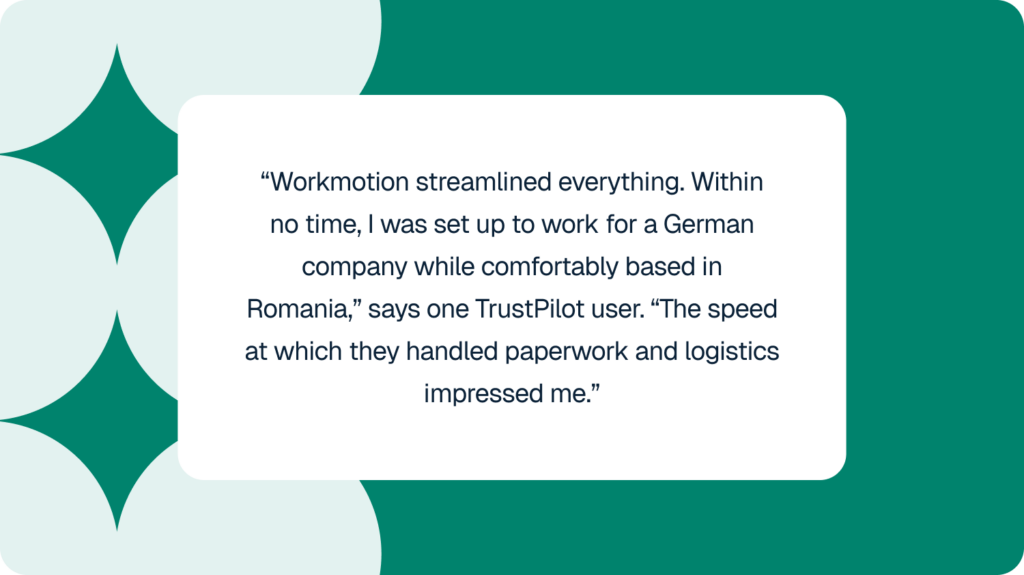
WorkMotion delivers accelerated onboarding, with contract generation completing in under 10 minutes from initial data entry to signed employment agreement. Once the contract is signed, new hires are enrolled in payroll processing within three to five business days in most European markets.
Deel
Deel has automated onboarding workflows with self-service capabilities and pre-built country-compliant templates. It can take just three days to onboard employees in countries like Spain, and five days in countries such as France and Poland.
Remote
Remote has a five-step onboarding process with automated workflows. Onboarding varies by country, as some EU countries like Spain or France only take three days to onboard. But Hungary can take up to six working days and Germany up to five.
Contractor Management
Contractor management capabilities for international hiring span across all three platforms. The differences lie in pricing and how contractors integrate with broader employment services.
WorkMotion
WorkMotion integrates contractor management directly into its EOR platform, which is useful for companies managing a mix of contractors and employees. The contractor solution is built around compliance, with each onboarding including a mandatory misclassification check, and contracts generated from country-specific templates to ensure local legal alignment. It costs only €29/contractor/mo and the platform supports multiple currencies with automated conversion options.
Deel
Contractor management is one of Deel’s most-used products. It’s priced at $49 or $325/contractor/mo depending if you need a contractor of record or not.
Remote
Remote offers the ability to manage independent contractors in a few plans, priced at €27, €91, or €299/contractor/mo. Companies only pay for contractors actively working.
Customer Support
Support quality directly affects the employee experience for your international hires and determines how quickly compliance questions get resolved when comparing Remote vs Deel vs WorkMotion.
WorkMotion
WorkMotion’s 94% CSAT and +39 NPS are among the highest verified scores in the EOR industry, backed by a support architecture built on specialists, not generic support teams. Each client receives a dedicated Customer Success Manager who leads onboarding and coordinates internal teams, while a Talent Success Manager guides employees through documentation and country-specific requirements from day one.
Local HR professionals provide in-country expertise on labor laws and benefits, payroll specialists manage calculations and statutory processes, and a dedicated legal team advises on complex cases like terminations and disputes. Wanda AI handles routine HR and payroll questions instantly, routing complex cases to the right specialists when needed.
Critical issues like payroll-blocking cases receive a response within two hours and resolution within one day. 49 G2 users specifically call out the positives of WorkMotion’s customer support.
Deel
Deel has specialized expert teams including local payroll experts and Deel Payroll Managers. If your hiring model involves complex payroll or country-specific regulatory questions, support quality may matter just as much as platform functionality, and users have complained about support quality at scale.
“Customer support can be slow to respond during periods of high traffic, which is frustrating when issues come up and I need help quickly,” says a G2 user at a mid-market organization.
Remote
Remote has hundreds of in-house legal and HR experts and a dedicated team of legal experts available for personalized support. But slow ticket responses may frustrate some teams.
“Any questions raised via the ticket system is already unanswered for more than 1 month,” says one TrustPilot reviewer from the Netherlands.
Integrations
Integration depth with major HRIS and accounting platforms is broadly comparable. The meaningful question when evaluating Remote vs Deel vs WorkMotion is whether your specific tech stack is supported.
WorkMotion
WorkMotion aims to empower companies to keep their existing HR tools and use WorkMotion as the employment layer for international hires. It integrates with HRIS platforms like BambooHR, Personio, and Workday — alongside HCM systems like UKG Pro and productivity tools like Google Workspace. There’s also an open API for custom integrations, enabling seamless integration with existing tech stacks.
Deel
Deel has 68+ pre-built integrations, including Workday, BambooHR, Quickbooks, and NetSuite. The platform also provides an open API for custom integrations.
Remote
Remote has plug-and-play integrations with many accounting and HR platforms. With Zapier, Remote customers can connect to thousands of other applications.
When Each Platform Fits
The right EOR is the one whose entity model, license stack, and compliance depth match the markets where you’re hiring. Here’s how to choose between Remote, Deel, and WorkMotion based on your international hiring needs.
Choose WorkMotion If
- You’re an SME (11–500 employees) hiring into Germany, Spain, France, Poland, Italy, Portugal, or any of the 160+ supported countries.
- You need a provider that owns its entities and holds the necessary labor leasing licenses in each market.
- Independent compliance certification is a hard requirement.
- EU data residency is required for European clients.
If this sounds like you, book a demo to see how WorkMotion combines 3-5 day onboarding with certified compliance across Europe.
Choose Deel If
- You need broad global coverage across EOR, contractor payments, and global payroll in one platform.
- You need payment flexibility for contractors (Deel offers 120+ currencies across 150+ countries).
- Multi-country hiring is a priority — Deel’s native payroll engines cover 50+ countries.
Choose Remote If
- You want straightforward onboarding and a clean UX for global expansion.
- Your hiring is concentrated in markets where Remote has documented owned entities.
These three options aren’t mutually exclusive. Many companies use WorkMotion strategically alongside their existing global EOR to address specific European compliance requirements.
Use WorkMotion Alongside Deel or Remote If
- You have a global EOR but need to fill a regulatory or licensing gap.
- You want to have a Direct Hiring option additionally to your existing EOR setup, particularly in Europe.
- Your current provider lacks independent compliance certification.
- You want to consolidate European hiring under a provider with owned entities and certified compliance, without migrating your entire global HR stack.
- You manage contractors with Deel and Remote, but you want to have the best compliance setup for your EOR talents.
WorkMotion integrates with existing systems, making it easy to add without disrupting your current setup.
What WorkMotion Brings That Deel and Remote Don’t
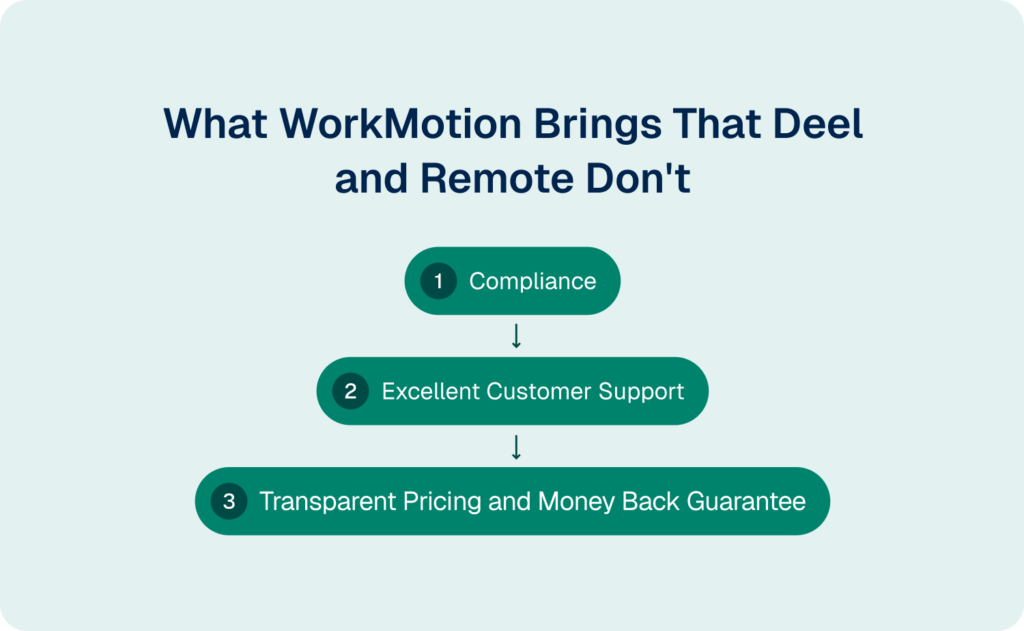
Three structural differentiators set WorkMotion apart from its competitors.
Compliance
WorkMotion’s compliance advantage comes from two pillars that work together. First is an independently verified compliance framework, certified by The IEC Group at Gold Level. The other is an own-entity network that holds labor leasing licenses in 94% of entities where they’re legally required. No other EOR provider has passed this third-party verification and both Deel (below 20%) and Remote (around 50%) hold fewer labor leasing licenses.
Excellent Customer Support
WorkMotion’s service model is built around specialist accountability at every layer including legal, payroll, invoicing, and in-country HR expertise. The result is a 94% CSAT and +39 NPS verified through 2025 delivery data, with SLAs tied to real performance rather than marketing promises.
Transparent Pricing and Money Back Guarantee
WorkMotion provides clear total employment cost breakdowns per country with no hidden fees, backed by a money-back guarantee. Customers like TIS have hired Product Owners in Poland within 16 business days from initial contact to signed contract, avoiding months of entity setup delays while maintaining full health insurance continuity for their employees.
Book a demo to see how WorkMotion’s compliance infrastructure works in your target markets, or explore the product tour to understand the platform before scheduling a call.

















![idWjC-9cC6_logos 1 [Vectorized]](https://workmotion.com/wp-content/uploads/2026/02/idWjC-9cC6_logos-1-Vectorized.svg)