

Europe remains one of the world’s most attractive regions for international hiring, giving businesses access to highly skilled professionals across established technology, finance, manufacturing, and life sciences hubs. Yet while accessing talent has become easier, hiring compliantly has become significantly more complex. Every country has its own employment laws, payroll taxes, social security contributions, mandatory benefits, termination procedures, and tax withholding requirements that employers must navigate.
At the same time, businesses are expanding their talent searches beyond national borders. Deloitte’s 2025 Global Human Capital Trends report found that 66% of managers and executives believe many recent hires are not fully prepared for their roles, prompting organisations to rethink how, and where, they recruit talent.
For many organisations, the goal is no longer simply to fill vacancies. It’s about accessing European talent, hiring skilled workers across diverse markets, and building a global team that supports long-term strategic planning without creating unnecessary compliance risk.
Whether you’re a US company hiring your first employee in Europe or an international business expanding across many European countries, one of the biggest decisions you’ll make isn’t who to hire; it’s how to hire them. Should you establish a local entity, use an Employer of Record (EOR), hire contractors, or register as a foreign employer through Direct Hiring?
This guide compares each hiring model, explains the compliance, cost, and operational considerations behind every approach, and shows how WorkMotion helps businesses hire employees in Europe quickly and compliantly while supporting long-term expansion across the region.
Why Hiring Abroad Could Be the Best Idea
Hiring a candidate that fits the job profile and has the right amount of skills and experience for the role isn’t easy. It takes about a week to 30 days to hire a new employee, and this timeframe includes sourcing eligible candidates, screening them, interviewing them, and then initiating the offer. Not to forget, preboarding and onboarding are now considered essential parts of the hiring process.
When you’re filling an urgent position, chances are you can’t afford to go wrong with the hiring process. You need to have the right candidate who’s fit for the role accept your job offer and join by the required date before you can actually tick ‘hiring’ off your list. Your chances narrow down when you hire locally, as you only get access to a handful of talent.
By going international, you broaden your reach and access the best talent around the world. Moreover, by hiring an international candidate, you bring diversity to your team, adding a new cultural dimension to your workplace. You get to learn about other countries’ cultures and show them your ways to work collaboratively with each other.
Additionally, if you’re planning to set up a new office in a foreign country, it’s best to start bringing more locals from that country into your team. Alternatively, many companies choose an EOR-led approach instead of setting up an entity, especially when entering the EU market for the first time. It won’t only make the transition easier but also help you expand your business effectively in that location.
Convinced about hiring international candidates? Let’s look at some best practices to speed up the hiring process and find the right candidates for your team.
How to Hire Employees in Europe: Choosing the Right Hiring Model

Hiring internationally isn’t a one-size-fits-all process. The right hiring structure depends on how quickly you need to hire, whether you’re planning long-term expansion, the level of compliance support you require, and whether you’re employing full-time employees or engaging contractors.
For some organisations, setting up a local entity makes sense once they have an established presence in a country. Others need to hire quickly without taking on the legal and administrative burden of creating an overseas business. In those cases, models such as Employer of Record (EOR), Direct Hiring, or compliant contractor management often provide a faster and lower-risk route into new markets.
Rather than asking “How do we hire in Europe?”, the better question is “Which hiring model best fits our business?”
The comparison below outlines the four most common approaches and when each is most appropriate.
Hiring Models at a Glance
| Hiring model | Time to hire | Compliance owner | Local entity required? | Best for |
|---|---|---|---|---|
| Employer of Record (EOR) | 3–5 business days | EOR provider | No | Companies entering new European markets quickly |
| Direct Hiring | 2–6 weeks | Employer | No (foreign employer registration where supported) | Businesses wanting to employ directly without creating a local subsidiary |
| Own legal entity | Several months | Employer | Yes | Long-term expansion with larger local teams |
| Contractor engagement | 1–5 days | Employer | No | Short-term projects and specialist expertise where contractor status is appropriate |
Employer of Record (EOR)
An Employer of Record becomes the legal employer on your behalf, allowing you to hire employees in Europe without establishing your own legal entity. The EOR manages employment contracts, payroll, tax withholding, social security contributions, mandatory benefits, and ongoing compliance with local employment laws, while you retain responsibility for the employee’s day-to-day work.
This model is often the fastest way to enter a new European market, making it particularly attractive for businesses hiring their first international employees or testing demand before committing to permanent expansion.
Best suited for:
- Hiring quickly across many European countries
- Companies without existing legal entities
- Building a remote team while reducing compliance risk
- US companies and international organisations expanding into Europe
Direct Hiring
Direct Hiring allows your business to employ workers under its own brand while avoiding the complexity of establishing a full legal entity in certain jurisdictions. Rather than acting as the legal employer, the provider supports employer registration, payroll administration, and local compliance so your organisation remains the direct employer.
This model gives businesses greater ownership over the employment relationship and employer brand while still benefiting from local compliance expertise.
Best suited for:
- Long-term expansion plans
- Businesses building permanent teams in specific countries
- Organisations wanting direct employment relationships
- Companies ready to take greater responsibility for HR and compliance
Establishing Your Own Entity
Setting up your own legal entity gives you complete control over employment, payroll, benefits, and HR processes. However, it also means assuming full responsibility for company registration, tax compliance, payroll administration, social security reporting, employment contracts, and ongoing legal obligations.
While this approach provides maximum flexibility, it’s usually the most time-consuming and expensive option, making it better suited to organisations planning significant headcount growth within a country.
Best suited for:
- Large-scale expansion
- Established operations
- Significant local hiring plans
- Businesses with dedicated HR and legal resources
Contractor Management
Hiring independent contractors offers flexibility and can significantly reduce the time needed to engage specialist talent. However, contractor arrangements must be carefully managed, particularly in Europe, where worker classification rules vary considerably between countries.
As contractors become more integrated into your business, the risk of employee misclassification increases. Monitoring contracts, working arrangements, and local legal requirements is therefore essential, particularly for organisations managing remote workers across multiple jurisdictions.
Best suited for:
- Project-based work
- Specialist skills
- Flexible workforce planning
- Short-term engagements
Why Many Companies Combine Multiple Hiring Models
For many growing businesses, the right answer isn’t choosing a single hiring model, but rather using different models at different stages of expansion. A company might begin by engaging contractors to test a new market, hire key full-time employees through an Employer of Record, and later transition to Direct Hiring or establish its own legal entity as local operations grow.
WorkMotion is designed to support each stage of that journey through a single platform, combining Contractor Management, Employer of Record, and Direct Hiring solutions.
This gives organisations the flexibility to adapt their hiring strategy as their international workforce evolves, without rebuilding processes every time they enter a new market.
Planning to hire employees in Europe? Whether you’re exploring a new market or building a long-term international team, WorkMotion helps you choose the right hiring model for your business. Book a demo today to learn more.
Best Practices for Hiring Employees in Europe
Hiring internationally is about much more than finding the right candidate. Every country has its own employment laws, payroll taxes, social security contributions, mandatory benefits, and termination procedures. The organisations that scale successfully across Europe are those that build these considerations into their hiring strategy from the beginning rather than trying to solve them after an offer has been accepted.
Whether you’re hiring your first remote employee or expanding into multiple European countries, these best practices will help you reduce compliance risk while creating a better experience for both hiring teams and new employees.
The examples below highlight five of the most common hiring destinations for international employers, but the same principle applies across Europe: every country has its own legal framework, payroll obligations, and compliance requirements that should be understood before making a hire.
1. Understand Local Employment Laws Before You Hire
No two European labour markets operate in exactly the same way. Rules surrounding probation periods, notice periods, collective bargaining agreements, minimum wages, statutory leave, social security contributions, payroll taxes, and tax withholding vary considerably between countries.
For example, hiring a software engineer in Germany involves different legal requirements than hiring the same role in Spain or France. Understanding these differences before making an offer reduces delays later in the process and helps avoid costly compliance mistakes.
If you’re evaluating multiple markets, reviewing country-specific employment requirements before you hire can help you understand local labour laws, statutory benefits, payroll obligations, and employment costs, allowing you to compare hiring conditions across Europe before making expansion decisions.
If you’re expanding into several countries simultaneously, working with local experts or an Employer of Record can simplify compliance without requiring your business to develop in-house expertise for every market.
2. Build Your Hiring Strategy Around Long-Term Growth
The right hiring structure depends as much on where your business is heading as where it is today.
If you’re testing a new market or hiring only a handful of employees, an Employer of Record can help you hire quickly without establishing a local entity. If you’re planning significant long-term expansion, Direct Hiring or creating your own entity may offer greater operational control.
Planning your hiring model early makes it easier to scale your global team without repeatedly changing payroll providers, employment contracts, or HR processes as headcount grows.
3. Don’t Underestimate Payroll and Benefits Administration
Offering a competitive salary is only one part of hiring international employees in Europe. Employers must also account for mandatory benefits, employer social security contributions, payroll taxes, statutory leave, pension obligations, and country-specific reporting requirements. These costs differ significantly between European markets, making accurate workforce planning essential before extending an offer.
Using country-specific cost modelling before hiring gives finance teams greater visibility and reduces the likelihood of unexpected employment costs after onboarding.
4. Create a Consistent Experience for Every New Hire
A positive employee experience starts long before an employee’s first day. Clear communication, compliant employment contracts, structured onboarding, and timely payroll all contribute to stronger engagement and retention. This becomes even more important when managing remote employees across multiple countries, where the employer may never meet the employee in person.
Organisations that standardise onboarding while adapting to local legal requirements often see faster productivity and stronger long-term retention.
5. Choose Partners That Can Grow With Your Business
International hiring shouldn’t require rebuilding your HR infrastructure every time you enter a new market.
Whether you’re hiring one employee today or fifty over the next few years, your employment partner should be able to support different hiring models, changing compliance requirements, and future expansion plans without creating additional administrative complexity.
This flexibility allows businesses to respond quickly to new opportunities while maintaining consistent compliance standards across their international workforce.
WorkMotion Insight
Many organisations begin with an Employer of Record to enter a new market quickly, then transition to Direct Hiring or establish their own entity as local teams grow. Others combine contractor management with EOR employment to support different workforce models across multiple countries.
WorkMotion is designed around this flexibility. Rather than locking businesses into a single employment model, the platform supports Contractor Management, Employer of Record, and Direct Hiring within one solution, allowing companies to adapt their hiring strategy as their international workforce evolves.
Planning your European hiring strategy? Whether you’re hiring one employee or building teams across multiple countries, book a demo to see how WorkMotion helps businesses choose the right hiring model, stay compliant, and scale with confidence.
Hiring Employees in Europe: What Changes by Country?

One of the biggest misconceptions about hiring in Europe is treating it as a single employment market. While many countries share overarching EU regulations, employment law remains largely national, meaning employers must comply with local legislation governing contracts, payroll, tax withholding, mandatory benefits, termination procedures, and worker protections.
The differences can have a significant impact on both cost and compliance. A hiring model that works well in Poland may not be the most efficient option in Germany, while notice periods, collective bargaining agreements, and employer obligations can vary substantially between France and Spain.
Understanding these local requirements before making an offer helps businesses hire employees in Europe more confidently while reducing compliance risk as they expand across multiple markets.
Germany: Strong Worker Protections and Strict Compliance
Germany remains one of Europe’s largest economies and one of its most attractive destinations for international hiring, particularly across engineering, manufacturing, SaaS, and technology. It also has one of the region’s most structured employment frameworks.
Employers hiring in Germany must consider statutory notice periods, comprehensive social security contributions, tax withholding obligations, paid leave, and, where applicable, collective bargaining agreements. In addition, labour leasing regulations (AÜG) mean businesses using third-party employment models should understand exactly who the legal employer is and which organisation holds the appropriate licence.
For organisations without a local entity, an Employer of Record can simplify compliant hiring while reducing administrative complexity.
Spain: Balancing Flexibility With Employment Protection
Spain continues to attract international companies thanks to its growing technology sector, multilingual workforce, and strong remote working culture. However, employment legislation has become increasingly focused on protecting workers through stricter employment classifications and enhanced labour rights.
Businesses hiring in Spain should account for mandatory benefits, employer social security contributions, payroll administration, and statutory employment protections from the outset. Worker classification is particularly important when engaging contractors, making early compliance assessments essential before deciding on the most appropriate hiring model.
Companies planning long-term expansion often begin with an Employer of Record before deciding whether establishing their own entity is commercially justified.
France: Detailed Employment Rules With Significant Employer Obligations
France offers access to highly skilled professionals across finance, engineering, healthcare, and technology, but it also operates one of Europe’s most detailed employment systems.
Employers hiring in France must navigate comprehensive employment contracts, working time regulations, collective bargaining agreements, statutory leave, employer contributions, and structured termination procedures. Payroll administration is particularly detailed, requiring accurate reporting and ongoing compliance with evolving legislation.
Businesses entering France for the first time often benefit from local expertise that can simplify onboarding while ensuring every stage of employment remains compliant.
Poland: Accessing Skilled Talent in One of Europe’s Fastest-Growing Markets
Poland has become one of Europe’s most attractive hiring destinations, particularly for businesses building distributed engineering, product, customer support, and operations teams. A large pool of skilled professionals, competitive employment costs, and strong digital infrastructure continue to attract international companies looking to scale across Central and Eastern Europe.
Employers hiring in Poland must comply with local employment law covering employment contracts, payroll taxes, social security contributions, mandatory benefits, working time regulations, and termination procedures. As with other European markets, businesses should ensure employment agreements reflect local legal requirements and that payroll and tax withholding obligations are managed correctly from day one.
For organisations hiring their first employees in Poland, an Employer of Record can provide a faster route to market while reducing administrative complexity and ensuring ongoing compliance as employment legislation evolves.
United Kingdom: A Familiar Market With Its Own Employment Rules
For many international companies, the UK is the first step into European hiring. While the country shares many employment principles with the rest of Europe, it operates under its own legal framework following Brexit, so businesses shouldn’t assume that UK employment requirements mirror those of EU member states.
Employers hiring in the UK must comply with PAYE payroll, National Insurance contributions, statutory leave, minimum wage legislation, and employment rights relating to dismissal and redundancy. Businesses hiring overseas employees should also consider right-to-work requirements and immigration rules where work permits or sponsorship are needed.
For organisations looking to hire quickly without establishing a UK entity, an Employer of Record can provide a compliant route into the market while managing payroll, employment contracts, and ongoing legal obligations.
Country Comparison at a Glance
| Country | Key consideration | Biggest compliance focus | Best hiring approach for first hires |
|---|---|---|---|
| Germany | Labour leasing rules | Entity ownership, licensing, payroll compliance | Employer of Record |
| Spain | Worker classification | Social security, contractor status, statutory benefits | Employer of Record |
| France | Employment administration | Collective bargaining, payroll, termination rules | Employer of Record or Direct Hiring |
| Poland | Rapidly growing talent market with evolving employment requirements | Payroll taxes, social security contributions, compliant employment contracts | Employer of Record |
| United Kingdom | Separate post-Brexit employment framework | PAYE, National Insurance, right-to-work requirements | Employer of Record or Direct Hiring |
WorkMotion Insight
Every European market has its own employment framework, but the questions employers need to answer remain remarkably consistent:
- Who is the legal employer?
- What statutory benefits apply?
- How are payroll taxes and social security contributions calculated?
- What notice periods and termination procedures must be followed?
- Does the hiring model remain compliant as your team grows?
Answering those questions before extending an offer is one of the simplest ways to reduce compliance risk while creating a smoother hiring experience for both employers and employees.
Exploring new hiring markets? Browse WorkMotion’s country guides to compare employment laws, payroll obligations, statutory benefits, and hiring requirements across Europe before planning your next expansion.
What Does It Cost to Hire Employees in Europe?
One of the biggest misconceptions about hiring internationally is that salary alone determines the cost of employment. In reality, employer social security contributions, mandatory benefits, payroll taxes, statutory leave, and local employment obligations all influence your total employment cost – and those costs vary considerably between European countries.
Understanding the full cost before extending an offer helps finance, HR, and hiring managers budget accurately, compare hiring markets objectively, and avoid unexpected costs after onboarding. Whether you’re building a remote team or planning long-term expansion, modelling country-specific employment costs early makes hiring decisions far more predictable.
Estimated Employer Cost Comparison
| Country | Employer social contributions | Typical onboarding complexity | Typical hiring speed (EOR) | Relative employment cost |
|---|---|---|---|---|
| Germany | High | High | 3–5 business days | High |
| Spain | Medium–High | Medium | 3–5 business days | Medium–High |
| France | High | High | 3–5 business days | High |
| Poland | Medium | Medium | 3–5 business days | Medium |
| United Kingdom | Medium | Low–Medium | 3–5 business days | Medium |
Reviewing country-specific employment costs before making an offer helps finance teams build accurate hiring budgets and avoid unexpected expenses as they expand internationally.
WorkMotion Insight
One of the biggest advantages of planning before hiring is understanding your total employment cost, not simply the advertised salary. WorkMotion’s Employment Cost Calculator provides country-specific estimates that include employer contributions, statutory costs, and other mandatory employment expenses, giving finance teams greater confidence before approving international hires.
Planning your hiring budget? Use WorkMotion’s Employment Cost Calculator to estimate the full cost of employing talent across Europe before you make an offer.
How to Hire Employees in Europe in 3–5 Business Days
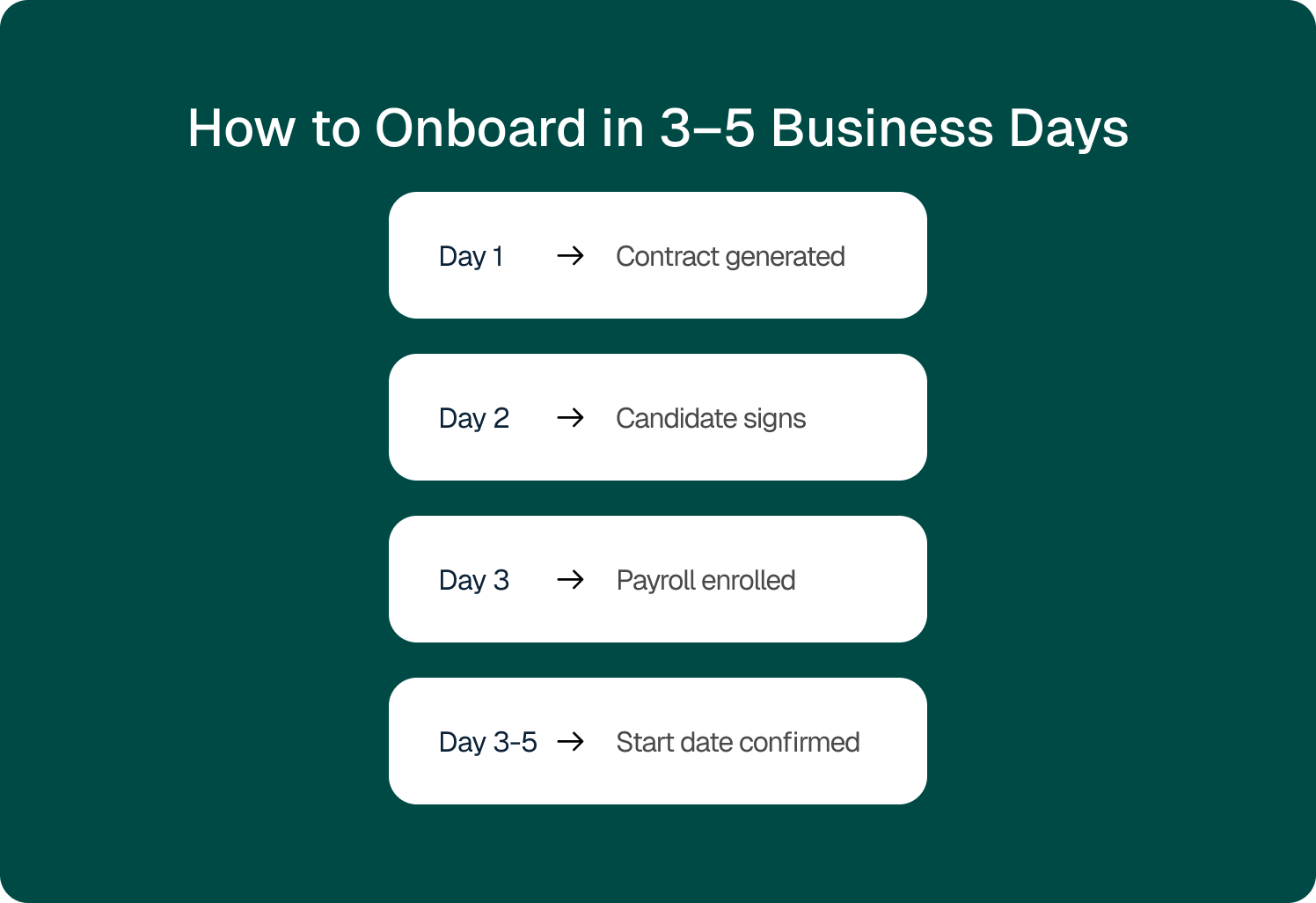
Hiring internationally no longer needs to involve months of entity setup, legal administration, and payroll implementation. With the right hiring model and local employment infrastructure already in place, businesses can hire employees in Europe in just a few business days while remaining compliant with local employment laws.
Although timelines vary by country and candidate responsiveness, organisations using an Employer of Record can typically move from signed offer to compliant employment within one working week.
Typical European Onboarding Timeline
| Timeline | What happens |
|---|---|
| Day 0 | Offer accepted and employment details confirmed. |
| Day 1 | Country-specific employment contract generated and compliance checks completed. |
| Day 2 | Employee reviews and signs the contract, with payroll information collected. |
| Day 3 | Payroll registration, statutory benefits, and employment documentation are finalised. |
| Days 4–5 | Employee is fully onboarded and ready to begin work. |
What Makes Hiring Faster?
Speed comes from preparation rather than shortcuts. Providers with established employment infrastructure, local legal expertise, and country-specific onboarding processes can complete much of the administrative work in parallel rather than sequentially.
WorkMotion combines owned entities across key European markets with local compliance expertise and standardised onboarding workflows, helping businesses hire quickly without compromising legal compliance or the employee experience.
Best Practices for Hiring Abroad
Choosing the right hiring model is only one part of successful international expansion. The organisations that build high-performing global teams also invest in understanding local employment practices, creating a consistent candidate experience, and planning for long-term growth rather than individual hires.
Understand Local Employment Expectations
Every European country has its own approach to employment contracts, probation periods, notice requirements, mandatory benefits, and working culture. Working with local experts helps ensure your hiring process reflects both legal requirements and candidate expectations from the outset.
Build Your Employer Brand Internationally
Competition for skilled professionals remains high across many European markets. Clearly communicating your company culture, career development opportunities, flexible working policies, and long-term vision helps attract candidates who are aligned with your organisation beyond salary alone.
Plan Beyond Your First Hire
Hiring one employee internationally is relatively straightforward. Scaling to ten or fifty employees across multiple countries introduces additional complexity around payroll, compliance, reporting, and workforce management. Choosing a hiring model that can scale alongside your business reduces future disruption as your international team grows.
Why More Companies Are Choosing Employer of Record Services
Hiring internationally has traditionally required businesses to establish a legal entity in every country where they employ people. While that approach offers complete operational control, it also comes with sizeable upfront costs, administrative complexity, and ongoing compliance responsibilities that may not be justified for a small or growing international team.
Employer of Record (EOR) services provide an alternative. Rather than creating a local entity before making a hire, businesses can engage an EOR that becomes the legal employer in-country while the employee works exclusively for your organisation. The provider manages payroll, statutory benefits, tax withholding, employment contracts, and ongoing compliance with local employment law, allowing businesses to hire quickly without sacrificing compliance.
If you’re still evaluating providers, it’s worth comparing the best Employer of Record services in Europe before deciding which employment model best fits your expansion plans.
That said, an EOR isn’t always the right long-term solution. Organisations planning substantial growth in a single market may eventually benefit from establishing their own entity, while companies engaging genuinely independent freelancers may find contractor management more appropriate. The key is selecting the hiring model that matches your current stage of growth, compliance requirements, and long-term expansion plans.
Which Hiring Model Is Right for Your Business?
There is no single “best” way to hire internationally. The right approach depends on where you’re hiring, how quickly you need to onboard employees, and whether you’re building a permanent presence or testing a new market.
The comparison below highlights when each hiring model typically makes the most sense.
| Hiring model | Best for | Time to hire | Compliance responsibility | Upfront investment | Brand ownership |
|---|---|---|---|---|---|
| Employer of Record | Companies entering new markets without establishing an entity | 3–5 business days | EOR provider | Low | Employee works for your business while employed locally by the EOR |
| Direct Hiring | Businesses ready to employ people through their own overseas entity | Several weeks to months | Your organisation | Medium | Full |
| Local Entity | Long-term expansion with significant headcount in one country | Several months | Your organisation | High | Full |
| Contractor Management | Genuine independent contractors and project-based work | A few days | Shared – business remains responsible for correct classification | Low | N/A |
Ultimately, the decision comes down to balancing speed, flexibility, compliance, and long-term business objectives. Many organisations begin with an Employer of Record to establish a presence quickly before transitioning to Direct Hiring as their international operations mature.
Choosing the right hiring model is only part of the equation. Before you can decide whether Employer of Record, Direct Hiring, or Contractor Management is the right fit, you first need to find the right people. If you’re still sourcing talent, Synmatch AI is WorkMotion’s AI-native recruitment platform, helping businesses identify and shortlist qualified candidates across Europe that can also be onboarded as team members through WorkMotion’s global hiring infrastructure.
Why WorkMotion Supports Every Stage of International Hiring
International hiring rarely follows a straight line. A company may begin by engaging contractors, hire its first overseas employee through an Employer of Record, and later establish its own legal entity as the business grows. Choosing separate providers for each stage often creates unnecessary complexity, fragmented processes, and additional compliance risk.
WorkMotion brings these employment models together within a single platform, giving businesses the flexibility to adapt their hiring strategy as their international workforce evolves.
Employer of Record
WorkMotion enables businesses to hire employees across Europe and more than 160 countries without establishing a local entity. As the legal employer in-country, WorkMotion manages compliant employment contracts, payroll, statutory benefits, tax withholding, and ongoing regulatory compliance while helping organisations onboard new employees in as little as three to five business days.
Direct Hiring
For organisations ready to employ people through their own overseas entity, WorkMotion’s Direct Hiring solution provides local HR, payroll, and compliance support while allowing businesses to retain direct employment relationships and strengthen their employer brand in-market.
Contractor Management
When engaging independent professionals, WorkMotion helps businesses generate country-specific contractor agreements, monitor misclassification risk, manage contractor payments, and maintain compliant documentation throughout the engagement. If a contractor relationship evolves into full-time employment, businesses can transition workers onto an Employer of Record model without changing platforms. Taking a proactive approach to worker misclassification helps businesses reduce legal risk before contractor relationships become compliance issues.
Get Started With WorkMotion Today
Expanding into Europe creates access to highly skilled professionals, new markets, and long-term growth opportunities, but it also introduces new legal, payroll, and compliance responsibilities that vary from one country to the next. The right hiring model can dramatically reduce that complexity while giving your business the flexibility to grow at its own pace.
Whether you’re hiring your first international employee, building a distributed team across multiple European markets, or planning long-term expansion, WorkMotion combines Employer of Record, Direct Hiring, and Contractor Management within a single platform. Backed by owned entities across key European markets, the independently audited IEC Gold Certificate, and onboarding in as little as three to five business days, WorkMotion helps businesses hire with greater confidence while maintaining compliance as they scale.
If you’re evaluating the best approach for your international hiring strategy, speak with one of WorkMotion’s experts. We’ll help you understand which hiring model fits your business today, explain the compliance requirements for your target markets, and show how WorkMotion can support every stage of your global expansion.


















![idWjC-9cC6_logos 1 [Vectorized]](https://workmotion.com/wp-content/uploads/2026/02/idWjC-9cC6_logos-1-Vectorized.svg)