

There are two ways to hire someone in a country where you don’t have a legal entity. One takes three to six months and costs tens of thousands before the employee starts.
The other takes three to five business days and costs a predictable monthly fee. The first gives you full control and a local legal presence. The second gives you speed and flexibility. Neither is universally better, though, and the right choice depends on how many people you’re hiring and how committed you are to the market.
What often stalls the EOR vs entity setup decision is that each stakeholder needs different proof, and nobody has assembled it in one place. Finance needs a cost breakdown that includes the ongoing costs nobody quotes upfront. HR needs to know whether the contract lands this quarter or next. Legal needs to see who carries the liability if a termination goes wrong.
This article brings all three perspectives into a single decision framework.
EOR vs Entity Setup at a Glance
The fastest way to understand the EOR vs entity decision is to compare the two models side by side across the different variables that determine cost, risk, and control.
| Dimension | EOR | Local Entity Setup |
|---|---|---|
| Setup time | Days to weeks | 3–6 months |
| Upfront cost | None | Significant upfront costs |
| Ongoing management | Handled by the provider | Internal HR, audit, and local director |
| Compliance liability | Assumed by the provider | On your company |
| Control and legal presence | No local legal entity | Full ownership and legal presence |
| Reversibility | Easily scaled up or down | Fixed overhead, difficult to unwind |
What Each Model Actually Means for Your Business
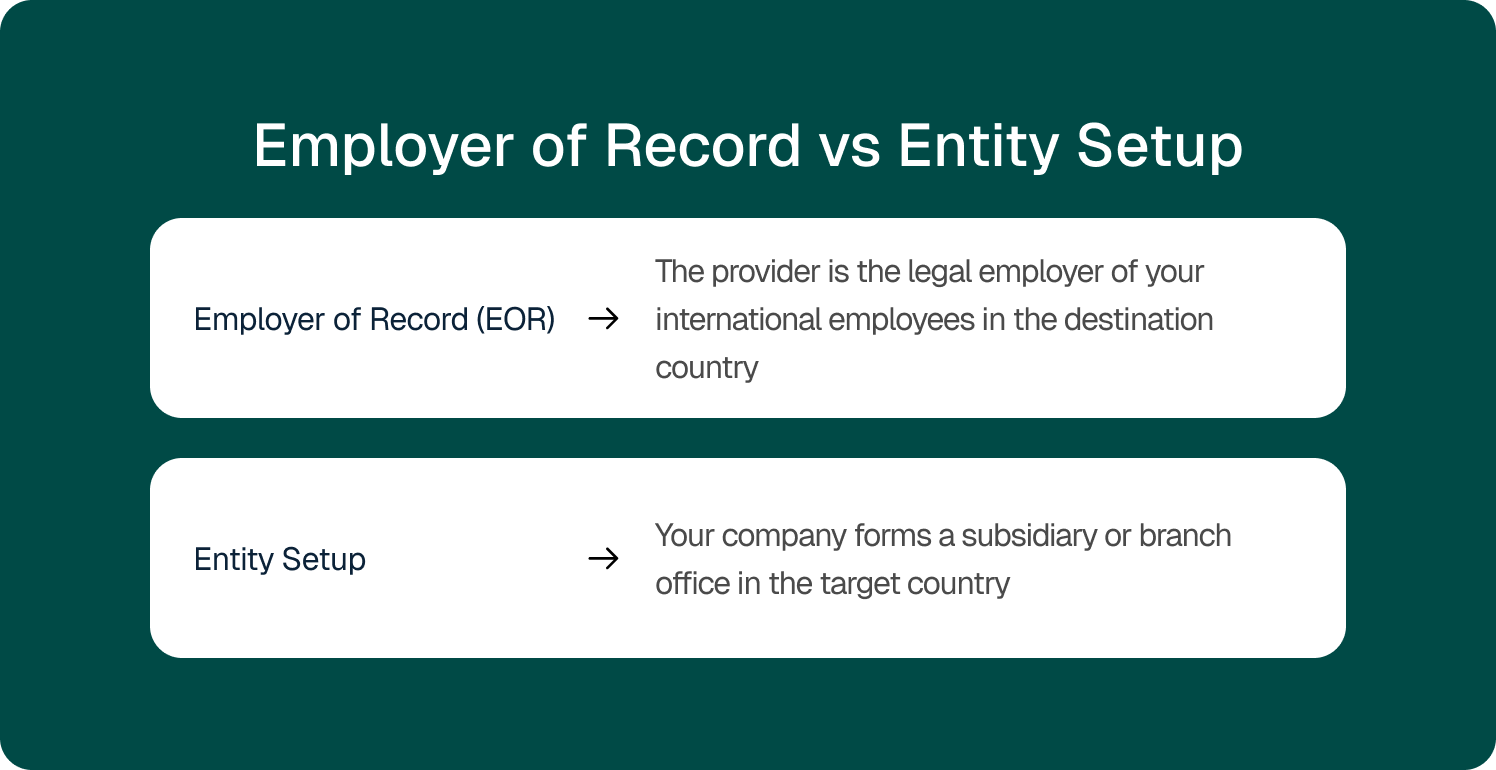
Before you start to consider costs, it’s worth knowing what each model means in operational terms rather than legal abstractions. The distinction comes down to who controls what, who owns what, and who is responsible for what on a day-to-day basis.
Employer of Record (EOR)
With an employer of record, the provider is the legal employer of your international employees in the destination country.
That means the provider:
- Holds the employment contracts
- Manages payroll
- Handles tax filings and social security contributions
- Assumes legal responsibility for compliance with local labour laws and employment regulations.
You direct the day-to-day work, set the salary, and manage the employee’s performance. But the EOR holds the legal employer status and bears the compliance risks. This means you don’t need to establish a local legal entity, open bank accounts in-country, or hire local HR and legal staff to manage ongoing compliance.
The employer of record is a third-party service provider that absorbs the administrative and legal complexity of hiring across multiple countries, global markets, and managing global entities. This way, you can focus on your core business activities, hire employees, and build your global workforce.
Entity Setup
With an entity setup, your company forms a subsidiary or branch office in the target country. You register with local authorities to create your own legal entity, obtain tax identification numbers, open a local bank account, and become the legal employer directly. Your company holds entity ownership and full control over employment contracts, benefits, policies, and the local operation.
The trade-off is that your company bears all compliance obligations, including:
- Managing compliance with local laws
- Running local payroll
- Handling tax reporting and tax regulations
- Maintaining ongoing compliance with employment laws and labour laws
You’ll also need local expertise to navigate government approvals, minimum capital requirements, and statutory benefits.
The entity model gives you a long-term presence and a registered entity in-country, but it comes with administrative burdens and financial risk and penalties if compliance isn’t managed correctly.
The Real Cost Comparison: What Finance Needs to See
The cost comparison between EOR and setting up a local entity is hard to directly compare because the two models carry fundamentally different cost structures. An employer of record charges a predictable per-employee monthly fee.
An entity carries significant upfront costs plus ongoing overhead that compounds over time. Here’s what each model actually costs, broken down line by line.
Entity Setup Service Costs
Entity setup costs vary significantly by country, with Germany’s GmbH requiring €25,000 in minimum capital while France’s SAS needs just €1. The figures below represent typical ranges for European markets based on published incorporation data and legal fee benchmarks.
| Cost Category | Description | Estimated Range |
|---|---|---|
| Incorporation and government fees | Registration fees, legal filing, tax identification numbers | €1,200–€5,000 |
| Legal fees | Local lawyers for incorporation and locally compliant contracts | €2,500–€5,000 |
| Bank accounts setup | Opening a local corporate account | €300–€1,000 |
| Local director retainer | Required in some European markets (e.g., Ireland, Netherlands, Switzerland) | €250–€700/month |
| Annual statutory audit | Mandatory once size thresholds are exceeded | €3,000–€30,000+/year |
| Accounting fees | Monthly bookkeeping and tax filing | €250–€1,000/month |
| Benefits administration and procurement | Health insurance, pension, statutory benefits | €700–€9,000/year |
| Internal HR headcount | Staff to manage HR processes and compliance | €40,000–€70,000/year |
| Minimum capital requirements | Varies by country, can be significant | €5,000–€25,000+ |
| Office and infrastructure | Physical or registered office address | €50–€1,300/month |
The total estimated annual cost comes out to €13,900–€62,000+ per year, excluding internal staff time.
EOR Cost Components
With an EOR, the cost structure is transparent and predictable. Instead of fixed overhead, you pay four clear components per employee, with no setup fees or ongoing administrative costs.
| Cost Component | Description |
|---|---|
| Gross salary | The employee’s salary, set by you |
| Employer social contributions | Country-specific social security contributions and payroll taxes |
| WorkMotion service fee | From €499/employee/month |
| Country-specific deposit | Required in some markets |
To estimate what a hire costs in your target country, try WorkMotion’s free Employment Cost Calculator for a full breakdown including salary, employer contributions, and benefits management in seconds.
Hidden Entity Costs Finance Teams Miss
The costs that don’t appear in an incorporation quote are the ones that catch finance teams off guard. These are ongoing costs, not one-time fees:
- Local director retainer fees: Some European countries (such as Ireland, the Netherlands, and Switzerland) require a local resident director, and the retainer runs €250–€700/month indefinitely. Germany and France don’t require one, but banks often prefer it for account-opening purposes.
- Annual statutory audits: Mandatory once your entity exceeds country-specific size thresholds (balance sheet, revenue, or headcount), costing €3,000–€30,000+/year depending on company size and jurisdiction.
- Accounting fees: Monthly bookkeeping, tax filings, and financial reporting run €250–€1,000/month.
- Benefits procurement and administration: Sourcing and managing health insurance, pension contributions, and statutory benefits requires either an internal HR function or an outsourced provider.
- Internal HR headcount: Someone on your team needs to manage compliance management, payroll management, and local HR processes.
- Ongoing government fees: Annual filing fees, licence renewals, and regulatory submissions.
Compliance monitoring costs for a foreign subsidiary can exceed €10,000 per employee annually in regulated European markets. That’s not a one-time setup cost. As your headcount grows, this recurring annual expense gets even larger.
How Audit Costs Scale With Entity Size
Audit costs also scale steeply with entity size. A small subsidiary with fewer than 50 employees and a balance sheet under €7.5M is typically audit-exempt in Germany, France, and the Netherlands. Once you cross country-specific thresholds, the audit becomes mandatory and costs jump.
For a typical SME subsidiary with 5–10 hires, you’re likely looking at the lower end or full exemption.
What You Actually Pay With an EOR
With an EOR, you pay four components:
- Gross salary
- Employer social contributions (country-specific)
- EOR service fee (WorkMotion’s is from €499/employee/month)
- Any country-specific deposit requirements
You don’t need to worry about legal fees, registration fees, director retainers, or separate accounting or audit costs. The EOR handles payroll management, global payroll, benefits administration, tax reporting, and compliance with local laws as part of the monthly fee.
For a full breakdown of costs in your target country, WorkMotion’s pricing page provides transparent EUR figures before you commit.
Real-World Cost Comparison: Hiring One Engineer in Germany
Say you’re hiring a software engineer in Germany at a €70,000 gross annual salary. The two routes look nothing alike.
Going the entity route, you’d spend €15,000–€20,000 just to get the company registered, open a bank account, and put the legal paperwork in place. Then the ongoing costs stack up. There’s accounting, benefits procurement, internal HR headcount to manage compliance, and potential audit costs once you cross size thresholds.
Before you’ve paid your new hire a single euro, you’ve spent 3–6 months and incurred thousands in year-one overhead alone.
The EOR route tells a different story. Using WorkMotion’s Employment Cost Calculator, the total annual employment cost comes to €85,903.90, which includes gross salary, employer health, social, and pension contributions of ~€14,904/year, and the €1,000 bonus.
Add the WorkMotion service fee of ~€5,988 (€499/month × 12), and the total annual cost is approximately €91,892, with no upfront sunk cost and a first payroll run in 3–5 business days instead of 3–6 months.
For one hire, the EOR is significantly more cost-effective. The break-even point, where entity setup becomes cheaper than EOR fees, typically arrives at 6–10+ employees in a single country. Though this varies by market and salary level.
Speed and Compliance: What HR and Legal Need to Know
The EOR vs entity setup decision isn’t just about cost. Speed and compliance scope determine whether your hire lands this quarter or next, and whether your legal team can sign off without reservations.
Onboarding Timelines: Entity vs EOR
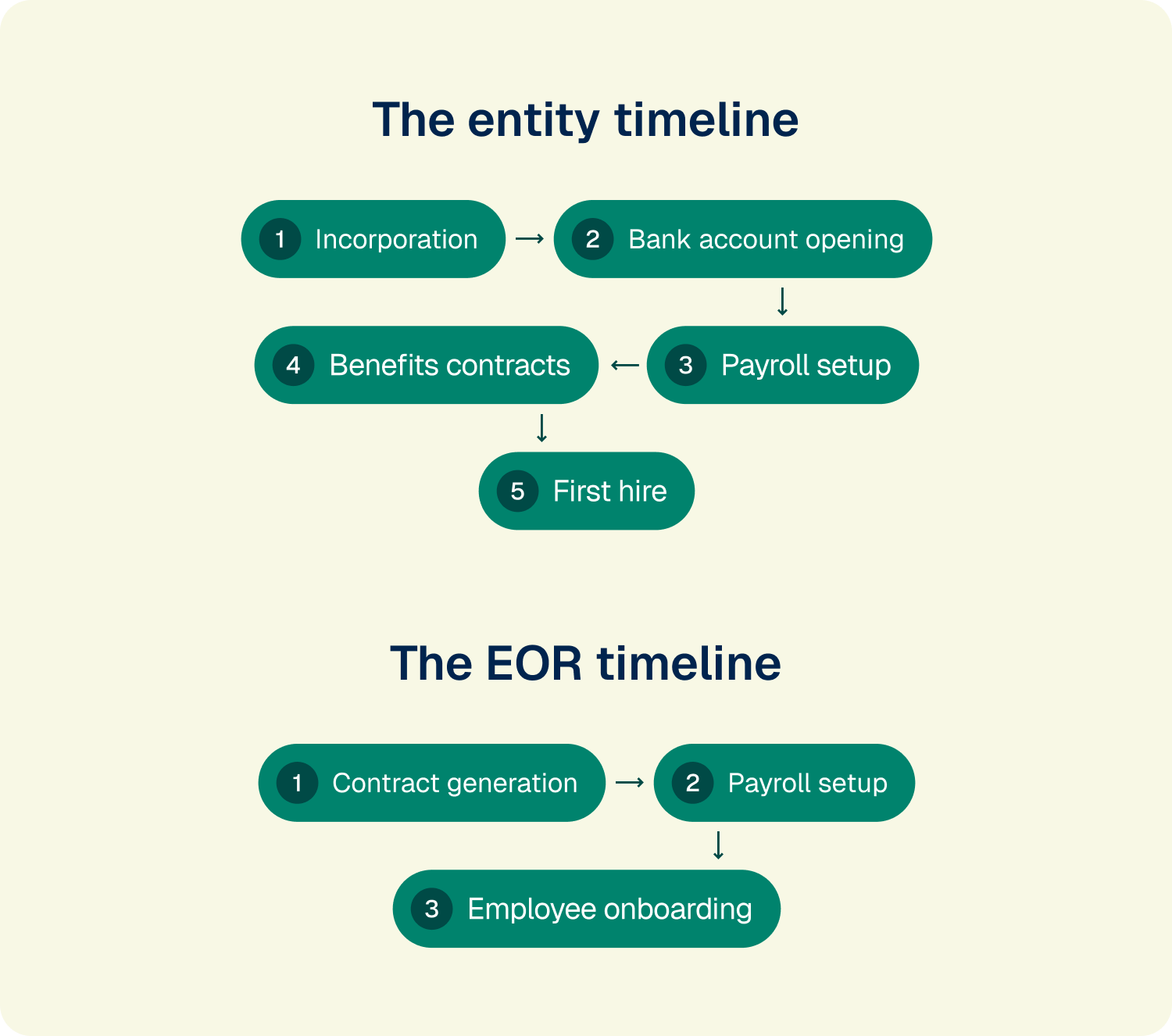
The entity timeline follows a sequential chain:
- Incorporation
- Bank account opening
- Payroll setup
- Benefits contracts
- First hire
Each step depends on the previous one, and the total timeline runs 3–6 months in most European markets.
The EOR timeline is dramatically shorter:
- Contract generation
- Payroll setup
- Employee onboarding
These three things can be completed in days. WorkMotion generates local contracts and locally compliant contracts in approximately 10 minutes and completes full onboarding in 3–5 business days. EORs eliminate the bureaucracy of hiring globally and reduce the administrative burdens that slow down internal teams.
Compliance Scope: What EOR Removes and What It Doesn’t
An EOR takes on a defined set of compliance responsibilities. EORs handle compliance with local labour laws, payroll management, and benefits administration, and assume full liability for compliance risks and violations.
WorkMotion’s compliance posture is independently verified through its IEC Gold Compliance Certification, the first independent compliance certification in the EOR industry. WorkMotion achieved Gold certification with the highest standard, making it the first global EOR to earn this distinction.
That means your legal team doesn’t have to take compliance claims on trust. An independent body has already verified them.
An EOR doesn’t take care of permanent establishment considerations and corporate tax obligations where they apply. If your company’s activities in a country create a permanent establishment, the corporate tax implications are separate from employment compliance and need to be assessed with your tax advisor.
While an EOR handles employment-side compliance, it doesn’t replace corporate tax advice.
When to Use EOR vs Setting up a Foreign Entity
The decision between when to use EOR vs setting up a foreign entity comes down to two main things. One is how many people you’re hiring, and two is how committed you are to the new market.
This matrix gives you a quick idea on which model fits what stage you’re at.
| Hires | Testing | Growing | Established |
|---|---|---|---|
| 1–5 hires | EOR, fast, low cost, reversible | EOR, still the cheaper option | EOR, unless you need a legal presence |
| 6–20 hires | EOR, cost-effective at this scale | Hybrid, start with EOR, consider Direct Hiring as the transition step | Entity, break-even favours entity setup |
| 20+ hires | Hybrid, EOR now, entity in parallel | Entity, entity is more cost-effective | Entity, full control and legal presence |
An EOR is preferred for market testing without long-term commitment. A foreign entity is better-suited for high-volume contracts as it provides full control and legal presence in-country.
Role-Based Guidance: HR, CFO, and COO Questions Answered
Each stakeholder in the EOR vs entity decision is trying to answer a different question. Here’s what each role needs to know.
What HR Needs to Know
HR’s question: How fast can we get this person onboarded, and will the employee experience be good?
With an EOR like WorkMotion, contract generation is instant, and full onboarding takes 3–5 business days. The employee receives locally compliant contracts, statutory benefits, and a dedicated Talent Success Manager. EORs reduce administrative burdens for global hiring, so your HR team isn’t managing local payroll or tax filings in a country they don’t know.
If lock-in is a concern, WorkMotion’s Direct Hiring product provides a transition path. When you’re ready to set up your own foreign entity, WorkMotion helps you register as a foreign employer and migrate employees onto your own contracts without losing continuity.
What the CFO Needs to Know
The CFO’s question: What does this actually cost, and is it predictable?
EOR fees are predictable per employee since you just have to pay the gross salary, employer social contributions, EOR service fee, and deposit. There aren’t any hidden costs, director retainers, or expensive audit fees.
WorkMotion’s transparent pricing model publishes the full cost breakdown in EUR before you commit, and the money-back guarantee means if onboarding doesn’t happen as promised, you don’t pay.
For a small number of hires, the EOR is significantly cheaper. The break-even point where an entity becomes more cost-effective typically sits at 6–10+ employees in one country, depending on salary levels and local compliance costs.
What the COO Needs to Know
The COO’s question: Is this reversible?
An EOR is a reversible market test. You can scale up or down easily, add or remove employees without unwinding a legal structure, and exit a market without the cost and complexity of closing an entity. When headcount and market commitment justify the overhead, the transition to an entity is an easily documented process.
When an EOR Is the Wrong Choice
An EOR isn’t the right answer for every scenario. These are the cases where setting up your own entity is the better, or only, option:
- Permanent, long-term operations and global expansion requiring a local legal entity and physical presence in-country.
- Regulated industries with licensing restrictions that require the employer to be a locally registered entity, not a third-party provider.
- Brand-critical employment where the legal employer identity matters, if your employment contracts need to be in your company’s name for client or partner relationships.
- High-volume contracts or government tenders that require a registered entity and legal presence in-country.
The EOR-to-Entity Transition: A Practical Runbook
Many companies start with an EOR and transition to an entity when headcount and market commitment justify the overhead. Here we’ve documented the path for doing that.
When to Trigger the Transition
The trigger point for a local entity is typically around 6–10+ employees in a single country, with 12+ months of market validation and a confirmed long-term growth plan.
At this scale, the fixed cost of an entity spreads across enough employees to make it more cost-effective than per-employee EOR fees.
EOR to Entity: Step-By-Step Transition Process
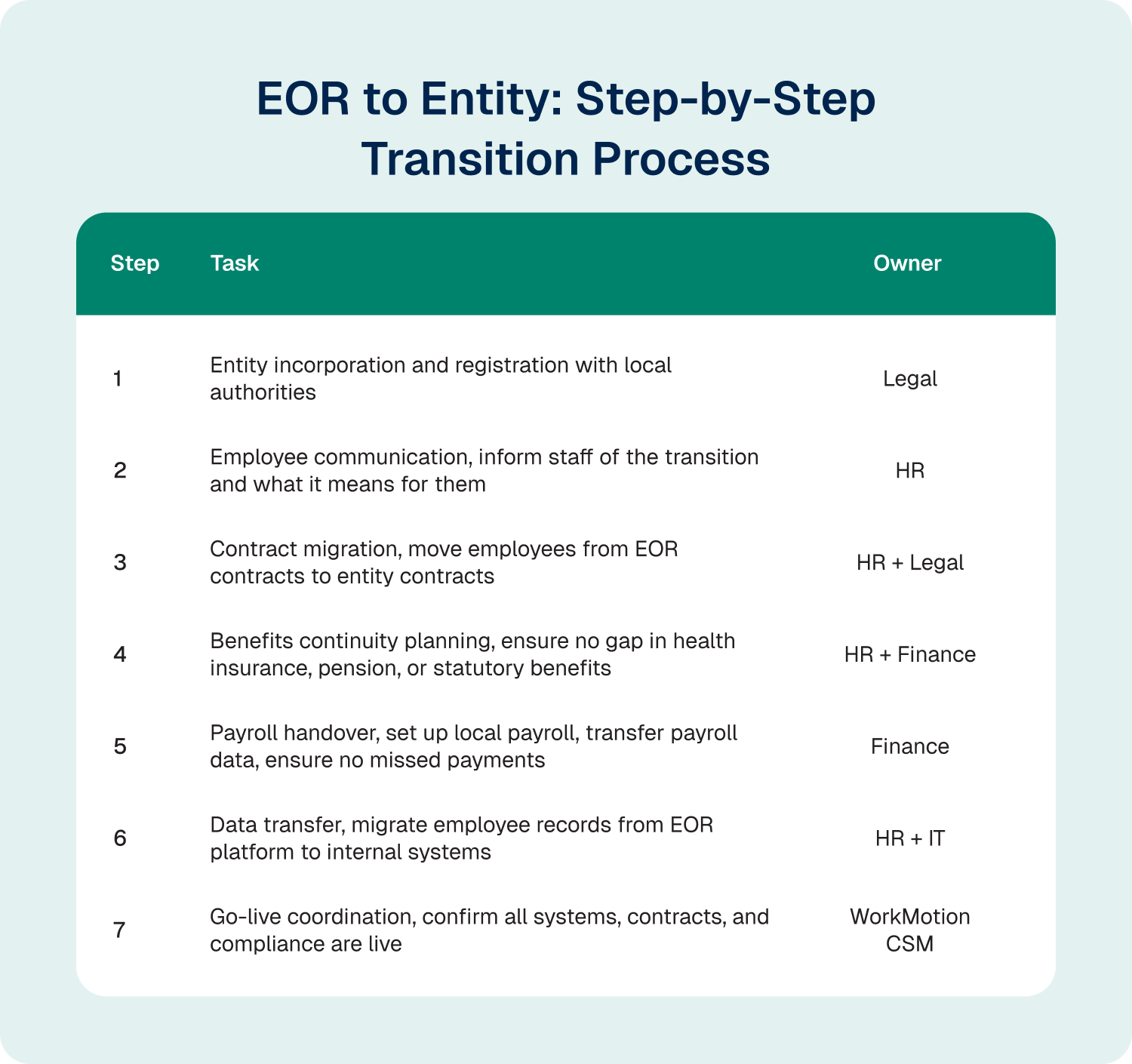
WorkMotion’s Direct Hiring supports this transition directly. WorkMotion helps you register as a foreign employer, migrate employees onto your own contracts, and manage the payroll and compliance handover so there’s no gap.
How WorkMotion Fits Into This Decision
If your personal EOR versus entity decision hinges on compliance risk accountability, WorkMotion’s independently audited IEC Gold Certification gives legal teams something most EOR providers can’t: proof, not promises. The certification means the compliance claims that other providers assert in marketing, WorkMotion has already had verified by a third party.
WorkMotion operates through its own licensed entities in core European markets, not through third-party partner networks. When you hire through WorkMotion, the party that holds the employment contract and the licence is the same party you contracted with.
For companies evaluating what an EOR really means in practice, that distinction matters.
For the transition path, WorkMotion’s Direct Hiring product provides the bridge from EOR to entity without leaving the platform. And the pricing model means finance can model the full cost before committing.
Get Set up With WorkMotion’s EOR Services Today
To sum everything up, use an EOR for 1–5 hires and testing in new markets. Set up an entity when headcount and long-term commitment justify the overhead, or when a legal presence is required for regulatory or commercial reasons.
Whether you’re hiring your first international employee or planning a transition to your own entity, WorkMotion provides the compliance infrastructure, clear pricing, and specialist support to make either path work.
Explore how WorkMotion compares to the best global EOR service providers or book a free 30-minute demo when you’re ready to learn more.


















![idWjC-9cC6_logos 1 [Vectorized]](https://workmotion.com/wp-content/uploads/2026/02/idWjC-9cC6_logos-1-Vectorized.svg)