

Hiring internationally is no longer reserved for enterprise organisations. Companies of every size are building distributed teams, entering new markets, and recruiting talent wherever the right skills are available. But while global expansion has become easier, staying compliant across multiple jurisdictions has become significantly more complex.
Every country has its own employment legislation, payroll requirements, tax obligations, worker classification rules, and data privacy regulations. Missing just one of these requirements can lead to financial penalties, delayed hiring, reputational damage, or costly cross-border legal issues that slow international growth.
Many organisations treat compliance as a purely legal exercise. In reality, successful cross-border compliance depends on collaboration between HR, finance, and legal teams, each responsible for different parts of the employment lifecycle. Without clear ownership, even well-planned international hiring strategies can create unnecessary cross-border challenges.
Platforms such as WorkMotion help organisations simplify global hiring by providing compliant employment solutions, local expertise, and automated workflows that reduce administrative complexity while supporting international expansion.
In this guide, we’ll explain what cross-border compliance means, explore the responsibilities shared across HR, finance, and legal teams, and examine nine of the most common compliance challenges businesses face when hiring internationally.
What Is Cross-Border Compliance?
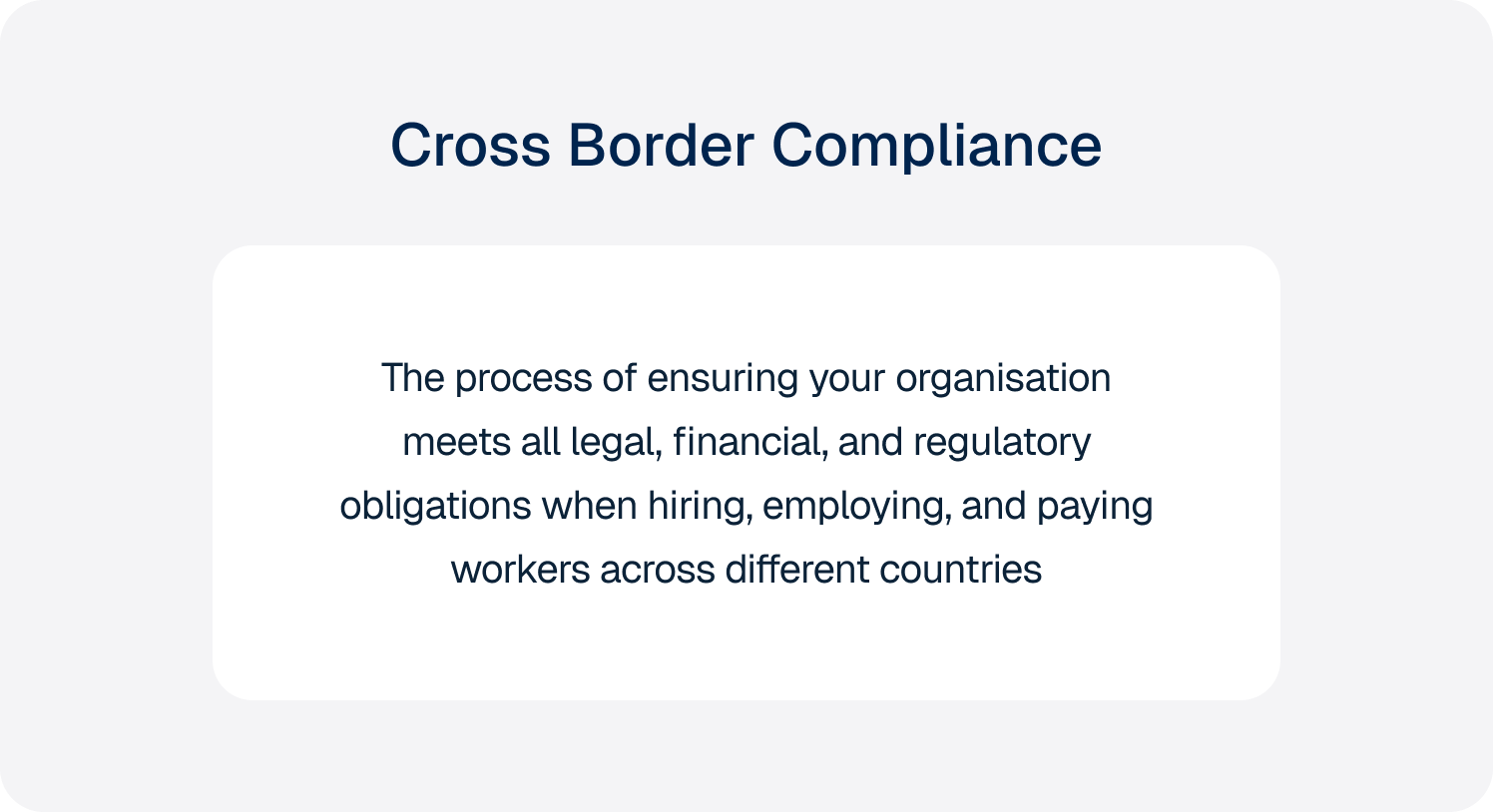
Cross-border compliance is the process of ensuring your organisation meets all legal, financial, and regulatory obligations when hiring, employing, and paying workers across different countries. It extends beyond simply following local employment laws and includes payroll, taxation, social security contributions, employee classification, immigration requirements, benefits, and data protection regulations.
However, cross-border compliance is about more than avoiding legal penalties. A well-designed compliance strategy helps reduce operational risk, protects employee trust, and gives businesses the confidence to expand into new markets without unnecessary disruption.
Because every jurisdiction has its own employment legislation, payroll requirements, tax obligations, and reporting standards, organisations must adapt their processes for each country where they operate. A compliant employment contract in Germany may not satisfy legal requirements in Spain, while statutory benefits, notice periods, and payroll reporting obligations can vary significantly across Europe and beyond.
Maintaining compliance is therefore an ongoing responsibility rather than a one-time exercise. Employment legislation evolves regularly, meaning businesses must continuously monitor regulatory changes, review internal policies, and ensure their global employment practices remain aligned with local requirements.
Why Cross-Border Compliance Matters
International expansion creates opportunities to access new markets and global talent, but it also introduces new legal and operational responsibilities. A single compliance failure can disrupt payroll, delay employee onboarding, trigger financial penalties, or damage your organisation’s reputation.
Many organisations underestimate the complexity of cross-border legal issues. Labour laws, tax regulations, social security contributions, worker classification rules, and data privacy requirements differ between jurisdictions, while regulatory updates can quickly make previously compliant processes outdated. Even experienced HR, legal, and finance teams can struggle to keep pace with these changes.
Building compliance into your expansion strategy from the outset helps reduce cross-border challenges before they become costly problems. Rather than reacting to issues after entering a new market, organisations should establish consistent processes for contracts, payroll, reporting, and governance that can be adapted for each country where they operate.
Technology also plays an increasingly important role. Modern global employment platforms can automate contracts, payroll, onboarding, compliance monitoring, and regulatory updates, helping organisations reduce manual administration while improving consistency across international operations. Combined with local expertise, these tools enable businesses to scale internationally with greater confidence and lower compliance risk.
The most successful global employers recognise that compliance is not owned by one department alone. HR, finance, and legal teams each have distinct responsibilities, and aligning those functions is essential for managing international growth effectively.
Who Owns Cross-Border Compliance?
Successful cross-border compliance isn’t the responsibility of one department. While legal teams play a vital role in interpreting local legislation, HR, finance, and legal must work together to ensure every stage of the employee lifecycle complies with local requirements.
For example, HR may be responsible for issuing compliant employment contracts and onboarding new hires, but finance must ensure payroll, taxes, and statutory contributions are processed correctly. At the same time, legal teams are responsible for monitoring employment legislation, advising on worker classification, and reducing regulatory risk.
When these responsibilities aren’t clearly defined, compliance gaps quickly emerge. A payroll process may comply with tax regulations but overlook statutory benefits, or an employment contract may satisfy local labour laws while incorrectly classifying a contractor as an employee.
Establishing clear ownership across each function reduces these risks and creates a scalable framework for international hiring.
Effective compliance also begins long before an organisation hires its first international employee. HR, finance, and legal teams should work together to identify target markets, understand local employment legislation, assess payroll and tax obligations, and determine whether an Employer of Record or local entity is the most appropriate hiring model. Investing time in planning helps businesses reduce cross-border compliance risk before expansion begins rather than reacting to issues later.
Cross-Border Compliance Responsibility Matrix
| Compliance Area | Primary Owner | Supporting Teams | Why It Matters |
|---|---|---|---|
| Employment contracts | HR | Legal | Ensures contracts comply with local employment legislation. |
| Employee classification | Legal | HR | Prevents costly employee misclassification claims. |
| Payroll processing | Finance | HR | Ensures employees are paid accurately and on time. |
| Tax and social security | Finance | Legal | Meets country-specific tax and reporting obligations. |
| Benefits administration | HR | Finance | Delivers statutory and contractual employee benefits. |
| Immigration and work permits | HR | Legal | Enables employees to work legally in each country. |
| Data privacy and GDPR | Legal | HR, IT | Protects employee data and supports regulatory compliance. |
| Regulatory monitoring | Legal | HR, Finance | Keeps policies aligned with changing legislation. |
| Compliance reporting and audits | Finance | HR, Legal | Demonstrates compliance during internal and external audits. |
Now that we’ve established who owns each area of compliance, let’s explore the nine most common cross-border challenges organisations face when hiring internationally and how to overcome them.
9 Cross-Border Compliance Challenges and How to Solve Them

International expansion rarely fails because of a single compliance issue. Instead, organisations typically face multiple cross-border challenges that span HR, finance, and legal, each carrying different risks and responsibilities. The sections below group the most common compliance challenges by the team that usually owns them, making it easier to identify where potential risks lie and how to address them before they affect your global workforce.
HR-Led Compliance Challenges
HR teams are responsible for delivering a compliant employee experience from recruitment through to onboarding and ongoing employment. When hiring internationally, this means adapting policies and processes to local employment requirements rather than applying a one-size-fits-all approach.
1. Complying With Local Employment Laws
Every country has its own employment legislation covering contracts, probation periods, working hours, statutory leave, dismissal procedures, and employee rights. Businesses expanding internationally must adapt their employment practices for every market they enter.
Primary owner: HR (supported by Legal)
What failure looks like: Using non-compliant employment contracts or applying home-country employment practices overseas can lead to employment disputes, financial penalties, or invalid contracts.
How to solve it: Standardise global HR processes while tailoring employment contracts to local legislation. Many organisations work with an Employer of Record (EOR) to ensure contracts, onboarding, and employment practices remain compliant without establishing their own legal entity.
2. Managing Immigration, Visas, and Work Permits
Hiring international talent often involves visa sponsorship, work permits, and immigration compliance, all of which vary significantly between jurisdictions.
Primary owner: HR (supported by Legal)
What failure looks like: Delayed visa approvals or missing documentation can postpone start dates, prevent employees from working legally, or expose the organisation to regulatory penalties.
How to solve it: Build realistic recruitment timelines that account for immigration requirements and partner with local employment experts who understand country-specific visa processes.
3 Delivering Compliant Benefits and Onboarding
A positive employee experience starts with compliant onboarding. Beyond issuing contracts, employers must provide statutory benefits, register employees with the appropriate authorities, and ensure onboarding processes meet local requirements.
Primary owner: HR (supported by Finance)
What failure looks like: Missing statutory benefits, delayed onboarding, or inconsistent employee experiences can damage retention and increase compliance risk.
How to solve it: Create standardised global onboarding processes while adapting benefits and employment documentation to local legislation. Centralised employment platforms can help automate onboarding and maintain consistency across multiple countries.
Finance-Led Compliance Challenges
Finance teams ensure employees are paid accurately and that organisations meet local tax, reporting, and statutory contribution requirements. As businesses expand internationally, these responsibilities become increasingly complex across multiple jurisdictions.
4. Managing Cross-Border Payroll
Paying international employees involves much more than transferring salaries. Payroll must account for local tax rules, statutory deductions, exchange rates, reporting obligations, and payment schedules.
Primary owner: Finance (supported by HR)
What failure looks like: Payroll errors can result in incorrect tax deductions, delayed salary payments, employee dissatisfaction, and regulatory penalties.
How to solve it: Use global payroll solutions that automate tax calculations, statutory deductions, and local currency payments while maintaining consistent reporting across every market.
5. Meeting Tax and Social Security Obligations
Every country applies different rules for income tax, employer contributions, pensions, and social security. Employers must understand where employees are tax residents and ensure all statutory obligations are met.
Primary owner: Finance (supported by Legal)
What failure looks like: Incorrect tax calculations or missed social security contributions can result in fines, back payments, or double taxation.
How to solve it: Combine automated payroll systems with local tax expertise to ensure calculations remain compliant as regulations evolve.
6. Maintaining Compliance Reporting and Audit Readiness
International employers must maintain accurate employment records, payroll documentation, tax filings, and compliance evidence across every country where they operate.
Primary owner: Finance (supported by HR and Legal)
What failure looks like: Poor record keeping can slow audits, create reporting gaps, and make it difficult to demonstrate compliance during regulatory investigations.
How to solve it: Centralise employment records, automate reporting where possible, and establish regular compliance reviews to identify issues before they become audit findings.
Legal-Led Compliance Challenges
Legal teams play a critical role in interpreting employment legislation, reducing regulatory risk, and ensuring organisations remain compliant as laws evolve across different jurisdictions.
7. Preventing Employee Misclassification
The distinction between employees and independent contractors differs between countries, making employee misclassification one of the most common cross-border legal issues organisations face.
Primary owner: Legal (supported by HR)
What failure looks like: Misclassifying workers can trigger back taxes, unpaid benefits, financial penalties, and legal claims.
How to solve it: Assess worker status using local legal guidance and consider using an Employer of Record when employing workers in unfamiliar jurisdictions.
8. Protecting Employee Data Across Borders
International employers must comply with data privacy regulations such as GDPR alongside country-specific rules governing how employee data is collected, stored, and transferred.
Primary owner: Legal (supported by HR and IT)
What failure looks like: Inadequate data protection measures can result in regulatory investigations, significant fines, and reputational damage.
How to solve it: Implement secure data management processes, conduct regular privacy reviews, and ensure employment systems meet local data protection requirements.
9. Keeping Pace With Changing Regulations
Employment legislation changes regularly, particularly in areas such as minimum wage, statutory benefits, payroll reporting, and worker protections. Staying compliant requires continuous monitoring rather than one-off policy reviews.
Primary owner: Legal (supported by HR and Finance)
What failure looks like: Outdated policies and employment practices can quickly become non-compliant, exposing organisations to unnecessary legal and financial risk.
How to solve it: Monitor legislative developments proactively and use trusted local experts or global employment partners that provide ongoing regulatory updates and compliance support.
Employer of Record vs Entity Setup
Many organisations assume they need to establish a local legal entity before hiring internationally. In reality, that isn’t always the most practical or cost-effective approach. The right employment model depends on your hiring plans, expansion strategy, and long-term business goals.
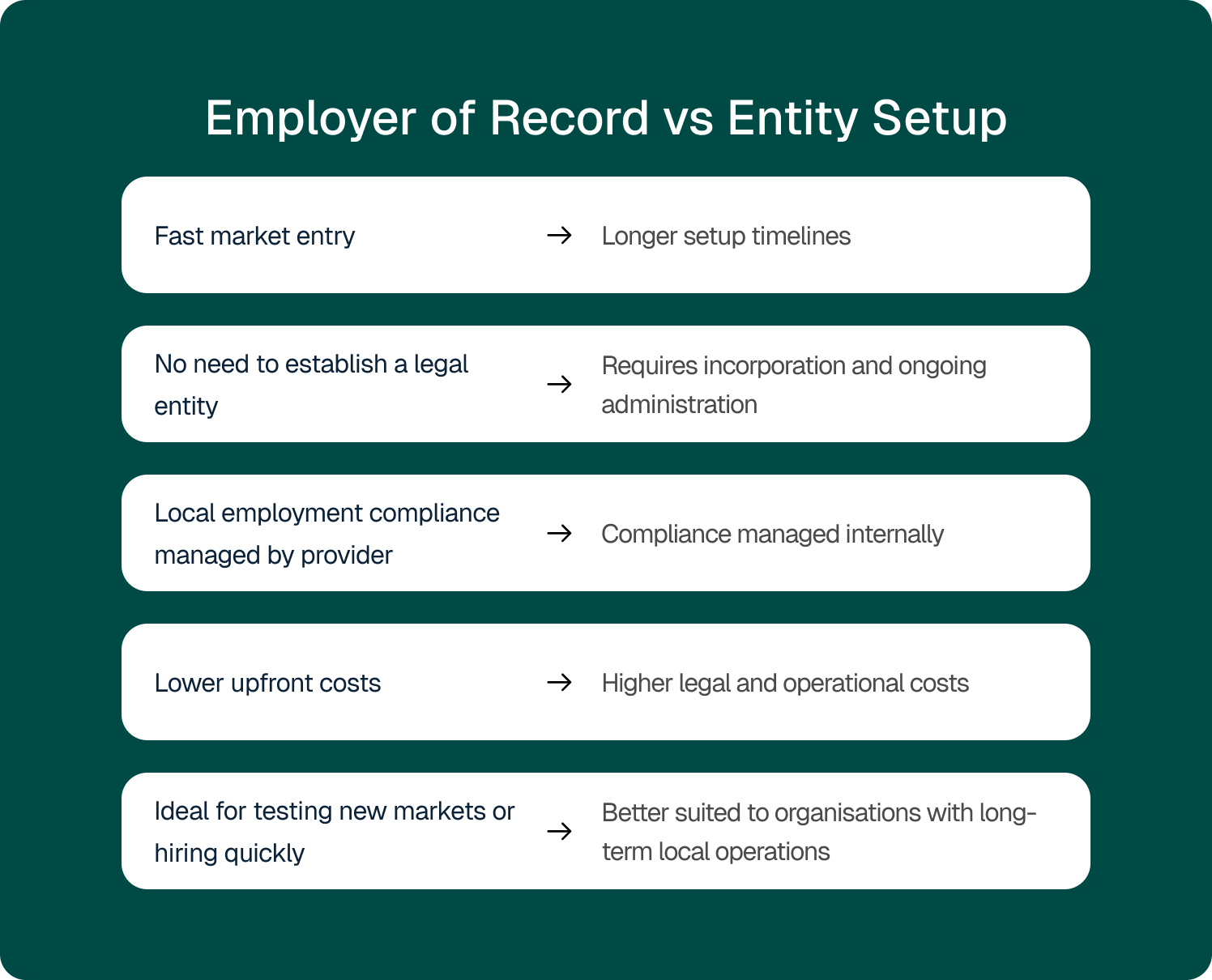
For many organisations entering a new market for the first time, an EOR offers a practical way to hire quickly while reducing administrative complexity and compliance risk. Businesses planning significant long-term operations may eventually decide that establishing their own entity is the better strategic option.
When Should You Choose an EOR?
An Employer of Record is often the right choice when businesses want to hire quickly in new markets without taking on the administrative burden of establishing a local entity. If your organisation plans to build a long-term presence with significant in-country operations, setting up your own entity may become more appropriate over time.
How to Evaluate an EOR Provider’s Compliance Depth
Once organisations understand the importance of cross-border compliance, the next challenge is choosing the right Employer of Record (EOR) or global employment partner. While many providers advertise coverage across dozens of countries, the depth of their compliance capabilities can vary significantly.
Some own legal entities and licences in-country, while others rely heavily on third-party partners. Asking the right questions about an EOR helps you assess a provider’s compliance expertise, not just its country count.
- Does the provider hold the required licences in each target country (for example, the AÜG licence in Germany)?
Why it matters: Licensing requirements vary across Europe, and missing licences can delay hiring or expose your business to compliance risk. - Does the provider own legal entities in-country or rely on third-party partners?
Why it matters: Direct ownership often provides greater operational control and more consistent compliance processes. - Has the provider completed an independent compliance audit, such as the IEC Gold Certificate?
Why it matters: Independent verification provides additional assurance that compliance processes have been externally assessed. - What service level agreements (SLAs) do you offer for contract generation, payroll accuracy, and onboarding?
Why it matters: Defined SLAs help set expectations for operational performance and employee experience. - Where is employee data stored, and how is GDPR compliance maintained?
Why it matters: Cross-border hiring requires strong data governance alongside compliance with local privacy laws. - What is your process for termination and severance in each country?
Why it matters: Employment termination requirements vary significantly between jurisdictions and are a common source of compliance disputes.
For example, WorkMotion has achieved the IEC Gold Certificate, maintains a 4.9-star Trustpilot rating, and reports a 100% customer satisfaction score (CSAT), giving buyers independent proof points they can verify during vendor evaluation.
Building a Compliance-First Organisation
Cross-border compliance doesn’t begin when you hire your first international employee, nor does it end once contracts are signed. Successful global employers treat compliance as an ongoing business process that supports sustainable growth rather than a one-time legal requirement.
Preparation is key. Before expanding into a new market, organisations should identify where they plan to hire, understand local employment legislation, assess payroll and tax obligations, and evaluate the risks associated with different employment models. Early planning helps reduce cross-border compliance risk while avoiding costly mistakes such as non-compliant contracts, payroll errors, or employee misclassification.
Just as importantly, compliance should be a shared responsibility across HR, finance, and legal teams. Regular communication between departments helps ensure hiring decisions, payroll processes, regulatory requirements, and employment policies remain aligned as the organisation grows internationally.
Technology also plays an important role in supporting compliance at scale. Modern global employment platforms can automate contracts, onboarding, payroll, statutory benefits, and regulatory monitoring. This reduces manual administration while helping businesses respond more quickly to changes in local legislation. Rather than replacing internal expertise, these tools enable HR, finance, and legal teams to work more efficiently and maintain consistent compliance across multiple jurisdictions.
Ultimately, building a compliance-first culture means making compliance part of everyday business operations rather than treating it as a reactive exercise. Businesses that expand successfully typically:
- Provide regular compliance training for HR, finance, and legal teams
- Encourage collaboration between departments rather than working in silos
- Establish clear reporting procedures for compliance concerns
- Review employment policies regularly as regulations evolve
- Make compliance part of everyday decision-making rather than reacting to problems after they occur.
When compliance becomes embedded within an organisation’s culture, businesses are better equipped to adapt to regulatory changes, support employees consistently across different markets, minimise cross-border legal issues, and scale internationally with confidence.
Get Started With WorkMotion and Become Compliant No Matter Where You’re Hiring
Cross-border compliance is far more than a legal obligation; it is the foundation of successful international hiring. As organisations expand into new markets, they must navigate evolving employment laws, payroll regulations, tax obligations, data privacy requirements, and worker classification rules across multiple jurisdictions. Without a clear compliance strategy, these challenges can quickly slow growth and increase operational risk.
The most successful organisations approach compliance as a shared responsibility. By aligning HR, finance, and legal teams, implementing consistent processes, and using the right employment model for each market, businesses can reduce compliance risk while creating a better experience for employees worldwide.
For organisations looking to simplify international hiring, WorkMotion provides compliant global employment solutions that support every stage of the employee lifecycle. Whether you’re hiring through an Employer of Record (EOR), exploring Direct Hiring, or planning long-term expansion with your own legal entity, WorkMotion helps businesses hire, onboard, and manage employees while remaining compliant with local employment regulations.
If you’re planning your next stage of international growth, book a demo to see how WorkMotion can help you build a compliant, scalable global workforce.


















![idWjC-9cC6_logos 1 [Vectorized]](https://workmotion.com/wp-content/uploads/2026/02/idWjC-9cC6_logos-1-Vectorized.svg)