

The offer is signed. Your new hire’s start date is set. Everything looks ready.
Then something slips. System access isn’t ready. Payroll paperwork is missing. The direct supervisor has no plan for the first week. A positive first impression quickly turns into a poor onboarding experience.
Most onboarding experiences break down between teams rather than during orientation. As your onboarding process expands across countries and remote teams, those gaps become harder to manage.
We’ll cover employee onboarding best practices, a practical 30/60/90 day framework, and the systems that help businesses deliver consistent onboarding through an Employer of Record (EOR).
Why Employee Onboarding Breaks Down at Scale
Most employee onboarding problems happen behind the scenes.
A new hire starts without system access. Payroll isn’t ready. Benefits enrollment is delayed. The direct supervisor assumes someone else owns the task. What should be a positive first impression quickly becomes a poor onboarding experience.
As companies hire more employees across multiple countries, the onboarding process becomes harder to manage. A workflow built for local hiring often can’t handle different employment laws, payroll rules, and compliance requirements.

For example, Germany’s AÜG regulations can affect certain hiring models. France has strict statutory benefit requirements. Poland applies country-specific notice period rules through local employment contracts.
Classification is another common risk. A worker may seem fully onboarded but still be incorrectly categorized. Understanding common employee misclassification risks is an important part of effective onboarding, especially when hiring internationally.
The good news is, these challenges are predictable and preventable.
10 Best Practices for New Employee Onboarding

The best practices for new employee onboarding work in any business. The challenge is keeping them consistent as your onboarding process expands across teams, countries, and hiring models.
The best employee onboarding practices combine clear ownership, strong communication, and repeatable systems that support onboarding success at scale.
1. Start Before Day One With Structured Preboarding
The onboarding process starts the moment a candidate accepts your job offer.
Before the first day, complete the essentials:
- Collect tax forms and identity documents
- Confirm equipment delivery timelines
- Set up accounts and system access
- Share practical information about the new position
This initial onboarding stage removes unnecessary friction and helps new employees focus on learning their roles rather than chasing paperwork.
2. Get the Compliance Layer Ready Before the Welcome Plan
Compliance isn’t part of onboarding. It’s the foundation of it.
Employment contracts, payroll enrollment, benefits registration, and local employment requirements should all be completed before work begins. This is especially important when managing international teams through an Employer of Record (EOR).
Without a compliant setup, there isn’t a legal employment relationship to onboard into.
3. Assign a Buddy or Mentor From Day One
Starting a new job can feel overwhelming, even for seasoned employees.
An onboarding buddy gives new employees someone they can approach with everyday questions that don’t always belong in a meeting with their direct manager. It also helps employees feel connected to the existing team much faster.
For remote teams, mentoring programs often fill the gap left by informal office conversations and help build relationships early.
4. Define Clear Ownership Across HR, IT, Finance, and Managers
Many onboarding experiences fail because responsibilities aren’t clearly assigned.
A simple ownership framework might look like this:
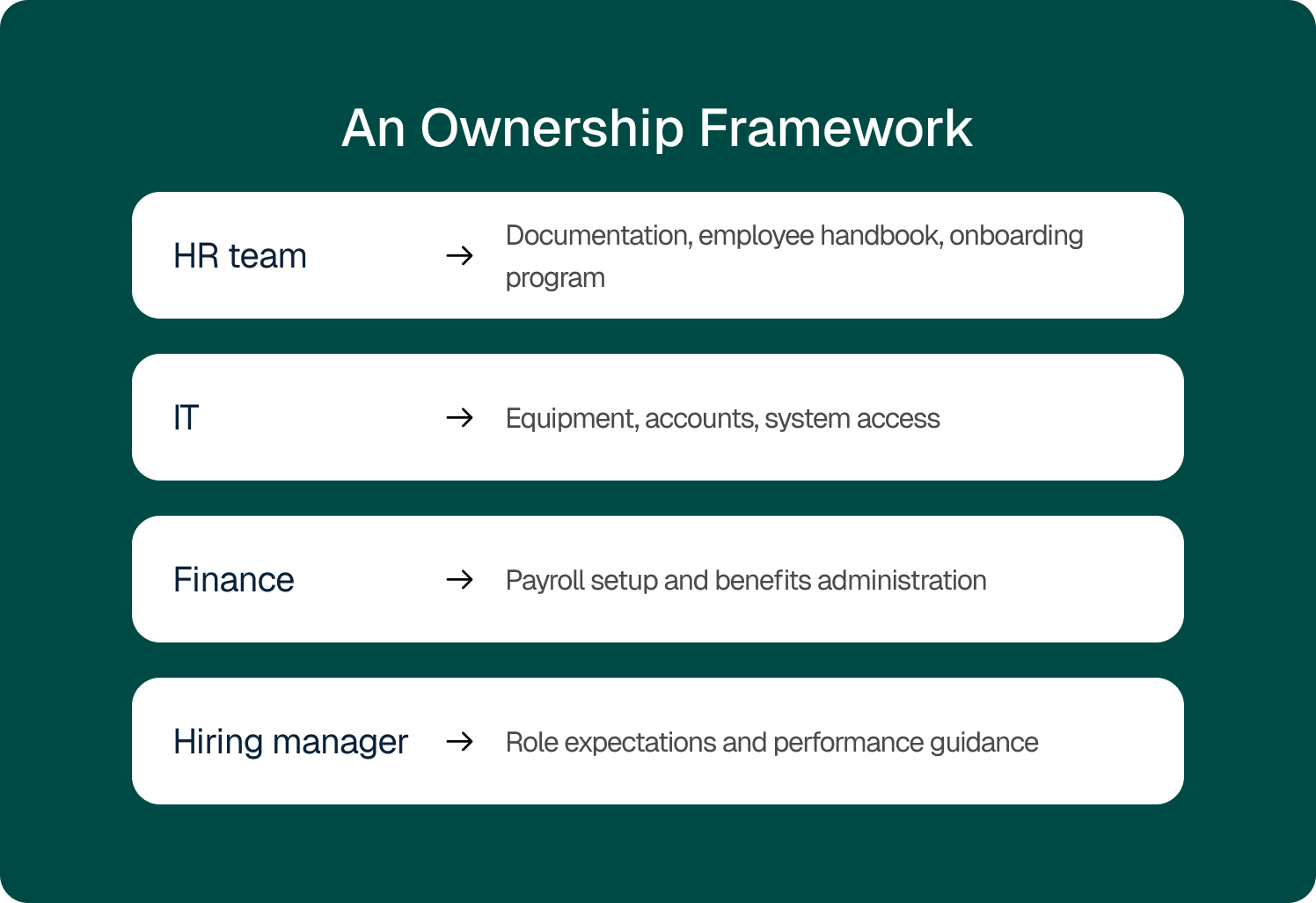
Clear ownership creates a more effective employee onboarding process and reduces the risk of tasks falling through the cracks.
5. Give the New Hire a Clear 30/60/90 Day Roadmap
One of the best practices for new employee onboarding is making expectations visible from the start.
A strong roadmap should define:
- Key responsibilities
- Performance expectations
- Job-specific training goals
- Success milestones
This gives the new hire clarity on what good performance looks like and improves time-to-productivity during the first 90 days.
6. Make the Hiring Manager Visibly Involved
The direct supervisor has a greater impact on onboarding success than any software platform.
The first week should include regular check-ins, role clarification, feedback discussions, and opportunities to ask questions. When managers stay involved, new hire engagement improves and employees are more likely to remain motivated.
Strong manager participation is one of the most overlooked onboarding best practices.
7. Localize the Experience for International Hires
A process designed for one country rarely works everywhere.
International onboarding should include localized documentation, country-specific benefits, accessible language support, and employment terms that reflect local regulations.
Companies using WorkMotion can manage local employment requirements while maintaining a consistent employee onboarding experience across multiple countries.
Generic onboarding experiences often struggle because they assume every market follows the same rules.
8. Design for Async-First Collaboration
Remote employee onboarding best practices should work across multiple time zones.
Instead of relying entirely on live meetings, prioritize:
- Recorded training sessions
- Written documentation
- Self-service resources
- Async check-ins
This approach helps other employees access information when they need it and creates a more consistent employee experience across distributed teams.
Managing updates and contract changes through documented workflows also becomes much easier when teams work asynchronously.
9. Build Feedback Loops Into the First 90 Days
The best employee onboarding practices improve over time.
Schedule structured check-ins during:
- Week one
- Day 30
- Day 60
- Day 90
Use those conversations to gather feedback, identify obstacles, and provide insight into the overall employee journey. Regular feedback also helps managers identify issues before they affect employee retention.
10. Plan Probation Management Deliberately
Probation periods shouldn’t be treated as administrative deadlines.
Instead, use them as structured development opportunities. Schedule review conversations early, revisit goals regularly, and document progress throughout the onboarding process.
Whether employees are hired through traditional employment models or direct hiring, a structured probation process helps hires feel supported and creates a stronger foundation for long-term success.
Understanding the distinctions among workforce models, such as independent contractors vs. employees, also helps businesses apply the right onboarding approach from the start.
When these onboarding best practices work together, effective onboarding becomes repeatable, scalable, and far easier to maintain as your business grows.
The 30/60/90 Day Onboarding Framework
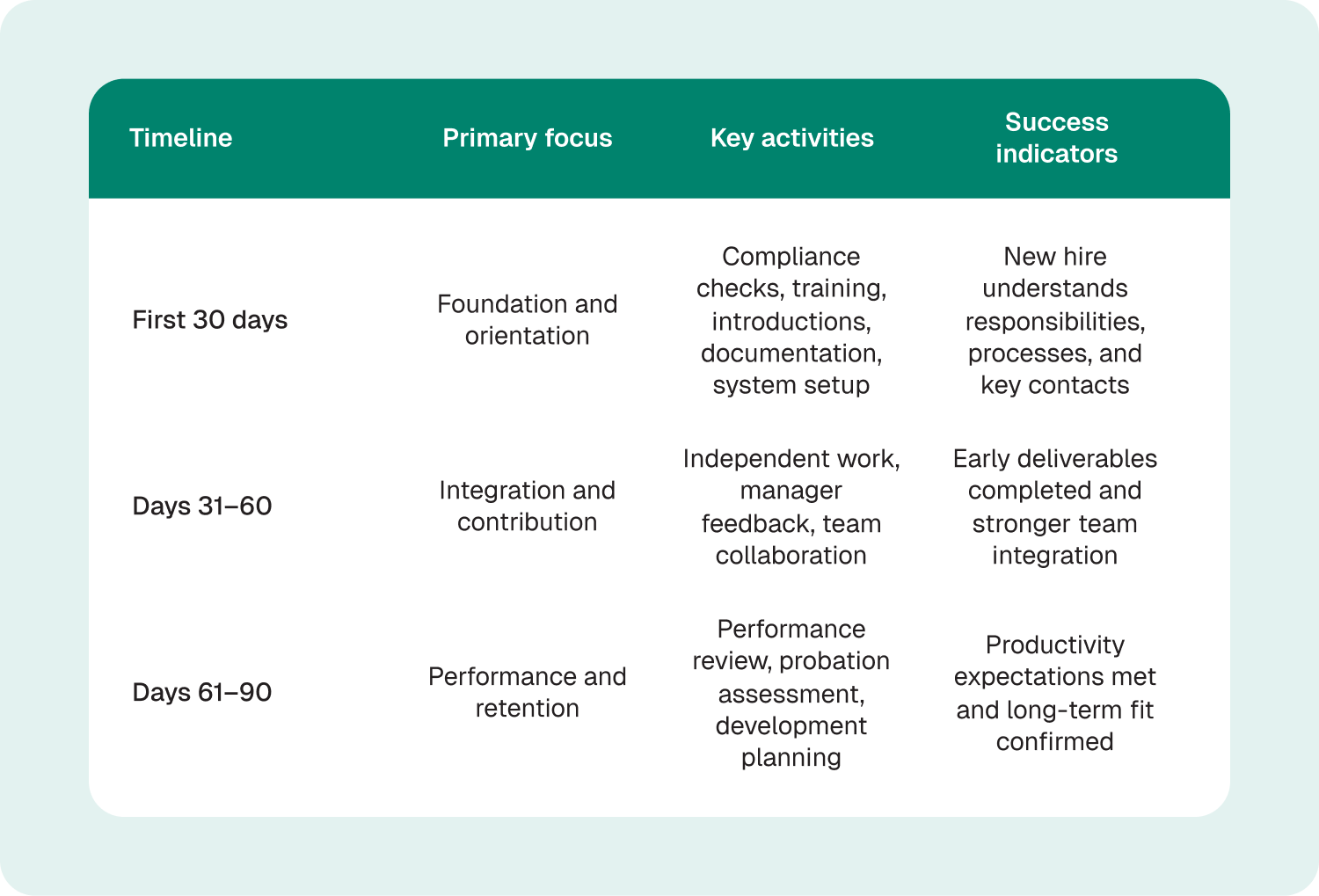
A structured employee onboarding process gives new employees clear goals and measurable progress. Instead of treating onboarding as a one-time event, this framework helps improve employee satisfaction, strengthen company culture, and support employee retention.
First 30 Days: Build the Foundation
The first month should focus on clarity and confidence. New employees should understand their job responsibilities, learn the company’s mission, company values, and company culture, and complete core training. Access issues should be resolved and key relationships established.
If done right: By day 30, employees should know what they’re responsible for, who owns which decisions, and where to go for support.
Days 31–60: Move Toward Independence
This stage shifts from learning to contribution. Employees should begin handling work independently while continuing to receive support from managers and other team members. Regular check-ins help track progress, gather feedback, and address issues early.
If done right: By day 60, employees should be delivering meaningful work and contributing confidently to team goals.
Days 61–90: Confirm Long-Term Success
The final phase focuses on performance, employee satisfaction, and long-term fit. Managers should review progress, discuss career development opportunities, and confirm that expectations remain aligned. Teams hiring internationally through contractors should also confirm that the engagement structure remains appropriate.
If done right: By day 90, employees should be meeting expectations, feel comfortable within the corporate culture, and be positioned for long-term success.
Your goal isn’t just to complete onboarding tasks. It’s to help every new hire become a productive member of the team.
Common Onboarding Mistakes to Avoid
Even strong onboarding programs can fail when a few key steps are missed. Watch out for these common mistakes:
- Treating compliance as a day-one task instead of a prerequisite
- Overloading new employees with information and offering no clear structure
- Failing to assign an onboarding buddy or mentor
- Leaving managers unprepared for the first week
- Using the same onboarding process in every country
- Skipping 30/60/90-day milestones and performance check-ins
- Not collecting feedback from the new hire
- Relying on automation without enough human interaction
- Waiting until the end of probation to discuss performance
Avoiding these issues can significantly improve onboarding success and create a better experience for both employees and managers.
How Onboarding Software and Automation Help With Employee Onboarding
The right onboarding software removes repetitive admin work and creates a more consistent employee onboarding process.
Here are some tasks most onboarding platforms can automate:
- Collecting documents and tax forms
- Managing e-signatures
- Generating contracts
- Provisioning accounts and system access
- Tracking onboarding progress
- Managing onboarding program checklists
These tools help new employees get what they need faster and allow HR teams to focus on people rather than paperwork. They also make it easier to maintain onboarding best practices as hiring volumes increase.
However, software alone doesn’t solve every onboarding challenge. International hiring is where many onboarding tools reach their limits.
They can automate paperwork and workflows, but compliance, benefits enrollment, and local payroll often require additional systems and processes.
WorkMotion combines onboarding and country-specific compliance in a single workflow, helping teams manage contracts, payroll enrollment, and local employment requirements while reducing administrative effort.
That means you’ll have onboarding support to help new employees reach time to productivity faster.
The best tools don’t just automate tasks. They help teams onboard employees correctly from day one.
How to Measure Onboarding Success
A successful onboarding process should be measurable. The right metrics help you identify gaps, improve the employee onboarding experience, and ensure new employees reach their expected productivity levels.
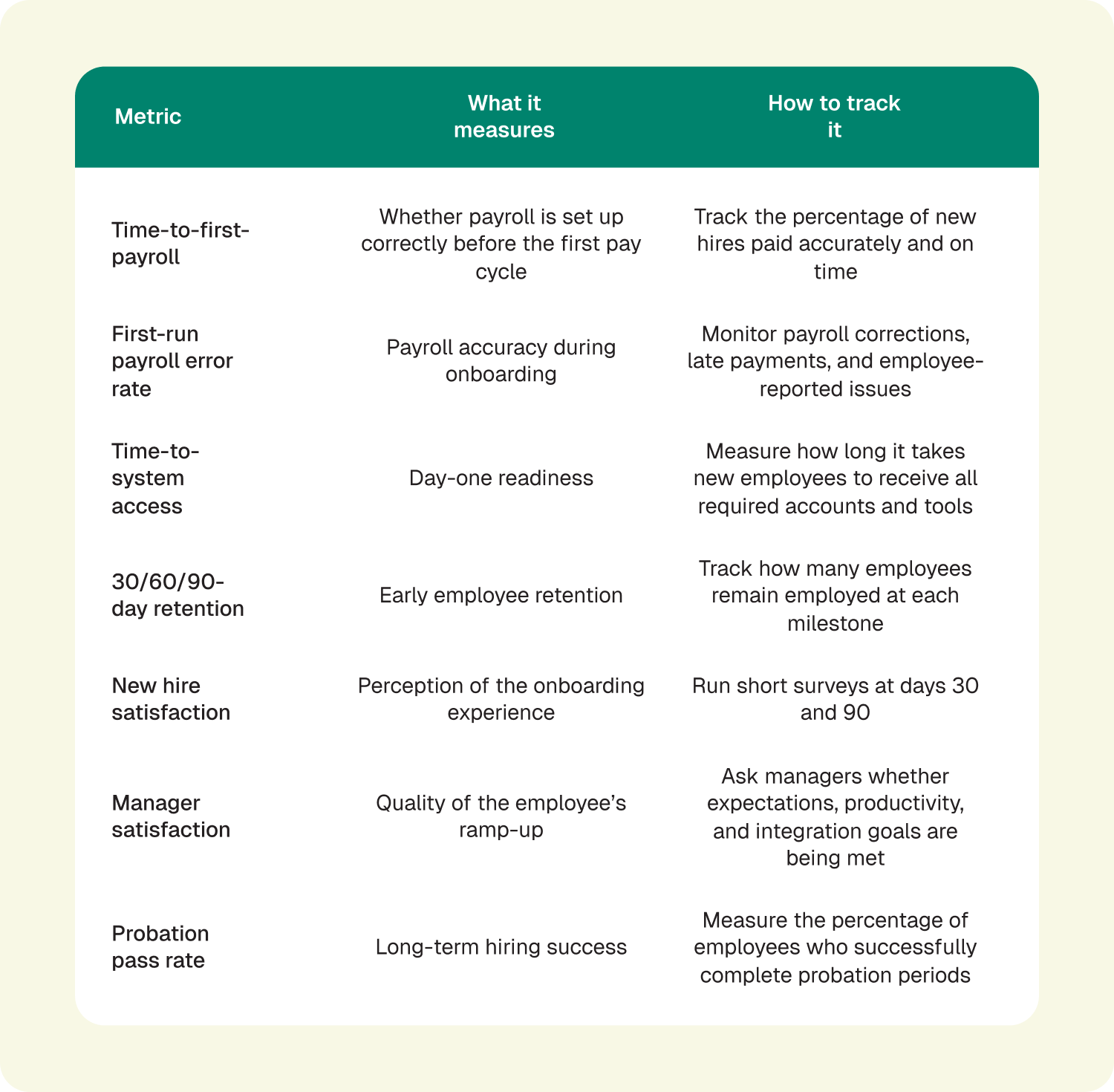
No single metric tells the whole story. The strongest onboarding programs combine operational measures, such as payroll and access readiness, with employee and manager feedback.
Together, they provide insight into onboarding success and highlight opportunities for improvement.
Final Thoughts
Great onboarding comes down to a few fundamentals: clear ownership, structured milestones, manager involvement, and regular feedback. These practices help new hires settle in faster and become productive sooner.
International hiring adds another layer. Contracts, payroll, benefits, and local employment requirements must all be in place before day one.
The strongest onboarding programs combine a great employee experience with operational readiness.
For teams hiring internationally, WorkMotion provides the infrastructure behind compliant onboarding, from employment setup and payroll enrollment to ongoing local compliance.
Book a demo to see how we can help your team onboard employees faster and with less risk.

















![idWjC-9cC6_logos 1 [Vectorized]](https://workmotion.com/wp-content/uploads/2026/02/idWjC-9cC6_logos-1-Vectorized.svg)