

You hired a few freelancers to move faster. Then a few became twenty. Suddenly, you’re managing contracts in multiple countries, chasing invoices, and trying to keep track of payments across different systems.
The best freelancer management software helps bring that complexity under control. Some tools focus on project tracking and freelance work, while others specialise in contractor management software, compliance, onboarding, and freelancer payments.
This guide compares eight leading freelancer management platforms, including WorkMotion, and explains which management system best fits different workforces and global talent needs.
Best Freelancer Management Software at a Glance
The best freelancer management software depends on what you’re trying to solve. Some platforms focus on project management and freelancer collaboration, while others help companies manage onboarding, compliance, payments, and global talent from a single system.
When evaluating international contractor hiring, it’s also important to understand contractor compliance, and the differences between independent contractors and employees can affect your long-term workforce strategy.
| Tool | Best for | Compliance depth | Path to employment | Global coverage | Pricing model |
|---|---|---|---|---|---|
| WorkMotion | International SMEs managing contractors who may later become employees | High | Yes | 160+ countries | From €29 per contractor |
| Deel | All-in-one contractor, EOR, and payroll management | High | Yes | 200+ countries and jurisdictions | From $49 per contractor/month |
| Remote | Global contractor management and compliance | High | Yes | 200+ countries and jurisdictions | From $29 per contractor/month |
| TalentDesk | Freelancer, contractor, and vendor management | Medium | No | 190+ countries | Custom quote |
| Worksome | External workforce sourcing and management | Medium | No | 150+ countries | Custom quote |
| Worksuite | Managing private freelancer networks at scale | Medium | No | 190+ jurisdictions | Public pricing unavailable |
| YunoJuno | Freelancer sourcing and contingent workforce management | Medium | No | 165+ countries | Custom quote |
| Fiverr Enterprise | Marketplace-based freelancer workforce management | Low/Medium | No | 160+ countries | Custom pricing |
What Type of Freelancer Management Tool Do You Actually Need?
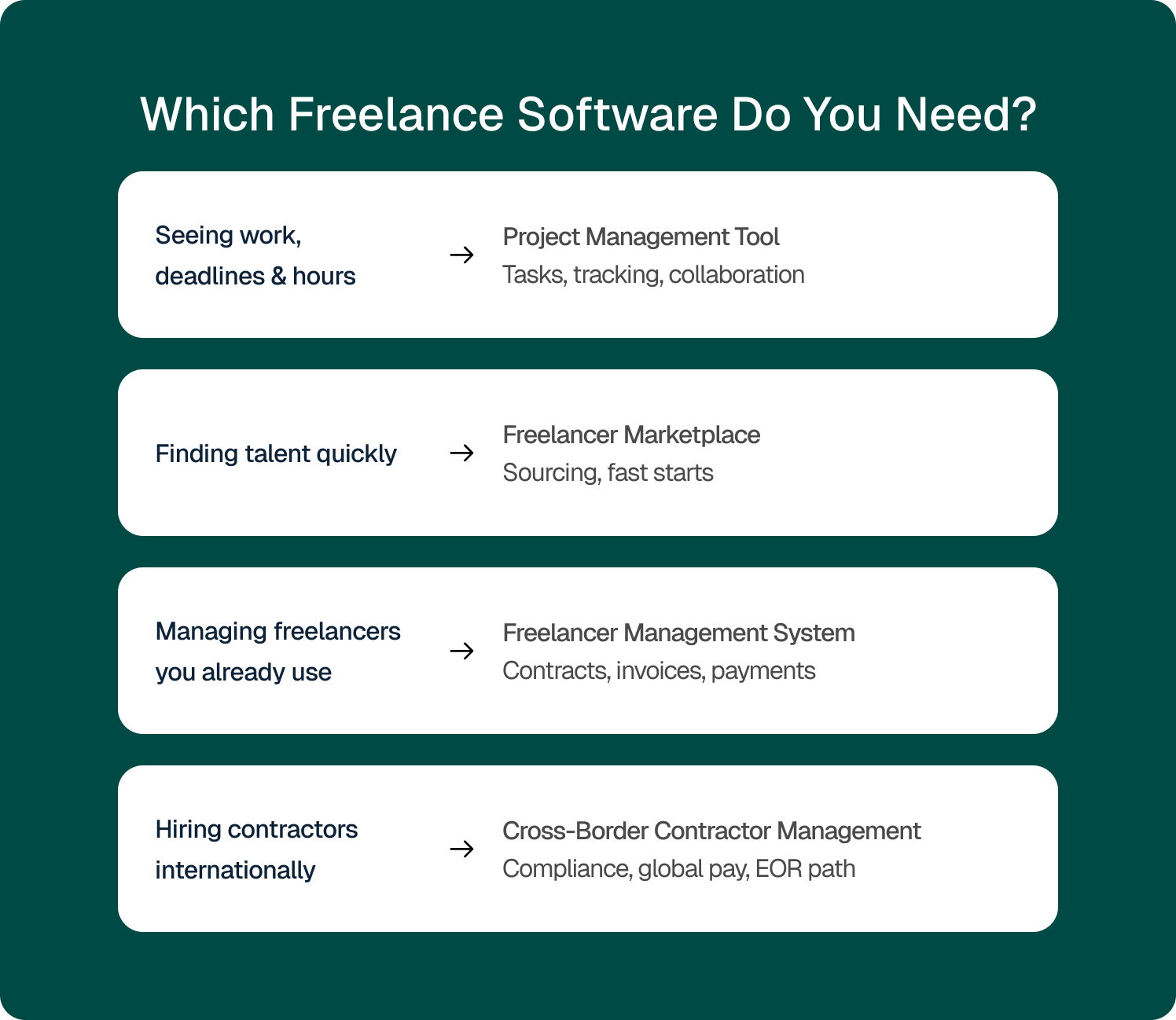
Not all freelancer management software is built for the same purpose.
The right choice depends on whether your biggest challenge is managing projects, finding talent, controlling a freelance workforce, or handling international contractor compliance.
Project Management and Time Tracking Tools
These tools help teams manage tasks, assignments, collaboration, and project tracking across multiple projects. They focus on execution rather than contracts, payments, or compliance.
Choose this when: Your main challenge is visibility into work, deadlines, and hours.
Freelancer Marketplaces
Marketplace platforms help companies find talent and start projects quickly. Some include onboarding and payment features, but sourcing is their primary purpose.
Choose this when: You need access to freelancers more than workforce management.
Freelancer Management Systems (FMS)
Freelance management systems centralise onboarding, contracts, invoices, vendors, reporting, and freelancer payments on a single platform. They help organisations manage an existing freelance workforce more efficiently.
Choose this when: You already work with freelancers and need better control and visibility.
Cross-Border Contractor Management With an Employment Path
These platforms combine contractor management software, onboarding, compliance, and global payments.
Solutions such as WorkMotion’s Contractor Management can also scale with you as your team and employee needs change, with an Employer of Record service allowing you to employ full-time employees from anywhere in the world.
Explore how WorkMotion helps companies manage contractors today and hire employees tomorrow. Book a 30-minute demo with us today.
Choose this when: You work with independent contractors internationally and may want to convert some to full-time employees later.
The question many buyers miss is simple: what happens when a contractor becomes someone you want to keep permanently?
8 Best Freelancer Management Software Solutions
Right now, you’re probably trying to solve one specific problem: finding talent, managing contractors, reducing compliance risk, or bringing a growing external workforce under control.
The tools below are built for different situations, so it’s worth understanding where each one fits before you start comparing features.
1. WorkMotion

Best for:
International SMEs managing contractors who want a single platform for compliant contractor management and a path to full employment.
WorkMotion combines contractor management, EOR, and Direct Hiring capabilities and is best for companies hiring internationally that may eventually want to convert contractors into employees.
Core strengths:
- Manage contractors compliantly across 160+ countries
- Convert contractors to employees through EOR without switching providers
- First EOR provider to achieve independent IEC Gold Certification for compliance
- Own entities in key European markets, including Germany, France, Spain, Portugal, Poland, and Italy
- Flexible hiring infrastructure through Contractor Management, Employer of Record, and Direct Hiring
Limitation:
WorkMotion is built for compliant workforce management rather than freelancer sourcing. If your primary goal is finding freelancers, a marketplace-based platform may be a better fit.
Pricing: Contractor Management starts at €29 per contractor per month.
Want a closer look? Take the WorkMotion product tour to see how contractor management, EOR, and Direct Hiring work together.
2. Deel

Best for:
Deel is best suited to companies that want contractor management, payroll, and EOR services in a single platform.
Core strength:
Deel brings contractor onboarding, compliance, global payments, payroll, and EOR services together in a single system. Its broad scope makes it appealing for companies that want to manage multiple workforce types through one provider.
Limitation:
Teams that only need contractor management may find Deel’s broader HR and payroll focus more than they need.
Pricing:
Contractor Management starts at $49 per contractor per month, making the base price pricier than WorkMotion.
Further reading: Compare WorkMotion vs. Deel.
3. Remote

Best for:
Remote is best suited to companies prioritising global employment infrastructure and compliance across multiple countries.
Core strength:
Remote focuses on helping companies hire and manage global talent while reducing compliance risk. Its platform combines contractor onboarding, localised contracts, tax documents, payments, and worker classification safeguards in a single workflow.
Limitation:
Remote’s focus leans more toward employment infrastructure than freelance management software designed around freelancer pools and vendor relationships.
Pricing:
Contractor Management starts at $29 per contractor per month.
4. TalentDesk
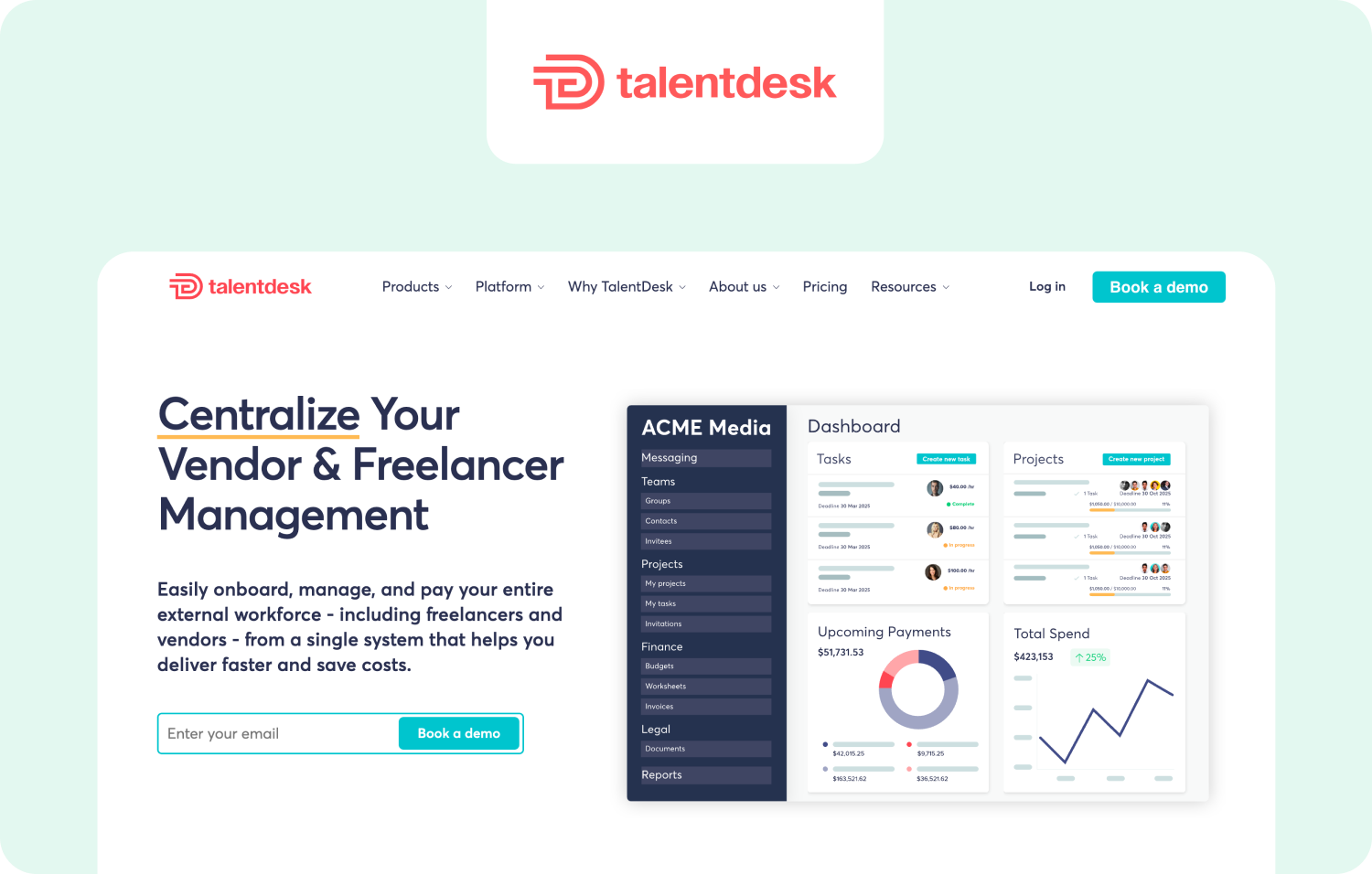
Best for:
TalentDesk is best suited to organisations managing large numbers of freelancers, contractors, clients, and vendors through a single platform.
Core strength:
TalentDesk is one of the most purpose-built freelance management systems on this list. It helps organisations easily manage onboarding, project tracking, freelancer payments, vendor relationships, and workforce reporting from one central location while helping automate payments and administrative processes.
Limitation:
TalentDesk focuses on managing freelancers and vendors rather than providing a built-in path to employment when contractor relationships become permanent.
Pricing:
Custom pricing.
5. Worksome
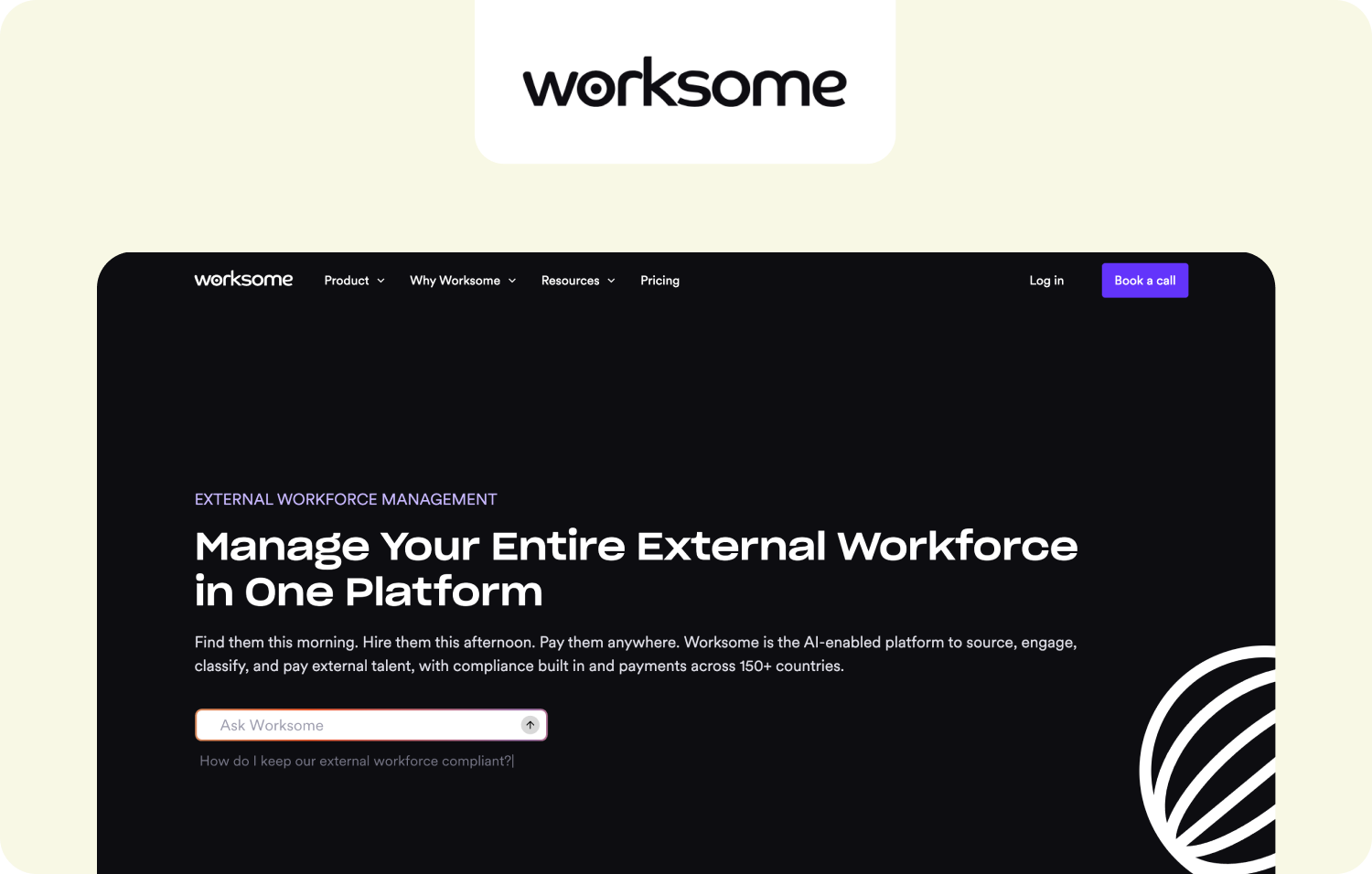
Best for:
Worksome is best suited to companies that want sourcing, contractor classification, onboarding, and payments in a single workflow.
Core strength:
Worksome combines sourcing and freelance management in one platform. Companies can find talent, create contracts from templates, manage onboarding, simplify payments, and oversee contractor operations without relying on multiple other apps.
Limitation:
Public information around pricing and country coverage is less transparent than that of some larger competitors.
Pricing: Custom pricing.
6. Worksuite

Best for:
Worksuite is best suited to enterprises managing large private freelancer networks.
Core strength:
Worksuite helps organisations build structured freelance management processes around onboarding, communication, contracts, project tracking, compliance, and payments. Its strength lies in helping large teams organise workforce data and maintain control as freelancer operations grow.
Limitation:
The platform is designed for mature freelancer programmes and may be more complex than smaller teams require.
Pricing:
Public pricing unavailable.
7. YunoJuno

Best for:
YunoJuno is best suited to organisations that want both freelancer sourcing and workforce management capabilities.
Core strength
YunoJuno combines a freelancer marketplace with freelance management software for onboarding, contracts, payments, compliance, and workforce visibility. This helps companies source talent, communicate with contractors, and manage ongoing engagements from one platform.
Limitation:
While it supports global contractor management, its strongest market presence remains in the UK and broader contingent workforce space.
Pricing: Custom pricing.
8. Fiverr Enterprise

Best for:
Fiverr Enterprise is best suited to organisations managing project-based freelance work across multiple teams.
Core strength:
Fiverr Enterprise combines sourcing, onboarding, compliance, payments, and private talent pools in one platform. It is particularly useful for companies that want to build a repeatable workflow for finding freelancers, managing assignments, controlling costs, and supporting collaboration across the organisation.
Limitation:
The platform is strongest for project-based freelance work and creative engagements rather than long-term contractor workforce planning.
Pricing:
Enterprise pricing is available on request.
Now that you’ve seen all the tools, you’ll need to figure out the one that will work best for your business and teams.
How to Evaluate Freelancer Management Software
As you’ve seen, these platforms can onboard contractors and process payments. The bigger differences usually appear when you look at compliance, scalability, and the amount of manual work your team still has to do.
| Evaluation area | What to verify | Question to ask in a demo |
|---|---|---|
| Onboarding and contracts | How quickly contractors can be onboarded and whether contracts are localised for different countries | “What does onboarding look like for a contractor in a country we’ve never hired in before?” |
| Payment handling | Supported currencies, FX fees, invoicing workflows, and payment automation | “How are international payments handled, and what costs should we expect?” |
| Classification and compliance | Worker classification support, local contracts, audit trails, and compliance monitoring | “What safeguards do you provide to reduce misclassification risk?” |
| Integrations | Connections with HR, payroll, finance, and accounting systems | “Which integrations are native, and which require manual work or third-party tools?” |
| Scalability | Whether the platform can support growth, new countries, and changing workforce models | “What happens if we decide to convert a contractor into an employee?” |
Don’t be wowed by which solution has the most features. You’re simply trying to find the platform that fits your business today and still fits a year from now.
What Freelancer Management Software Costs
Pricing can vary significantly between platforms, so it’s worth understanding what you’re actually paying for before comparing monthly fees.
In most cases, costs fall into four categories:
| Cost component | What it covers |
|---|---|
| Platform fee | A monthly fee per contractor, freelancer, or user |
| Payment and FX fees | Costs associated with international payments, currency conversion, and payroll administration |
| Compliance services | Worker classification support, tax documents, contract generation, and legal safeguards |
| Admin time saved | The reduction in manual onboarding, invoices, payments, reporting, and workforce administration |
Some platforms also charge separately for premium features such as compliance coverage, vendor management, custom workflow automation, advanced reporting, or access to specialised expertise. Others offer a free version with limited functionality before moving to paid plans.
It’s also worth looking beyond the monthly fee. A lower-cost platform that still requires manual processes may end up costing more in internal time than a platform that helps automate payments, onboarding, contracts, and workforce operations.
Here’s a simple comparison:
| Typically automated | Often still manual |
|---|---|
| Contractor onboarding | Hiring decisions |
| Contract generation | Workforce planning |
| Invoicing | Performance reviews |
| Payment processing | Matching people to the right job |
| Tax document collection | Resource allocation across teams |
WorkMotion’s Contractor Management starts at €29 per contractor per month. If you’re comparing international hiring costs, WorkMotion’s Employment Cost Calculator can help estimate employer costs across different countries.
Companies managing both contractors and employees may also benefit from consolidating workforce administration through a single global payroll solution.
Book a demo to see how WorkMotion supports every stage of the contractor-to-employee journey.
How to Manage Freelancers Effectively
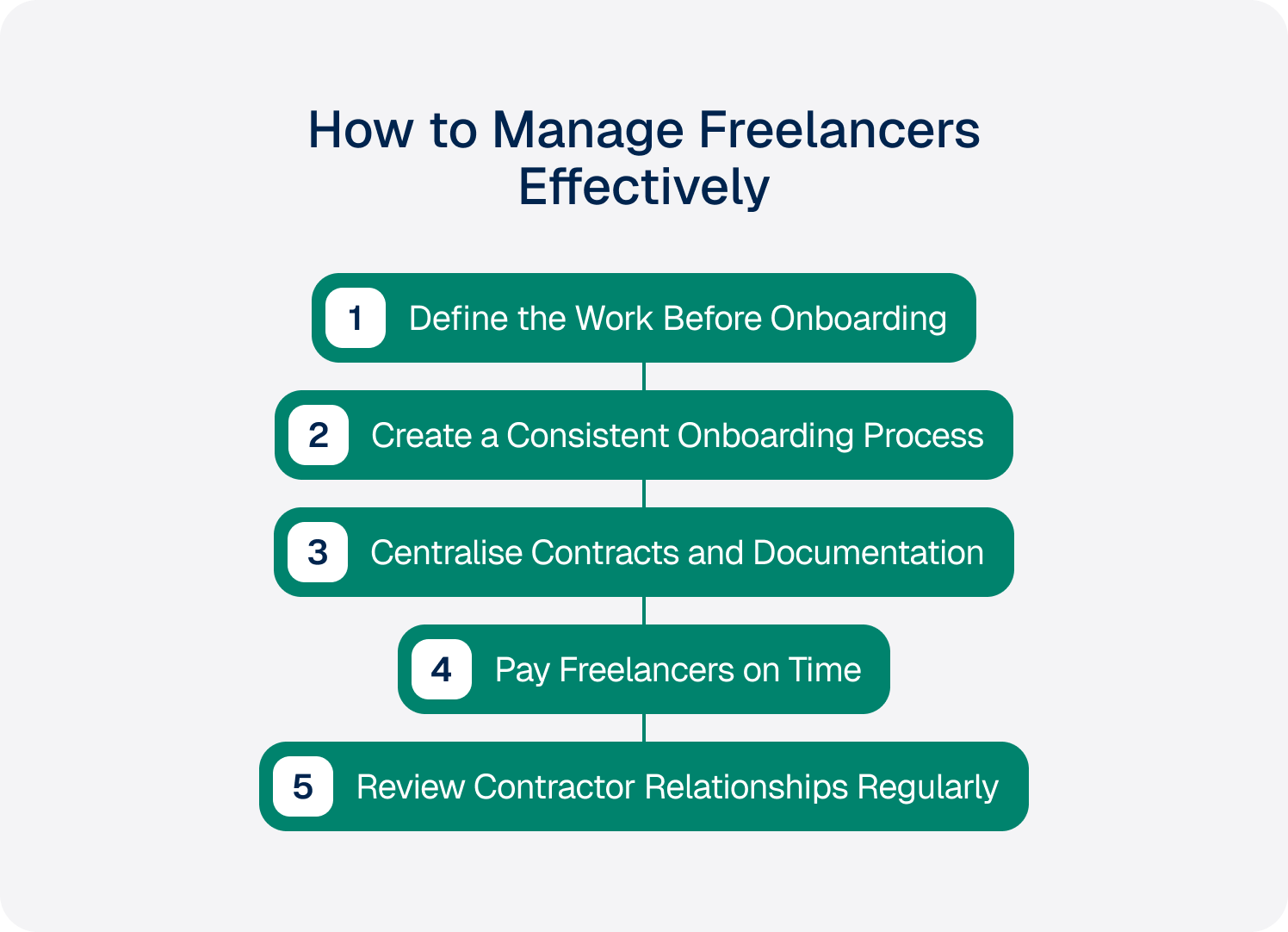
Managing freelancers doesn’t have to be complicated. The goal is to create a consistent process that protects your business, supports your contractors, and scales as your workforce grows.
Step 1: Define the Work Before Onboarding
Agree on deliverables, timelines, payment terms, and responsibilities before work begins. Clear expectations prevent misunderstandings and make projects easier to manage.
Step 2: Create a Consistent Onboarding Process
Every freelancer should complete the same onboarding steps, including contracts, payment details, tax documentation, and access to relevant systems and tools.
Step 3: Centralise Contracts and Documentation
Store contracts, approvals, invoices, and key records in one place. As your contractor workforce grows, scattered documentation becomes difficult to track and audit.
Step 4: Pay Freelancers on Time
Late payments damage relationships and make it harder to retain good talent. A consistent approval and payment process helps avoid unnecessary delays.
Step 5: Review Contractor Relationships Regularly
Not every freelancer stays project-based. Some gradually become part of the day-to-day operation. Regular reviews help you identify when a contractor relationship is changing and whether the current arrangement still makes sense.
That final step is where many companies run into challenges. The longer a contractor relationship continues, the more important it becomes to assess whether the engagement still reflects how the person is actually working.
Contractor vs Employee: When to Convert
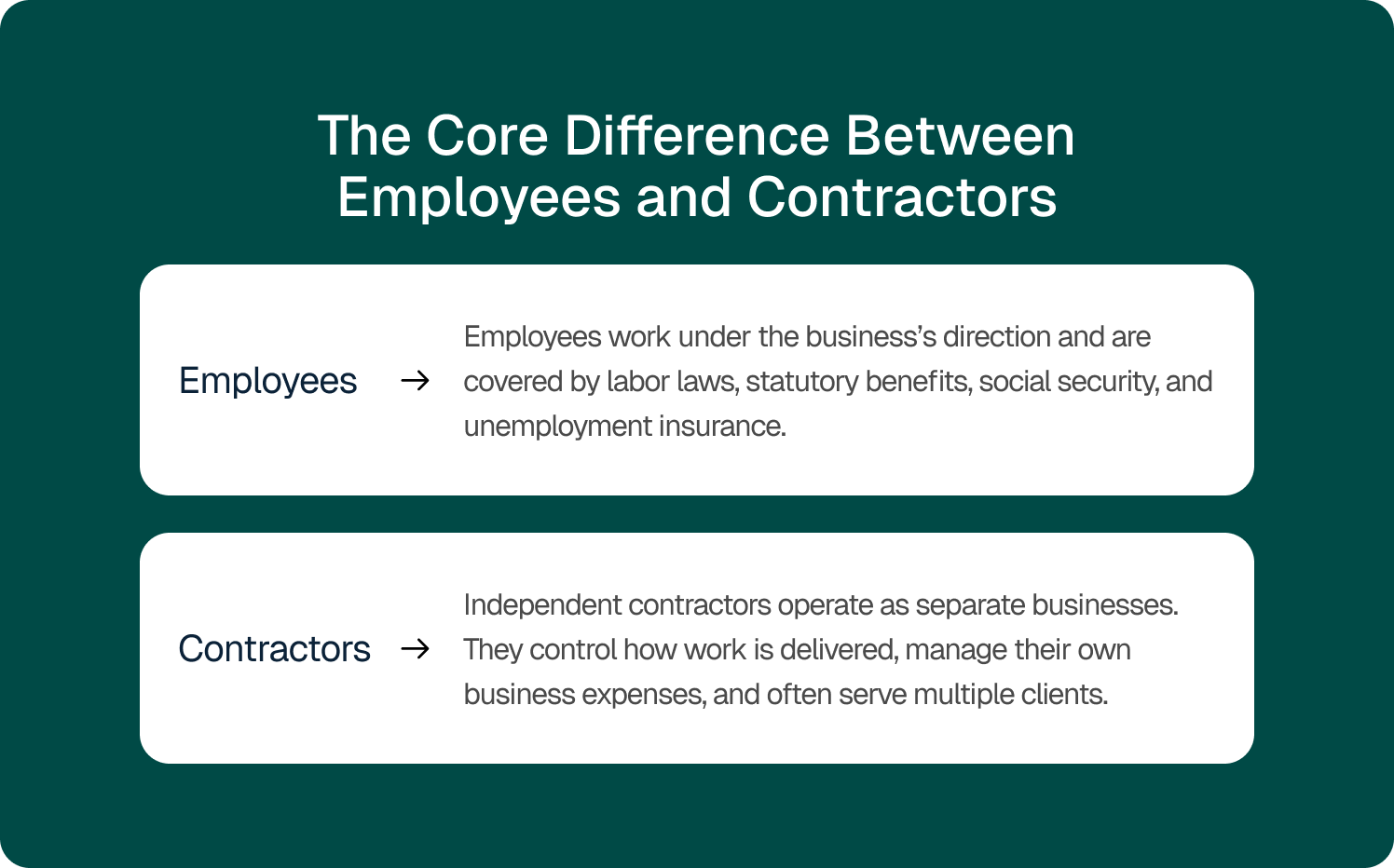
Your relationship with a freelancer might not stay temporary.
What starts as a project-based engagement can gradually become an ongoing working relationship. At some point, it’s worth asking whether the contractor model still reflects how that person works with your business.
Some common signs include:
- They’re working close to full-time hours
- The work is ongoing rather than project-based
- They’re deeply integrated into the team
- They’re becoming a core part of day-to-day operations
- Misclassification risk is starting to increase
This is where things often become complicated.
Converting an international contractor into an employee usually means setting up a local entity or working with an EOR, issuing new contracts, and repeating parts of the onboarding process.
Some platforms only support one side of that journey. Others support both.
For example, you could start by managing a contractor through WorkMotion’s Contractor Management solution. Then, you could also hire that same person through direct hiring or Employer of Record, depending on the country and employment model. That removes the need to switch providers as the relationship evolves.
Get Started With WorkMotion Today
Most freelancer management platforms stop at contractor management.
WorkMotion goes a step further. You can manage international contractors compliantly across 160+ countries today, then hire the people you want to keep without changing providers, rebuilding processes, or starting from scratch.
For growing teams, that flexibility matters. What begins as a short-term engagement often turns into a long-term working relationship, especially when you’re hiring specialised talent internationally.
WorkMotion supports onboarding in as little as 3–5 business days and is the first EOR provider to achieve IEC Gold Certification following an independent compliance audit.
Want to see how it works in practice? Book a demo and explore how WorkMotion supports both contractor management and long-term hiring.


















![idWjC-9cC6_logos 1 [Vectorized]](https://workmotion.com/wp-content/uploads/2026/02/idWjC-9cC6_logos-1-Vectorized.svg)