

Your payroll provider worked well when you operated in one country. Then your expansion exposed gaps in contracts, statutory benefits, payroll processing, and local compliance requirements.
Understanding how to switch payroll providers is about more than moving payroll data into a new system. For international teams, switching payroll providers affects employee data, tax payments, and compliance across multiple jurisdictions.
Many organisations switch payroll because of payroll errors, limited country coverage, or growing compliance risks. Solutions such as an Employer of Record can help businesses stay compliant while entering new markets.
This guide explains how to evaluate a new payroll provider and manage a smooth transition across multiple countries.
Why Companies Switch Payroll Providers
Most organisations like yours don’t switch payroll providers because they want new software. They switch payroll because the current payroll system can no longer support the business.
| Trigger | Business consequence |
|---|---|
| Payroll errors | Repeated payroll errors create employee dissatisfaction, increase manual corrections, and reduce confidence in payroll processing. |
| Compliance gaps | Compliance issues across multiple countries can lead to incorrect tax filing, missed statutory obligations, and growing legal risk. |
| International expansion | A payroll provider that works in one market may struggle to support compliant hiring across new countries and employment models. |
| Cost opacity | Unclear pricing, unexpected charges, and limited visibility into employer costs make workforce planning difficult for finance teams. |
| Slow onboarding | Delays in contracts, benefits administration, and payroll setup can slow hiring and impact business growth. |
These challenges become more visible as companies enter new markets.
For many organisations, the time to switch payroll arrives when their current provider creates friction rather than reducing it.
Using an employment cost calculator can help finance teams forecast hiring costs, while a structured direct hiring model can reduce complexity as international teams grow.
Delaying the switch can turn small operational issues into larger compliance risks.
Best Time to Switch Payroll Providers
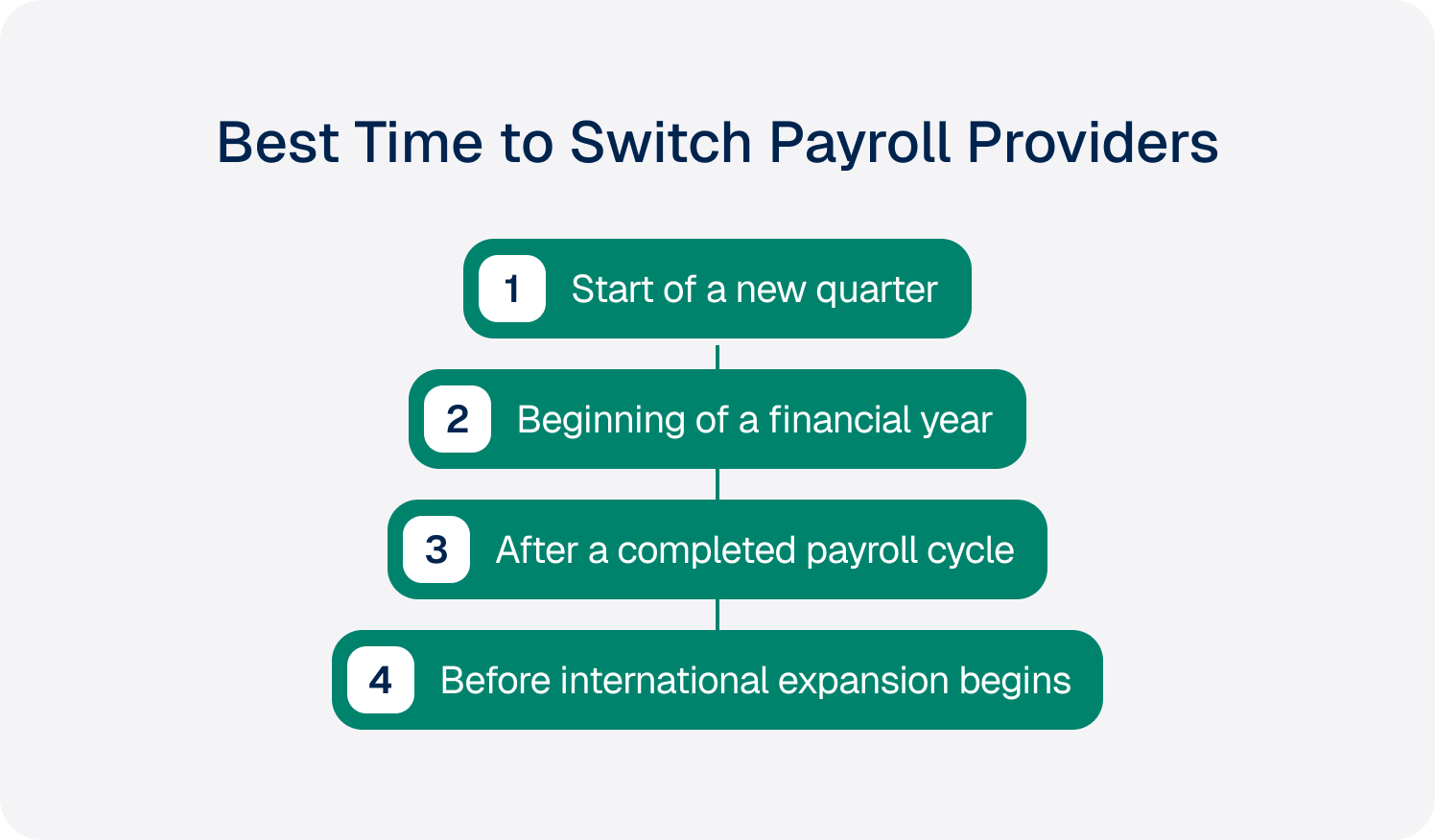
Ideally, you’d switch payroll providers at the start of a new quarter or financial year, when payroll records, tax documents, and reporting periods align more cleanly.
Common transition windows include:
- Start of a new quarter
- Beginning of a financial year
- After a completed payroll cycle
- Before international expansion begins
But a mid-year switch is also possible. Running a parallel payroll run before cutover helps payroll teams compare results and resolve issues before the new provider goes live.
If international expansion is driving the change, timing should follow hiring plans rather than calendar dates.
What to Prepare Before You Switch
Before changing payroll providers, gather and verify all payroll information before migrating your data. Missing records can create reporting issues, disrupt payroll services, and complicate future tax filing requirements.
| Data category | What to export/verify |
|---|---|
| Year-to-date payroll registers | Export all payroll records for the current tax year, including employee wages, tax withholdings, and payroll tax returns. |
| Employee master data | Verify employee information, employment status, job titles, compensation details, and work locations. |
| Tax account IDs | Confirm employer identification number details, tax account numbers, and any country-specific registration IDs. |
| Benefits deductions | Review retirement plans, statutory benefits, and all employee deduction settings. |
| Banking and direct deposit files | Validate direct deposit details, payroll account information, and payment instructions for all employees. |
| Historical payslips | Export pay stubs and historical payroll data required for audits, employee requests, and compliance reviews. |
| Audit trail and compliance records | Retain payroll reports, tax documents, tax forms, quarterly tax returns, and approval records from the current provider. |
The cleaner your payroll data, the easier it becomes for a new provider to configure the new system accurately.
When you start evaluating international payroll structures, be sure to check out a vendor’s product tour (if available). That way, you can understand how payroll data, contracts, and compliance workflows will be managed after migration.
Preparation becomes even more important when evaluating how the migration itself will be managed.
How to Switch Payroll Providers: Step-by-Step
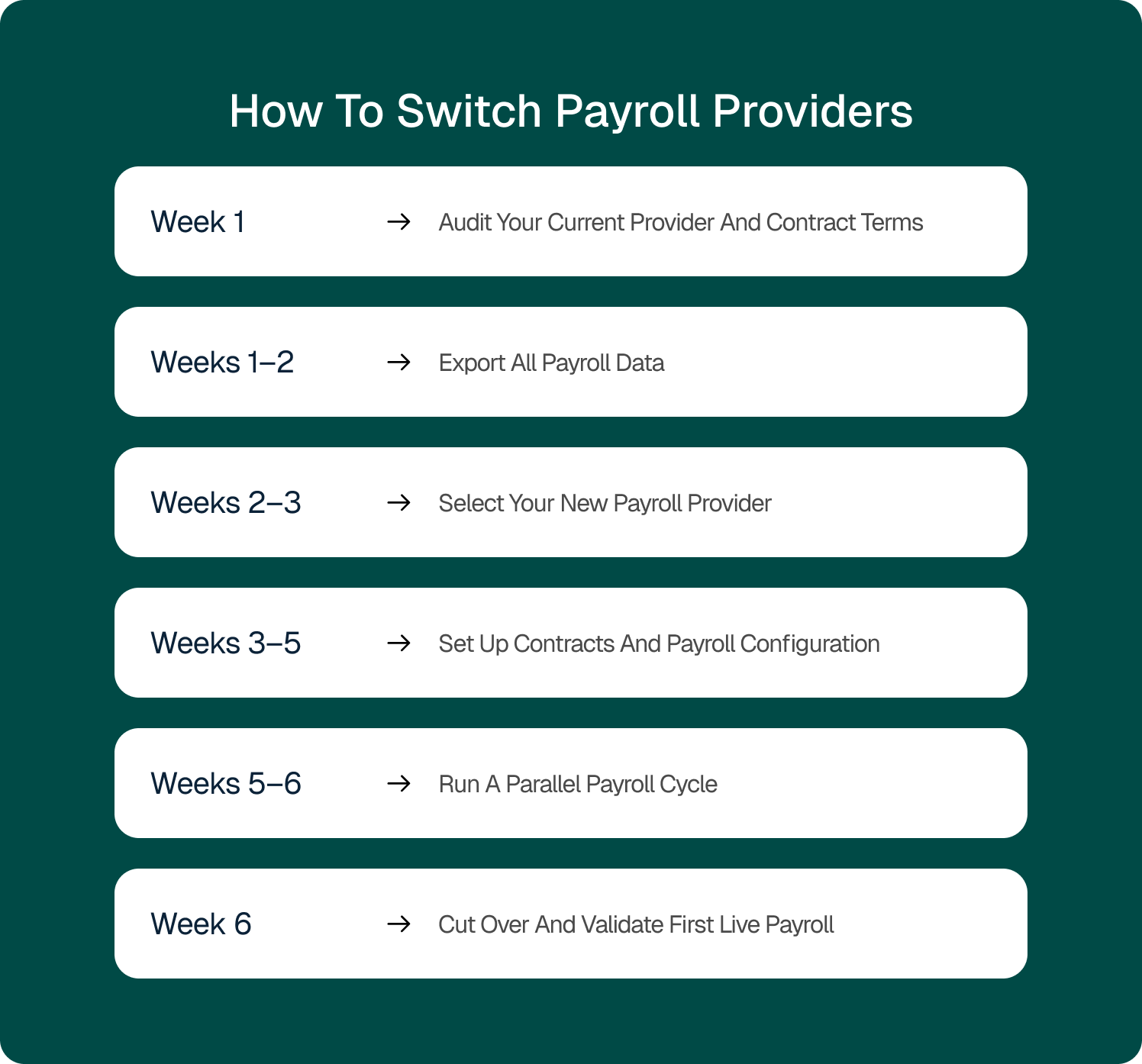
Most organisations can switch payroll providers successfully by following a structured process. The goal is to protect payroll continuity while reducing disruption and compliance risks.
Step 1: Audit Your Current Provider and Contract Terms (Week 1)
Review your current contract before starting the transition.
Focus on:
- Notice periods
- Termination clauses
- Data export rights
- Service agreement obligations
- Ownership of payroll information
Many payroll companies include contractual requirements that can affect migration timelines.
Step 2: Export All Payroll Data (Weeks 1–2)
Request all required records from your current payroll provider.
This should include:
- Historical payroll data
- Employee master data
- Payroll tax returns
- Tax filing records
- Benefits deductions
- Banking files
- Employee self-service records
The goal is to migrate data completely before moving to a new payroll system.
Step 3: Select Your New Payroll Provider (Weeks 2–3)
Not all payroll companies are built for international hiring.
Prioritise:
- Licensing status
- Independent compliance certification
- Payroll accuracy commitments
- Support team responsiveness
- International scalability
If international hiring is part of your strategy, reviewing the best payroll software criteria alongside requirements in France or Poland can help identify the right payroll provider.
Step 4: Set Up Contracts and Payroll Configuration (Weeks 3–5)
The new provider should handle:
- Contract generation
- Payroll platform configuration
- Benefits enrolment
- Employee self-service features
- Pay schedules and pay period setup
Your role is primarily approval and sign-off.
Step 5: Run a Parallel Payroll Cycle (Weeks 5–6)
Run both the current system and new system for one payroll cycle.
Compare:
- Employee wages
- Tax withholdings
- Direct deposit amounts
- Benefits deductions
- Payroll reports
Only proceed once results match.
Step 6: Cut Over and Validate First Live Payroll (Week 6)
Move fully to the new provider after the payroll run is reconciled.
Validate:
- Employee payments
- Tax filings
- Payroll account balances
- Direct deposit processing
- Reporting outputs
Companies hiring internationally should also review local employment obligations. Comparing payroll service providers for global businesses and requirements in Portugal can help prevent avoidable compliance issues.
Hiring in a new country as part of your switch? Book a demo to see how WorkMotion handles compliant onboarding in 3–5 business days, no entity required.
What Changes When You Switch to International Hiring
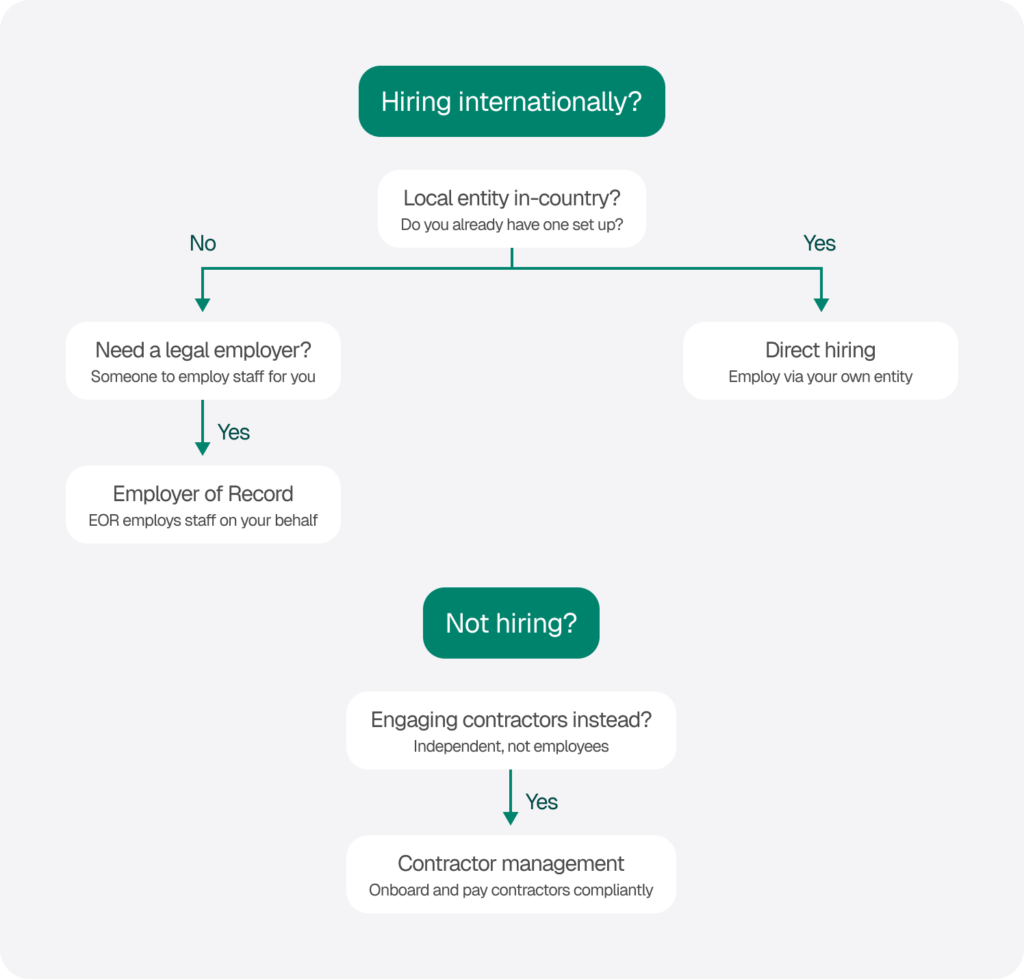
Switching providers during international expansion introduces additional legal obligations.
Choosing a provider without the required licensing or legal infrastructure in your target country can create compliance risks, particularly in regulated markets such as Germany, where AÜG requirements may apply depending on the employment structure.
International hiring changes the scope of a payroll migration. What works for a domestic payroll solution may not support local employment laws across multiple jurisdictions.
Key differences include:
- Country-specific contracts and statutory benefits
- Local licensing and compliance requirements
- Employment model selection (EOR, Direct Hiring, or Contractor Management)
- Payroll in local currency with employer contributions visible upfront
Multi-Country Contract Terms and Statutory Benefits
Every country has its requirements for contracts, leave entitlements, social contributions, and statutory benefits.
Many domestic payroll software providers can run payroll, but they cannot generate compliant employment contracts or manage local obligations across international markets.
Licensing Requirements Per Country
Licensing requirements vary significantly between countries. When switching providers, it is important to understand who carries legal responsibility for compliance.
WorkMotion operates through its own entities in key European markets, including France, Germany, Italy, Poland, Portugal, Spain, and the UK.
This helps reduce compliance gaps during provider transitions and provides greater operational control than models that rely entirely on third-party partners.
When you’re evaluating providers, always review local employment requirements before deciding on your next step.
Employment Model Decision: EOR vs Direct Hiring vs Contractor Management
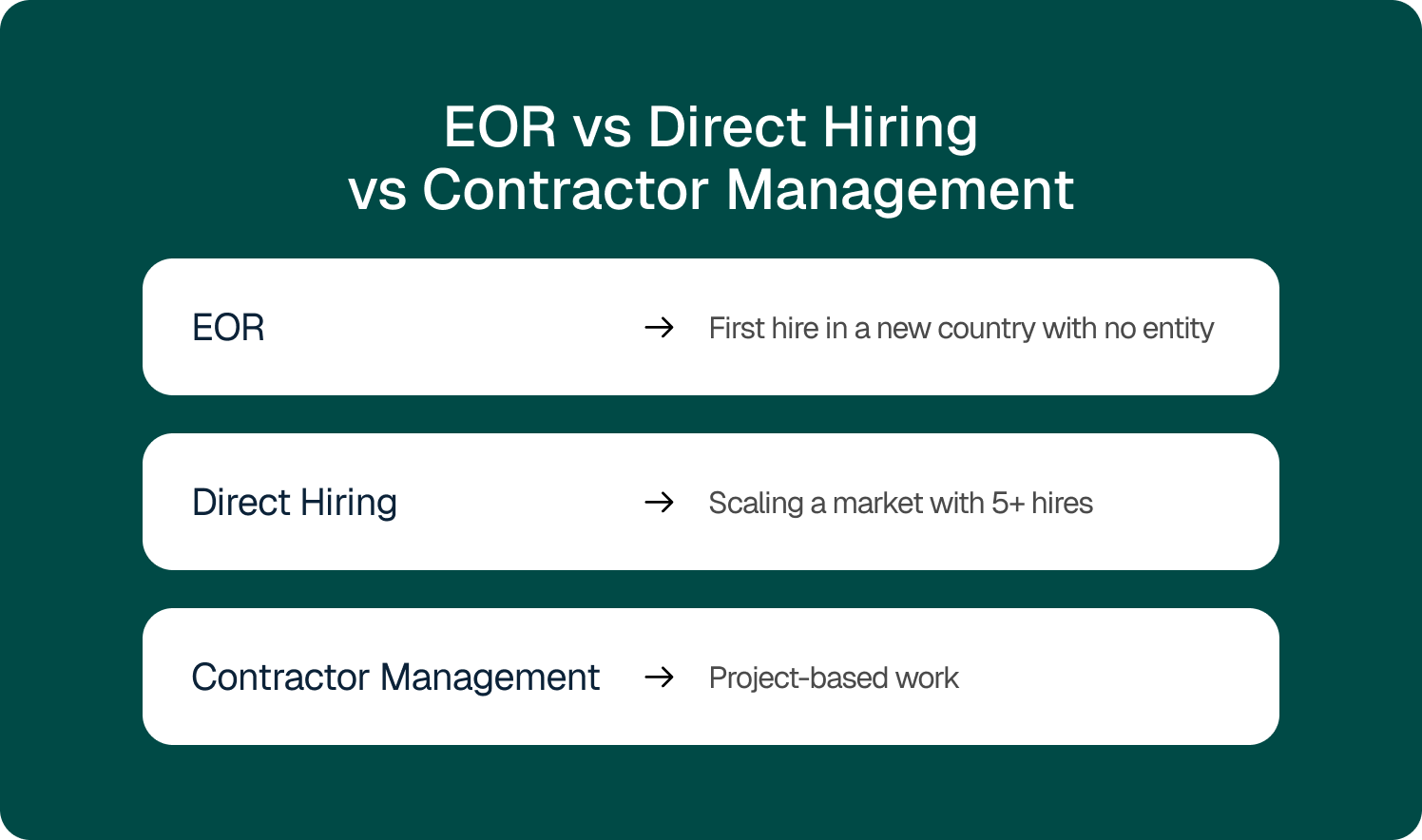
The right model depends on your expansion plans, internal resources, and compliance requirements. Businesses engaging freelancers alongside employees may benefit from dedicated contractor management rather than managing multiple systems.
Payroll in Local Currency With Transparent Employer Contributions
Cost uncertainty is a common reason for switching payroll companies. Finance teams need visibility into total employment costs before committing to a new payroll company.
WorkMotion provides country-specific cost breakdowns that include salary, employer contributions, and platform fees before onboarding begins.
Current pricing starts from:
- EOR from €499 per employee/month
- Direct Hiring from €399 per employee/month
- Contractor Management from €29 per contractor/month
Teams evaluating international payroll services can review current pricing before shortlisting providers.
Not sure whether you need EOR, Direct Hiring, or Contractor Management for your next hire? Talk to an expert and book a demo.
How to Evaluate a New Payroll Provider
Choosing a new payroll provider should be treated as a risk assessment exercise, not a feature comparison. The right payroll provider helps reduce operational complexity, supports international growth, and provides confidence that payroll services will remain compliant as your business scales.
| Criteria | What to ask | Why it matters |
|---|---|---|
| Licensing status in target countries | Does the provider operate through its own entities or rely on partners? | Licensing structure affects accountability, compliance ownership, and long-term operational control. |
| Independent compliance certification | Has the provider undergone independent audits? | Independent certifications such as IEC Gold Certification provide external validation of compliance processes. [TODO: verify — IEC claim for Bastian’s sign-off] |
| Payroll accuracy SLA | What service levels are guaranteed for payroll accuracy and issue resolution? | A payroll vendor should provide clear accountability for payroll outcomes. |
| Data residency and GDPR compliance | Where is employee data stored and how is GDPR compliance managed? | International payroll software handles sensitive employee data and requires strong data governance. |
| Escalation path and support response times | What happens when issues arise and how quickly are they resolved? | Poor customer service can quickly become a business risk during critical payroll periods. |
| Client satisfaction (CSAT) | How is customer satisfaction measured and reported? | WorkMotion reports a 97.0 CSAT score, providing a useful benchmark when evaluating providers. [TODO: verify figure] |
| Talent satisfaction (TSAT) | How do employees rate their payroll experience? | Employee satisfaction helps indicate whether payroll information, support, and payments are delivered consistently. |
When comparing payroll companies, look beyond software functionality alone. The strongest payroll platform combines compliance infrastructure, operational support, and clear accountability.
Reading recommendation: Review our guide to global payroll service providers to help establish a shortlist before engaging vendors.
A useful evaluation checklist should also include:
- Ability to support international hiring
- Visibility into compliance obligations
- Transparent pricing and contract terms
- Dedicated support team and escalation paths
- Scalability across countries and employment models
The final decision should balance compliance, operational fit, and long-term scalability.
Before signing with a new provider, make sure the numbers work for your target market. Use WorkMotion’s Employment Cost Calculator to estimate salary costs, employer contributions, and EOR fees before committing to a hiring plan.
Final Thoughts: How to Switch Payroll Providers Without Compliance Gaps
Understanding how to switch payroll providers is only part of the decision. For international teams, the bigger challenge is choosing a provider that can support compliant hiring, payroll, and employment across multiple countries.
WorkMotion is built for companies managing international hiring, payroll, and compliance without establishing local entities. With IEC Gold Compliance Certification, owned entities in key European markets, and a 97.0 CSAT score, it combines payroll, employment, and compliance infrastructure in a single platform.
Ready to evaluate your options? Book a demo to see how WorkMotion supports international hiring and payroll management.


















![idWjC-9cC6_logos 1 [Vectorized]](https://workmotion.com/wp-content/uploads/2026/02/idWjC-9cC6_logos-1-Vectorized.svg)