Hiring foreign employees used to be a rarity. It meant opening an office abroad, hiring a local accountant, and hoping you got the tax laws right. In 2026, 78% of companies now hire internationally for remote positions. Finding talent is the easy part. But unless you’re planning to source all your international hires from the same country, opening an office abroad isn’t usually the best route.
It’s important you hire your international employees compliantly, because every country has its own local regulations, tax obligations, and employment contract requirements. You can’t just run someone through your domestic payroll and send a bank transfer.
This article compares the best ways to pay international employees so you can choose the right method for your team, budget, and growth stage. We’ll cover the four main approaches, their costs and trade-offs, and the compliance considerations that apply no matter which one you pick.
The Four Ways To Pay International Employees
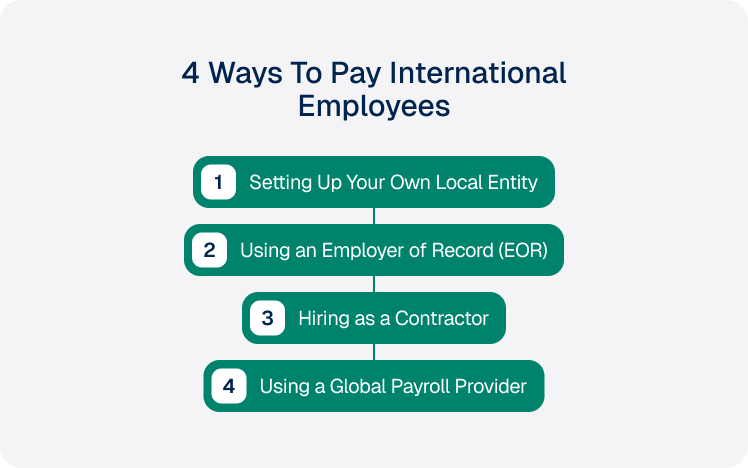
Before diving into each method in detail, here’s a side-by-side comparison of how they stack up on cost, speed, control, and compliance.
| Method | Setup cost | Ongoing cost | Speed to first payment | Control | Compliance burden | Best for |
| Own entity | €13,900–€62,000 | Upwards of €60,000/year | 3–9 months | Full | High (you own it all) | 5–15+ employees in one country |
| EOR | Minimal | €300–€1,000/employee/month | Days to weeks | Day-to-day only | Low (provider handles it) | 1–15 employees per country |
| Contractor | None | Just the invoice amount | Days | Low | Misclassification risk | Project-based or short-term work |
| Global payroll provider | €2,000–€100,000+ | €15–€60/employee/month | Weeks | Shared with provider | Medium | Multiple entities or EORs already in place |
1. Setting Up Your Own Local Entity
Setting up a legal entity in a foreign country gives you maximum control. You’re the legal employer, you run local payroll, and you own the employment relationship directly. This is the traditional route for companies with significant, long-term headcount in a market.
How It Works
Setting up a local entity requires a few steps:
- Register a subsidiary or branch office
- Obtain local tax and social security numbers
- Set up a bank account in the employee’s country
- Hire local HR and accounting staff (or outsource to a local firm)
- Run payroll yourself (or through a local payroll bureau)
Through this method, you handle income tax withholding, employer contributions, statutory contributions, and all local employment laws directly.
What It Costs
Entity setup typically runs €13,900 to €62,000 in total. This covers legal counsel, incorporation, notarisation, bank account opening, and payroll setup. Some countries require capital deposits, like Germany’s €25,000 share capital for a GmbH.
Ongoing costs for accounting, payroll, tax filing, and legal compliance run upwards of €60,000 per year. Setup time ranges from three to nine months, with opening a foreign bank account often causing the longest delay.
For a full line-item breakdown, see our guide to the cost of setting up a legal entity.
When To Choose It
An own local entity starts to make sense once you have approximately 5 to 15 or more employees in a single country. If you have less than that, the fixed costs of running an entity almost always exceed the per-employee cost of an EOR.
It’s also the right choice if you want full control over benefits design, employment contracts, and long-term per-employee economics.
If you want to set up your own entity in Europe without navigating the bureaucracy alone, WorkMotion’s Direct Hiring service handles the registration, local payroll setup, and ongoing compliance for you.
Pros and Cons
Pros:
- Full control over HR and payroll
- Ability to recruit as a local employer
- Long-term cost efficiency at scale
- Direct brand presence in the market
Cons:
- Very costly to set up and maintain
- Involves legal, tax, and HR personnel
- Setup takes three to nine months
- High recurring administrative cost
2. Using an Employer of Record (EOR)
An Employer of Record (EOR) is a third-party organisation that legally employs workers on your behalf in a country where you don’t have an entity. The EOR handles the employment contract, payroll, tax withholding, social contributions, statutory benefits, and compliance with local labour laws. You still control the day-to-day work, but the EOR handles the legal and administrative layer.
How It Works
You tell the EOR who you want to hire and at what salary. The EOR uses its own existing legal entity in that country to employ the worker, runs local payroll, files taxes, and ensures the employee gets paid in local currency with all mandatory benefits. Onboarding typically takes days to weeks, not months.
What It Costs
EOR fees range from €300 to €1,000 per employee per month, depending on the provider and country. Once you add employer contributions, currency conversion margins, and benefits markups, the all-in cost realistically reaches €9,600 to €14,400 per employee per year beyond gross salary. Keep in mind that’s still far cheaper than the €13,900–€62,000 setup cost of an entity for small teams.
When To Choose It
An EOR is ideal when you need to employ workers in a new country within weeks and don’t yet have payroll registrations, benefits setup, or local HR infrastructure. It’s the right default if you don’t have too many employees per country, or while you’re testing a market before committing to an entity. It’s also the fastest legal route into a country where you have no presence.
To explore this route, see how WorkMotion’s Employer of Record service works across 160+ countries.
Pros and Cons
Pros:
- Fast hiring (in days)
- No need to establish a local entity
- Full compliance handled by the provider
- Reduced risk
- Local currency payments
- Efficient onboarding
Cons:
- Per-employee fees add up at scale
- Less control over benefits design than an owned entity
- You depend on the provider’s compliance quality
3. Hiring as a Contractor
Hiring foreign contractors or an independent contractor is the simplest method when it comes to payment and legal employment. The contractor sends an invoice and you pay it. There’s no employment relationship, no payroll, and no employer contributions. It works for project-based work, short-term engagements, or genuinely independent professionals.
How It Works
You engage the international contractors under a contractor agreement (not an employment contract). The contractor is responsible for paying their own taxes, handling their own health insurance, and managing their own schedule. Contractor payments are typically made via bank transfers, payment platforms, or invoicing tools, often in multiple currencies.
What It Costs
You pay the invoice amount and it ends there. There aren’t any employer contributions, payroll taxes, or benefits costs you have to manage. This makes contractors the cheapest option per engagement, which is why companies use them to save money on short-term work.
When To Choose It
Contractors are suitable for project-based work, freelance engagements, or roles where the worker operates independently with multiple clients. They’re not suitable for full-time positions or integrated roles where you control how, when, and where the work happens.
The big risk is misclassification. If a contractor functions like an employee, local tax authorities can reclassify them. This triggers retroactive payroll taxes, social contributions, and penalties. Misclassification rules vary by country, and both the company and the worker can face consequences.
For compliant contractor management, WorkMotion’s contractor solution handles contracts, invoicing, and payments across 160+ countries with built-in misclassification safeguards.
Pros and Cons
Pros:
- Lowest cost
- Minimal admin
- Fast engagement
- Flexibility for short-term work
Cons:
- Misclassification risk
- No employer control over the worker
- Poor retention
- Limited brand impact
- No access to employee benefits
4. Using a Global Payroll Provider
A global payroll provider consolidates payroll across multiple countries into a single platform. It’s different from an EOR, which employs workers on your behalf. A global payroll provider processes payroll through your existing entities. It also works alongside an EOR arrangement. It’s designed for companies that already have a legal presence in multiple markets but want to centralise payroll operations.
How It Works
The provider takes care of:
- Salary calculations
- Applying the correct tax withholding and deductions
- Filing tax returns with local tax authorities
- Managing exchange rates and currency conversion
- Distributing payments to employees in their local currency
You fund the total international payroll once per cycle and the provider handles the rest.
What It Costs
Global payroll pricing typically follows a per-employee-per-month model. It ranges from €15 to €60 per employee per month for the core platform fee. Implementation costs can run from €2,000 to €100,000+ depending on company size and integration complexity.
When To Choose It
A global payroll provider makes the most sense when you’re managing payroll across different countries and already have entities or EOR arrangements in place. It’s a separate layer that sits on top of your employment infrastructure to consolidate reporting, funding, and compliance into one system.
When you transition from EOR to your own entity, a global payroll provider can run payroll on your owned entities more cheaply than per-head EOR fees.
For a comparison of the top providers in this space, see our guide to the best global payroll services for international hiring.
Pros and Cons
Pros:
- Centralised payroll across countries
- Consolidated reporting and funding
- Automated tax filings
- Reduced reconciliation errors
Cons:
- Requires existing entities or EOR arrangements
- Implementation can be costly and complex
- You’re still responsible for compliance
Key Considerations When Paying International Employees
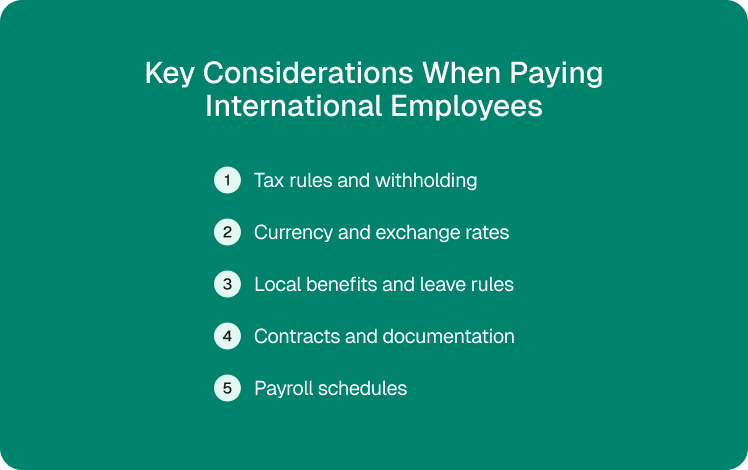
While some methods ease your personal compliance burden, there’s always going to be the same core compliance challenges.
Tax Rules and Withholding
One of the most significant questions is whether international workers pay taxes in both the company’s country and the employee’s country. In most cases, yes. Tax obligations depend on where the employee physically works, not where your company is registered. You’ll need to handle income tax withholding, social security contributions, and employer contributions according to local tax authorities.
Tax treaties between countries can prevent double taxation, but they add complexity. Workers may need to file tax returns in multiple countries, and you need to understand which treaty provisions apply.
For a deeper look at where companies go wrong, see our guide to the top 10 international payroll tax mistakes.
Currency and Exchange Rates
Salaries must be paid in the currency defined in the employment contract and accepted by local regulations and authorities. Exchange rates fluctuate, which affects both payroll costs and the employee’s take-home pay. Most companies implement currency buffers or peg salaries to a stable reference currency to keep compensation predictable.
International payments through bank transfers can also involve intermediary fees, SWIFT charges, and unfavourable conversion rates that eat into the amount the employee actually receives. Choose payment methods that minimise these costs, especially when you need to pay overseas employees in multiple currencies.
Local benefits and leave rules
Every country mandates specific employee benefits and leave entitlements. You need to comply with local labour laws regarding:
- Annual leave
- Sick leave
- Paid maternity/paternity leave
- Public holidays
- Mandatory insurance
- Retirement contributions
Some countries in Latin America and Southern Europe require 13th-month (and sometimes 14th-month) salary payments. These are mandatory, not optional.
Contracts and Documentation
Employment contracts must be compliant with local employment laws in the employee’s country. That means a US or UK template won’t work in Germany, France, or Spain. Contracts should cover:
- Compensation
- Working hours
- Role
- Benefits
- Termination rules
- Probation
- IP rights
- Confidentiality
All of this must be in the format and language the jurisdiction requires. You’ll also need to collect tax documentation, IDs, bank details, social security information, and address proof for each employee. Ongoing compliance means keeping records current as laws change.
Payroll Schedules
Different countries have their own rules about how frequently employees must be paid. It could be monthly, bi-monthly, or on another schedule. Align your processes with local patterns and requirements to ensure seamless integration and compliance with relevant regulations.
Pay Your International Team with Confidence
Paying international employees in 2026 doesn’t have to be complicated, but it does have to be compliant. The four methods we’ve compared each serve a different stage of growth, and the right one depends on your headcount, timeline, and risk tolerance.
WorkMotion is a platform for today’s global teams. It simplifies the global recruitment process, from onboarding to payment, so your company can recruit with confidence anywhere in the world.
WorkMotion keeps your employment set-up compliant and current, from contracts to payroll to benefits, as laws, taxes, and entitlements change:
- Manage mandated and optional benefits: WorkMotion will provide all employee benefits as stipulated by their nation, as well as any other incentives you may offer.
- Run global payroll with accuracy and reliability: The system calculates salaries, applies the correct deductions, files tax returns, and automatically pays wages.
- Onboard talent within days: Document workflows, e-signatures, and local compliance tools make it easier and simpler for you to welcome those new hires.
- Minimise compliance risks across all markets: Real-time updates and local insights enable your business to stay compliant with ever-changing regulations.
Before you can pay international talent, though, you need to find the right people. Synmatch AI, WorkMotion’s sister brand, sources and pre-screens candidates from across the globe, so you can start having hiring conversations that matter sooner. Once you’ve found your match, you can compliantly onboard and pay them through any of the methods above, all in one place.
Ready to build your international team? Book a demo with WorkMotion today and see how easy compliant global hiring can be.