Managing payroll across multiple countries is rarely as simple as applying a different tax rate to each employee. Businesses need to determine where an employee is taxable, what must be withheld from their pay, which employer contributions apply, what needs to be reported, and whether tax treaties or social security agreements affect those obligations.
The challenge is that these requirements can change depending on where an employee lives and works, how long they spend in a country, their employment status, and the benefits they receive. A process that works for one country or employee may therefore create compliance risks elsewhere.
For businesses hiring internationally, getting these details wrong can result in under- or over-withholding, unexpected tax liabilities, penalties, reporting issues, and frustrated employees. WorkMotion’s global payroll solution can help businesses manage payroll across multiple jurisdictions while navigating the local requirements that apply to their international workforce.
The following 10 international payroll tax mistakes highlight the areas where businesses are most likely to encounter problems, along with practical steps to help reduce the risk.
What Are the Most Common International Payroll Tax Mistakes?
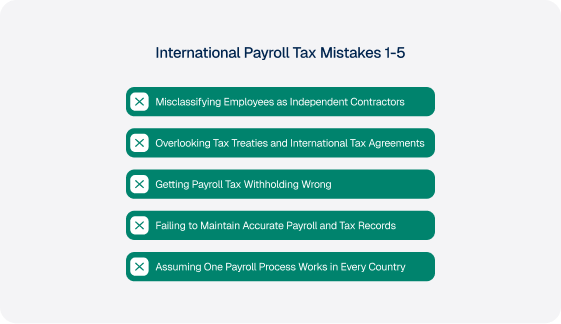
International payroll tax mistakes often happen when businesses apply a familiar payroll process to employees working under different tax and employment rules. The risks can range from incorrect tax withholding and employee classification to missed employer contributions, reporting obligations, and tax liabilities created by cross-border work. Understanding these common payroll tax mistakes helps businesses identify potential gaps before they become costly compliance issues.
Mistake #1: Misclassifying Employees as Independent Contractors
Employee classification is one of the most important considerations when managing payroll taxes for international employees. Treating someone as an independent contractor when they legally qualify as an employee can affect income tax withholding, employer social security contributions, statutory benefits, payroll registration, and other employment obligations.
Classification rules vary between countries and typically depend on factors such as how the individual works, who controls their work, the nature of the relationship, and how they are paid. A worker who is correctly classified as a contractor in one country may meet the definition of an employee elsewhere.
The risk can be particularly significant when hiring internationally before establishing a local entity. Businesses may assume that engaging someone as a contractor is a straightforward way to begin working with talent abroad, when the arrangement may not reflect the reality of the employment relationship.
How to avoid it: Businesses should assess employee and contractor status against the rules of the relevant jurisdiction before engaging the worker. Document the basis for the classification and review it if the individual’s responsibilities, working arrangements, or location change.
Mistake #2: Overlooking Tax Treaties and International Tax Agreements
Tax treaties can influence which country has the right to tax an employee’s income and may help prevent the same income from being taxed twice. However, treaty provisions interact with domestic tax rules and often depend on factors such as tax residency, where work is performed, and the length of an employee’s stay in another country.
Failing to identify an applicable tax treaty can result in incorrect withholding or missed opportunities to claim available relief. Businesses also need to understand what documentation is required to apply treaty provisions correctly.
Tax treaties should not be treated as a substitute for local payroll compliance. Even where a treaty affects an employee’s ultimate tax liability, the employer may still have registration, withholding, reporting, or documentation obligations in the country where the work takes place.
How to avoid it: Identify relevant tax treaties when employees work across borders, establish the employee’s tax residency and working location, and verify which treaty provisions and documentation apply before determining the appropriate payroll treatment.
Mistake #3: Getting Payroll Tax Withholding Wrong
Incorrect tax withholding is one of the most common payroll tax mistakes for businesses with international employees. Employers may be required to calculate and withhold income tax from employee wages before remitting it to the relevant tax authority, alongside any applicable employee contributions.
The calculation can depend on local tax rates, allowances, deductions, employee tax status, compensation, taxable benefits, and other country-specific rules. These requirements can also change over time, meaning an accurate payroll calculation at the start of the year may not remain accurate throughout it.
Under-withholding can leave employees with unexpected tax bills and expose employers to penalties, interest, or corrective filings. Over-withholding can create cash-flow issues for employees and require additional administration to correct.
How to avoid it: Maintain up-to-date country-specific tax rules, review withholding calculations regularly, and build processes for responding to changes in employee circumstances and local legislation.
Mistake #4: Failing to Maintain Accurate Payroll and Tax Records
Accurate records are essential for demonstrating that payroll taxes have been calculated, withheld, reported, and paid correctly. Poor record-keeping can make it difficult to identify errors, respond to employee queries, complete tax filings, or provide evidence during an audit.
International payroll records may need to cover more than salary payments. Depending on the jurisdiction, businesses may need documentation relating to tax registrations, withholding calculations, employer contributions, benefits, tax filings, payment confirmations, and an employee’s tax status.
As businesses add more countries and employees, relying on disconnected spreadsheets or local records can make it increasingly difficult to maintain a consistent view of payroll obligations. Clear processes for how long payroll takes to process, approvals, filings, and payments can also help teams identify potential delays before they affect employees.
How to avoid it: Establish clear record-keeping requirements, centralisze payroll information where possible, and retain supporting documentation for tax calculations, filings, payments, and employee records in line with local retention requirements.
Mistake #5: Assuming One Payroll Process Works in Every Country
A payroll process that works in one jurisdiction cannot necessarily be applied unchanged elsewhere. International payroll tax laws differ in areas such as income tax withholding, employer contributions, social security, taxable benefits, payroll registration, reporting requirements, and payment deadlines.
The solution is not to create an entirely different payroll process for every country. Instead, businesses should standardise their internal controls and workflows while allowing the underlying payroll calculations and compliance requirements to reflect local rules. This includes considering labour law compliance, as employment requirements around contracts, statutory benefits, working conditions, and employee protections can also vary between jurisdictions.
This distinction becomes increasingly important as companies expand into multiple markets. A centralised process can improve consistency, but only if it accounts for country-specific tax obligations and employment requirements. Effective global payroll processing can help businesses coordinate these requirements while maintaining consistent internal controls.
How to avoid it: Map payroll tax obligations by country, define which processes can be standardised, and build country-specific requirements into payroll calculations, approvals, reporting, and compliance reviews.
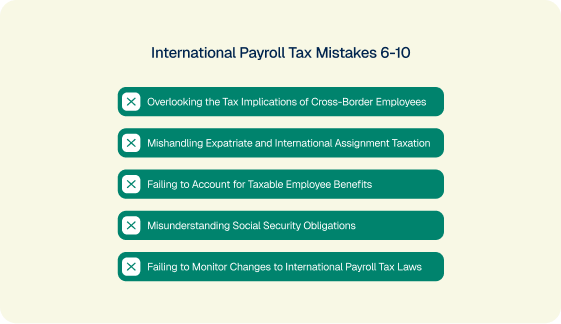
Mistake #6: Overlooking the Tax Implications of Cross-Border Employees
Employees who live in one country and work in another can create complex international payroll tax obligations. Their tax treatment may depend on where they physically perform their work, where they are tax resident, how long they spend in each country, their employer’s location, and whether a relevant tax treaty applies.
Simply assuming that an employee pays tax in their home country or the country where their employer is based can therefore lead to incorrect payroll treatment. A cross-border arrangement may create withholding, registration, reporting, or social security obligations in another jurisdiction.
For example, an employee who normally works in one country but spends an extended period working from another may trigger different tax considerations from an employee who occasionally travels for business. Each situation needs to be assessed based on the applicable rules.
How to avoid it: Track where employees physically work, review cross-border arrangements before they begin, and assess the relevant tax, payroll, and social security obligations in both the home and host countries. Businesses should also consider broader cross-border compliance challenges before allowing employees to work internationally.
Mistake #7: Mishandling Expatriate and International Assignment Taxation
International assignments and employee relocations can introduce additional payroll tax complexity. Employees may become subject to tax obligations in a new country while retaining connections to their original country, potentially creating additional reporting, withholding, or social security requirements.
Employers may also need to account for assignment-related compensation and benefits, including housing, relocation support, allowances, bonuses, or tax equalisation arrangements. The tax treatment of these items varies between jurisdictions and can affect both employee and employer obligations.
Without a clear approach, companies can end up correcting payroll after an employee has already moved or worked abroad, when addressing the issue proactively would have been simpler.
How to avoid it: Assess the tax and payroll implications before an international assignment begins. Establish where the employee is expected to be taxable, identify relevant withholding and reporting requirements, and determine how assignment-related compensation and benefits should be treated.
Mistake #8: Failing to Account for Taxable Employee Benefits
Salary is not the only part of compensation that can affect international payroll taxes. Benefits such as company cars, housing, private healthcare, relocation allowances, bonuses, and equity may be treated as taxable compensation depending on the country.
Businesses can therefore create payroll tax errors by correctly calculating an employee’s salary while overlooking the tax treatment or valuation of benefits. The rules can differ significantly between jurisdictions, and a benefit that is tax-exempt in one country may be taxable in another.
This can affect the amount of income tax withheld as well as employer or employee social security contributions.
How to avoid it: Review the tax treatment of each benefit in the relevant jurisdiction, establish how taxable benefits should be valued and reported, and ensure payroll teams receive accurate information about employee compensation beyond base salary.
Mistake #9: Misunderstanding Social Security Obligations
Social security contributions are separate from income tax but form an important part of international employment taxes. Depending on the country, employers and employees may both be required to contribute, with different rates, thresholds, exemptions, and reporting requirements.
Cross-border employees can make social security particularly complicated. An employee working temporarily in another country may potentially be subject to social security systems in more than one jurisdiction unless a social security agreement or other exemption applies.
Failing to determine which country’s social security system applies can lead to unnecessary double contributions, missed payments, or gaps in coverage.
How to avoid it: Assess social security obligations separately from income tax whenever an employee works across borders. Check whether a social security agreement applies, determine which system covers the employee, and maintain any required certificates or supporting documentation.
Mistake #10: Failing to Monitor Changes to International Payroll Tax Laws
International payroll compliance is not a set-and-forget process. Tax rates, thresholds, reporting requirements, social security contributions, taxable benefit rules, and filing deadlines can change, creating new obligations for employers.
Businesses that rely on outdated payroll rules may continue making incorrect calculations even when their underlying processes are sound. This risk increases when payroll is managed across multiple jurisdictions, each with its own regulatory calendar.
Regular compliance reviews and appropriate local expertise can help businesses identify changes before they affect payroll.
How to avoid it: Assign clear responsibility for monitoring regulatory changes, review country-specific payroll requirements regularly, and test payroll processes when tax rules or employee circumstances change. Where internal teams lack local expertise, work with qualified local advisers or an international payroll provider to validate requirements.
The Business Impact of International Payroll Tax Errors
International payroll tax errors can have consequences beyond correcting an employee’s payslip. Incorrect withholding, missed contributions, or incomplete reporting can result in unexpected tax liabilities, back payments, penalties, and interest. When problems affect multiple employees or jurisdictions, the administrative work required to investigate and correct them can quickly become significant.
Payroll tax mistakes can also affect employees directly. Incorrect deductions or unexpected tax bills can reduce trust in the employer, while unresolved payroll issues can create dissatisfaction and make it harder to provide a consistent employee experience across countries.
For businesses expanding internationally, the wider risks can include:
- Unexpected tax liabilities and back payments when taxes or employer contributions have been underpaid.
- Penalties and interest resulting from late or inaccurate payments and filings.
- Additional administrative costs associated with correcting payroll calculations and compliance issues.
- Employee dissatisfaction caused by incorrect pay, deductions, or tax documentation.
- Greater audit exposure when payroll records or tax reporting cannot demonstrate compliance.
- Delays to international expansion when tax registrations or payroll requirements have not been addressed before hiring begins.
- Potential employment or permanent establishment complications where the way employees work in a country creates broader corporate or employment obligations.
International payroll tax risk is therefore not just a finance issue. Payroll, HR, finance, legal, and global mobility teams may all need to work together to understand where obligations arise and ensure they are addressed before problems occur.
How to Reduce International Payroll Tax Risk
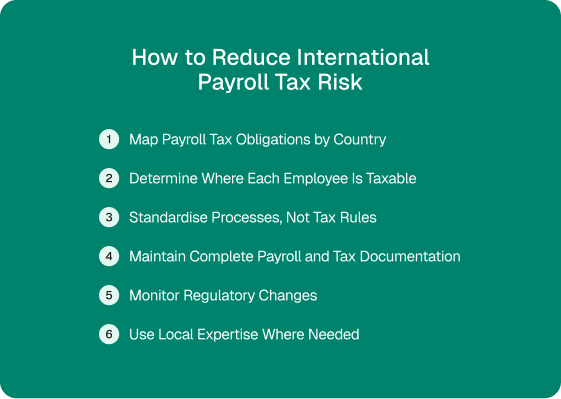
The best way to avoid payroll tax mistakes is to build processes that identify obligations before payroll is processed, rather than relying on corrections after an error occurs. A consistent framework can help businesses manage country-specific requirements while maintaining clear ownership and oversight as their international workforce grows.
1. Map Payroll Tax Obligations by Country
Start by identifying the payroll requirements that apply in every country where employees work. This can include income tax withholding, employer contributions, social security, taxable benefits, payroll registrations, reporting requirements, and filing and payment deadlines.
Creating a country-by-country view makes it easier to spot differences and prevent a standard payroll process from overlooking local requirements.
2. Determine Where Each Employee Is Taxable
Employee tax obligations depend on more than the location of the employer. Consider where each employee lives and physically works, their tax residence, how long they spend in each jurisdiction, the nature of any international assignment, and whether a tax treaty or social security agreement applies.
Review these factors before an employee starts working across borders and whenever their circumstances change.
3. Standardise Processes, Not Tax Rules
Centralising payroll workflows can improve consistency, but businesses should not assume that the same tax treatment applies everywhere. Use common processes for approvals, data collection, payroll reviews, and compliance checks while allowing country-specific rules to determine the actual payroll calculation.
This approach combines operational consistency with the flexibility needed to comply with different international payroll tax laws.
4. Maintain Complete Payroll and Tax Documentation
Keep evidence supporting payroll calculations, tax treatment, filings, payments, employee classifications, benefits, and any relevant treaty or social security decisions. Good documentation makes it easier to respond to employee questions, correct errors, and demonstrate compliance during an audit.
As international teams grow, centralised payroll data and clear documentation standards can also reduce the risk of information being lost between local teams or providers.
5. Monitor Regulatory Changes
International payroll tax laws can change throughout the year. Tax rates, thresholds, social security contributions, taxable benefits, reporting requirements, and filing deadlines may all be updated.
Build regular compliance reviews into the payroll process and establish clear responsibility for identifying and implementing regulatory changes. Payroll teams should also review employee circumstances when someone moves country, changes their working location, or takes on a new type of compensation.
6. Use Local Expertise Where Needed
Country-specific payroll requirements can be difficult to manage without local knowledge, particularly when entering a new market or dealing with cross-border employees and international assignments. Local tax advisers, payroll specialists, or an international payroll provider can help businesses understand requirements that may not be obvious from a general payroll process.
For businesses managing employees across several countries, the right global payroll infrastructure can also centralise payroll operations while supporting the local requirements that apply in each jurisdiction.
A proactive approach makes international payroll tax compliance more manageable. Rather than treating each tax issue as an isolated problem, businesses can build repeatable processes that identify obligations early, maintain accurate records, and adapt as their workforce and the regulatory environment change.
How to Manage International Payroll Taxes: Local Entity or Employer of Record?
Managing payroll taxes for international employees requires businesses to establish the right employment and payroll structure for each country. Two common approaches are establishing a local legal entity and employing workers directly, or using an Employer of Record (EOR) to employ workers on the company’s behalf.
The right option depends on factors such as the company’s long-term plans in the country, the size of its international workforce, and the level of control and local infrastructure it needs.
Establishing a Local Entity
Establishing a local entity can make sense for businesses planning a long-term presence in a country and wanting to employ workers directly. However, this approach also means taking responsibility for the local infrastructure needed to employ and pay those workers compliantly.
Depending on the jurisdiction, this can include registering as an employer, setting up payroll, calculating and withholding taxes, making employer contributions, managing statutory benefits, meeting local reporting requirements, and keeping appropriate records.
Businesses also need to consider the wider legal and tax implications of establishing a presence in another country. Setting up an entity can therefore provide greater control, but it typically requires more time, resources, and ongoing administrative expertise.
Using an Employer of Record
An Employer of Record (EOR) employs workers locally on behalf of a client company, while the client retains day-to-day direction and oversight of the employee’s work. The EOR typically manages employment administration, payroll processing, statutory deductions, benefits, and other local employment compliance responsibilities.
For businesses that need to hire internationally without immediately establishing their own local employing entity, an EOR can provide a faster way to build a compliant employment structure. It can also give companies access to local payroll and employment expertise without requiring them to build those capabilities in-house.
However, using an EOR does not automatically eliminate every tax obligation or compliance risk for the client company. Depending on the company’s activities and the specific arrangement, other considerations may include corporate tax, permanent establishment, transfer pricing, or other local regulatory requirements.
The key is to choose an employment structure that matches the company’s plans and risk profile. For businesses hiring internationally without their own local entity, an EOR can simplify many of the employment and payroll responsibilities that would otherwise need to be managed directly.
How to Avoid International Payroll Tax Mistakes
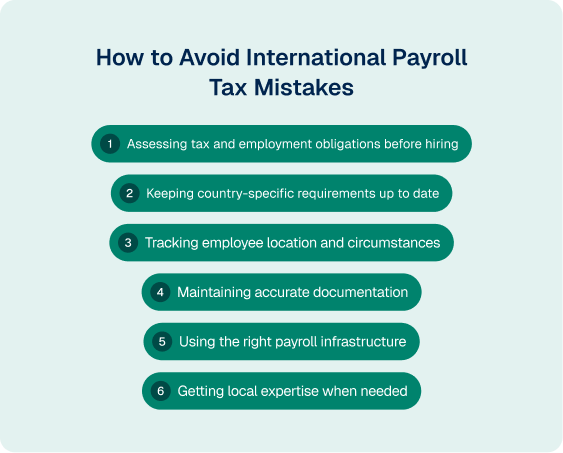
Avoiding international payroll tax mistakes starts with understanding your obligations before an employee begins working in a new country. Rather than relying on a single global payroll process, businesses should assess each jurisdiction and employee individually, while using consistent internal controls to manage payroll accurately.
A proactive approach should include:
- Assessing tax and employment obligations before hiring: Determine where the employee will work and may be taxable, which payroll registrations are required, and what income tax, social security, and employer contributions may apply.
- Keeping country-specific requirements up to date: Review international payroll tax laws regularly and update withholding calculations, reporting processes, and payroll systems when requirements change.
- Tracking employee location and circumstances: Changes in work location, tax residence, compensation, benefits, or international assignments can affect payroll tax treatment.
- Maintaining accurate documentation: Keep records supporting employee classification, tax calculations, withholding, contributions, benefits, filings, payments, and any relevant tax treaty or social security arrangements.
- Using the right payroll infrastructure: Centralised payroll systems and clear workflows can make it easier to manage country-specific requirements as an international workforce grows.
- Getting local expertise when needed: Tax advisers, payroll specialists, and EOR providers can help businesses navigate requirements that are difficult to manage without country-specific knowledge.
The goal shouldn’t be to eliminate every complexity associated with international payroll taxes, but to build processes that identify potential issues early, assign clear responsibility, and make compliance repeatable as the business expands.
Managing International Payroll Taxes as Your Business Grows
International expansion can create significant opportunities, but payroll tax compliance needs to keep pace with that growth. The rules governing income tax, social security, employee benefits, reporting, and employer contributions can differ considerably between countries and may change as employees move between jurisdictions or take on new responsibilities.
Businesses can reduce their exposure to payroll tax mistakes by understanding their obligations before hiring, monitoring regulatory changes, maintaining accurate records, and adapting payroll processes to local requirements. Where managing these responsibilities internally becomes difficult, working with local specialists or an experienced international payroll provider can provide additional support.
For businesses building teams across multiple countries, the right infrastructure can simplify payroll while supporting local compliance requirements. WorkMotion’s global payroll solution helps businesses manage payroll across countries and support their international workforce.
Ready to simplify international payroll? Book a demo with WorkMotion to see how our platform can help you manage payroll across multiple countries while supporting the local requirements of your global workforce.