

You’re evaluating Multiplier vs Deel because you need to hire employees in another country without setting up local entities. Both platforms support global hiring, but they’re strongest in different regions. The challenge comes when the person you want to hire is based in Germany, Spain, France, or another regulated European market.
Now, the comparison becomes about more than EOR coverage, payroll, or contractor management. You need to know who legally employs your employees, who carries the compliance responsibility, and whether the provider holds the licences required in the countries where you’re hiring.
This guide compares Multiplier, Deel, and WorkMotion across compliance, entity ownership, global employment, onboarding speed, support, and total cost so you can make the right decision for your hiring plans.
Multiplier vs Deel vs WorkMotion: At a Glance
| Feature | WorkMotion | Multiplier | Deel |
|---|---|---|---|
| Entity model | Owned entities in key European markets | Multiplier states it has entities in 150+ countries | Deel states it has legal entities in 110+ countries |
| Strongest region | Europe | Asia-Pacific / cost-conscious global hiring | Broad global hiring and contractor management |
| EOR pricing | From €499/employee/month | From $400/employee/month | From $599/employee/month |
| Key European licensing | Country-specific labour leasing licences in key European markets | Information not provided | Information not provided |
| Onboarding speed (Europe) | 3–5 business days | Country-dependent | 3–5 business days in some European markets |
| Direct Hiring | Yes | No publicly listed equivalent | No publicly listed equivalent |
| Country coverage | 160+ countries | 150+ countries | 110+ countries for EOR |
| Trustpilot rating | 4.8/5 | Rating currently unavailable* | 4.6/5 |
*As of 11/06, Multiplier’s Trustpilot rating is unavailable as their page is under review due to reported fake reviews, which is a breach of Trustpilot guidelines.
The headline metrics hide an important regional split. Multiplier, Deel, and WorkMotion are built around different hiring priorities, which become clearer once you look beyond country counts and pricing.
Multiplier vs Deel vs WorkMotion: What Each Platform Is and What It Isn’t
When evaluating EOR providers, operating model matters more than feature parity. Entity ownership, licensing, and regional infrastructure determine who carries legal accountability and how payroll, benefits, local HR support, and compliance are managed in each market.
WorkMotion

WorkMotion is a compliance-first Employer of Record (EOR) built specifically for companies hiring internationally, with a particular focus on European markets.
As an EOR, WorkMotion becomes the legal employer in-country. Its German entity employs your German hire; its Spanish entity employs your Spanish hire. Your team manages the work, while WorkMotion handles payroll, statutory benefits, tax filings, and ongoing compliance.
Three structural differentiators set WorkMotion apart:
- Owned entities across key European markets: WorkMotion operates through its own entities across major European hiring markets, including Germany, Spain, France, Italy, Portugal, Poland, and the UK. For European SMEs, this means WorkMotion is the legal employer directly rather than routing employees through local partners or third-party vendors.
- Country-specific licensing depth: Entity ownership is only the starting point. WorkMotion holds country-specific licences in regulated European markets, including Germany’s AÜG staff leasing licence. This helps ensure compliance in markets where local licensing requirements extend beyond simply maintaining a local entity.
- Transparent total cost of employment: WorkMotion provides country-specific breakdowns covering service fees, employer social contributions, statutory contributions, and mandatory benefits before hiring begins. Teams can model total cost using the employment cost calculator before making a commitment.
WorkMotion is also the first EOR to achieve IEC Gold certification in 2025, providing independent third-party validation of its compliance framework. WorkMotion maintains a 4.8 Trustpilot rating and provides access to legal experts, payroll specialists, and local HR professionals.
Best understood as: The European hiring specialist. WorkMotion combines owned entities, current licensing, transparent employment expenses, and independently audited compliance in the markets where European SMEs most often expand.
See how WorkMotion handles compliance in your specific hiring markets by booking a demo today.
Deel

Deel is a global employment platform that combines EOR services, contractor management, global payroll, benefits administration, employee onboarding, and HR tools in one platform.
Its biggest strengths are scale, brand recognition, and contractor management. Deel supports global teams across more than 110 countries and has built one of the largest contractor payment networks in the market.
Three characteristics define Deel’s position:
- Broad global coverage: Deel offers one of the largest global employment footprints in the category, making it a common choice for companies hiring employees across multiple countries.
- Strong contractor management: Contractor management remains the strongest product in the Deel suite. Deel offers contractor onboarding, payments, tax filings, document management, and flexible payroll capabilities at a global scale.
- Mixed entity infrastructure: Deel operates through a combination of owned entities and local partners. For companies hiring employees in regulated European markets, entity ownership, licensing, and local compliance arrangements should be verified country by country.
Best understood as: The broadest-coverage option in this comparison and one of the strongest contractor management platforms available. For European EOR hiring, entity ownership and licensing depth warrant direct verification.
Multiplier
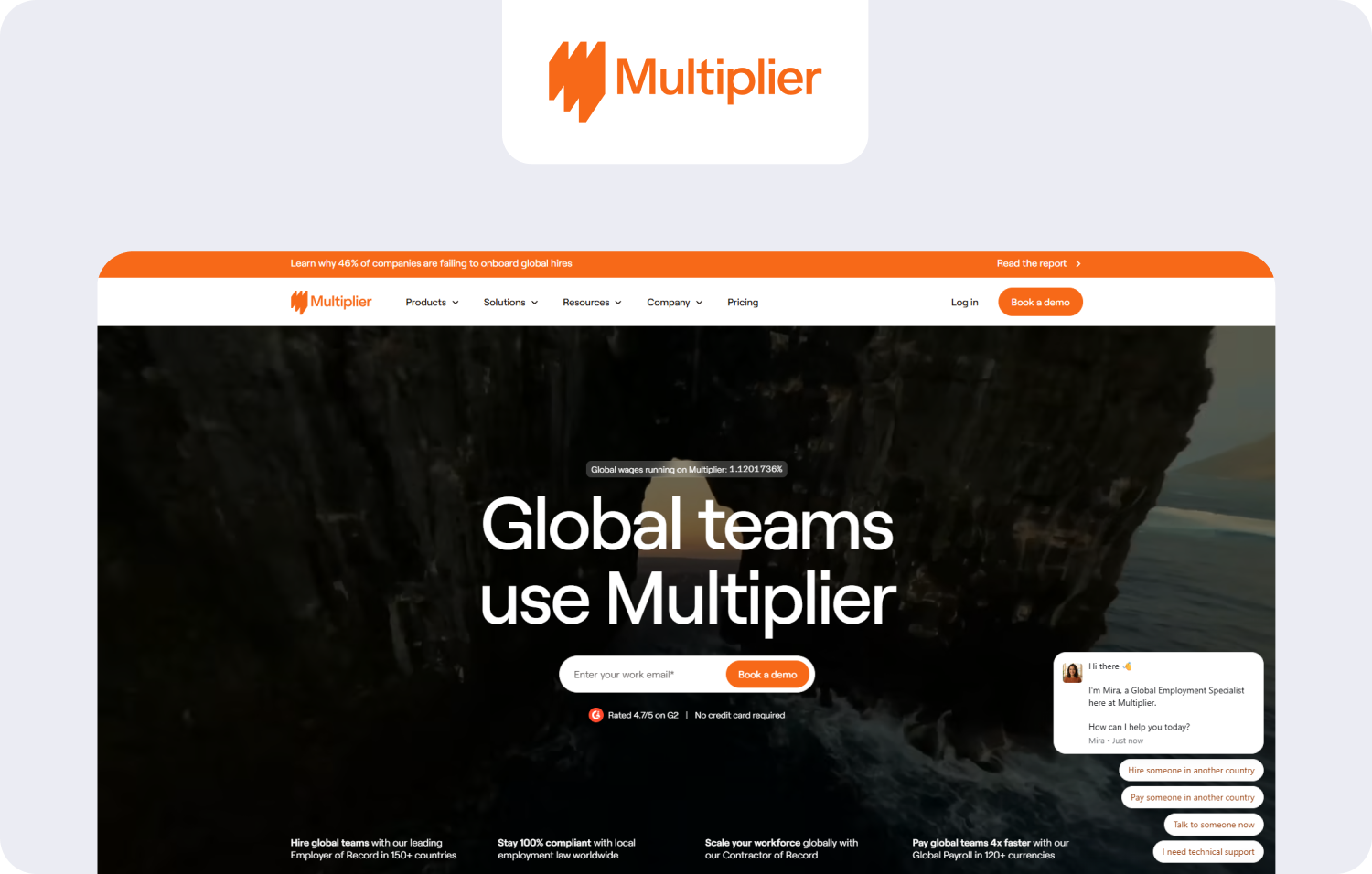
Multiplier is a global employment platform positioned around fast onboarding, self-service administration, and cost-effective international hiring.
Its strongest position is in Asia-Pacific, where it has built significant infrastructure and local market expertise for companies building global teams.
Three characteristics shape Multiplier’s position:
- Asia-Pacific strength: Multiplier has established a strong presence across major APAC hiring markets and supports hiring, payroll, benefits, and global employment across more than 150 countries.
- Lower entry pricing: Multiplier’s pricing starts below many competitors, making it attractive for companies focused on cost savings, cost efficiency, and rapid global expansion.
- European hiring requires additional verification: Multiplier uses a combination of owned entities and local partners, depending on the country. Companies hiring employees in Europe should confirm legal employer structures, local compliance arrangements, customer support availability, and total employment costs before making a decision.
Best understood as: A budget-friendly option with particular strength in Asia-Pacific hiring. For European hiring, especially in regulated markets, entity ownership and licensing should be confirmed directly during evaluation.
The next section compares how the three providers differ on compliance, payroll, onboarding speed, customer support, and total cost of employment.
The Real Decision Variable: Where Are You Hiring?
These three providers solve different problems. The right choice depends on where your employees will be based and what kind of workforce you’re building.

Hiring into Asia-Pacific?
Multiplier is often the strongest fit.
- Owned infrastructure across major APAC markets
- Same-timezone customer support and human support
- Lower headline pricing than many competitors
- Strong option for multi-country hiring plans focused on cost savings
- Cost-effective for companies building native teams in the region
For more insights, review our article on Multiplier alternatives.
Note: Deel also supports hiring across APAC and offers broader global payroll capabilities, but generally at a higher cost.
Hiring Across Multiple Countries?
Deel has the advantage.
- Broad global employment coverage across 150 countries
- Strong contractor management capabilities
- Mature global payroll infrastructure
- Extensive add-ons covering expense management, document management, onboarding workflows, and people analytics
- Deel’s platform combines EOR, contractor management, and global HRIS capabilities in one platform
For companies managing global teams across multiple countries, Deel offers one of the most complete unified solution approaches in the market.
This overview of Deel competitors provides additional context.
Hiring into Europe?
This is where WorkMotion does the heavy lifting.
In Germany, France, Spain, Poland, and other regulated markets, owned entities, local compliance, and licensing matter more than country count.
- WorkMotion operates through owned entities in key European markets
- WorkMotion holds country-specific licences where required
- WorkMotion provides local HR support, legal experts, and compliance experts familiar with local employment processes
- Companies can choose between EOR and direct hiring depending on their expansion strategy
- Businesses hiring freelancers can also manage international contractors through the same provider
Why This Matters for Your Business
When a payroll error, compliance risk, regulatory inquiry, or employee dispute occurs, the legal employer carries the exposure.
- In a partner-entity model, that may be one of several third-party vendors you never selected
- In an owned-entity model, accountability sits directly with the provider you signed with
- The provider’s local experts, payroll processes, data security controls, and compliance framework become critical
For companies evaluating European expansion, the more useful comparison is typically total cost rather than headline EOR pricing. That includes payroll, benefits, health insurance, statutory contributions, local compliance requirements, and any extra fees that may appear after onboarding.
WorkMotion’s pricing provides country-specific breakdowns designed to give buyers full transparency before hiring begins.
Planning hires across Europe? Book a demo to review entity ownership, licensing requirements, employment costs, and compliance considerations in your target markets before deciding.
Feature-by-Feature Comparison
Country coverage gets attention, but most buying decisions come down to pricing, compliance, and onboarding in the markets where you actually plan to employ people.
Pricing and Total Cost of Employment
Headline pricing rarely reflects the final cost. Employer contributions, mandatory benefits, and local employment requirements often have a bigger impact than the monthly EOR fee.
WorkMotion
WorkMotion’s approach is built around total employment cost visibility.
- From €499 per employee/month
- Country-level breakdown before commitment
- Employer contributions and mandatory benefits are shown upfront
- Get estimates with our Employment Cost Calculator
Deel
Deel’s pricing starts from $599 per employee/month.
- Higher headline EOR fee than Multiplier
- Strong contractor pricing
- Additional products and add-ons can increase total spend
- Country-specific employment costs apply separately
Multiplier
Multiplier’s pricing starts from $400 per employee/month.
- Lowest advertised EOR fee in this comparison
- Strong value proposition for APAC hiring
- Country-specific employment costs apply separately
- Buyers should verify final costs during procurement
Pricing Comparison Table
| Pricing factor | WorkMotion | Deel | Multiplier |
|---|---|---|---|
| EOR pricing* | From €499/month | From $599/month | From $400/month |
| Contractor pricing* | From €29/month | From $49/month | From $40/month |
| Employer contributions | Shown before commitment | Country-specific | Country-specific |
| Mandatory benefits | Shown before commitment | Country-specific | Country-specific |
| Cost visibility | Country-level breakdown provided upfront | Quote required | Quote required |
| Best fit | European hiring | Broad global hiring | Cost-conscious APAC hiring |
*Public pricing reviewed June 2026.
The most useful comparison isn’t the monthly EOR fee. It’s the total employment cost once salary, employer contributions, benefits, and local requirements are included.
Ready to compare your hiring options? Request a demo to see how employment costs, compliance requirements, and onboarding timelines differ across your target markets.
European Entity Ownership, Licensing, and Compliance
For a European hire, the key question is simple: who legally employs the worker, and do they hold the licences required to do so?
WorkMotion
- Owned entities across key European markets
- Current country-specific licences, including Germany’s AÜG licence
- IEC Gold certification as an independently audited compliance framework
- EU-focused infrastructure and local HR support
Deel
- Owned entities across many Western European markets
- Entity ownership and licensing should be verified country by country
- No publicly available equivalent to IEC certification
Multiplier
- Greater reliance on partner entities in Europe
- Country-specific setup should be verified directly
- No publicly available equivalent to IEC certification
For European hiring, entity ownership and licensing depth often matter more than country count.
Onboarding Speed
Fast onboarding only matters if the employment structure is compliant from day one.
WorkMotion
Typical onboarding in most European markets: 3–5 business days.
| Market | Typical timeline | Key consideration |
|---|---|---|
| Germany | 3–5 business days | AÜG licensing requirements |
| Spain | 3–5 business days | Employment registration requirements |
| France | 3–5 business days | Local employment and benefits rules |
Deel
- Fast onboarding in core European markets
- Timelines vary by country
- Local requirements can affect start dates
Multiplier
- Fast self-service onboarding
- Strongest in Asia-Pacific markets
- European timelines vary by country and operating model
For time-sensitive hiring, onboarding speed should be assessed alongside entity ownership, licensing, and local support.
Further reading: For a broader view of how different operating models affect onboarding and compliance, see this comparison of Deel vs Rippling vs WorkMotion.
When Each Platform Fits
The right EOR is usually the one whose entity footprint, licensing, and support model match the region where you’re hiring.
Choose WorkMotion If
WorkMotion is likely the strongest fit if:
- You’re hiring into Germany, Spain, France, Poland, Italy, Portugal, or other European markets.
- You need owned entities, local licensing, and direct compliance accountability.
- Predictable employment costs matter more than the lowest headline fee.
- EU data residency is a requirement.
- You’ve encountered entity, licensing, or compliance questions with another provider.
- Full compliance is a priority and you value dedicated account managers, in-house experts, local experts, and local HR support.
Choose Multiplier If
Multiplier is likely the strongest fit if:
- Most of your hiring is in Asia-Pacific.
- Lower EOR costs are a primary decision factor.
- You value fast onboarding and self-service processes.
- Your business doesn’t require deep European licensing coverage.
- Automating processes is more important than specialised European compliance infrastructure.
For APAC-focused companies, this is a credible and often cost-effective choice.
Choose Deel If
Deel is likely the strongest fit if:
- You need broad coverage across many regions.
- Contractor payments are as important as employee hiring.
- You want payroll, contractors, and global employment managed through one platform.
- Your internal team can validate entity ownership and licensing where needed.
Key features include global payroll, benefits administration, advanced reporting, document management, onboarding workflows, org charts, and an AI assistant.
Use WorkMotion Alongside Deel or Multiplier If
Many companies don’t use a single provider everywhere.
A common approach is:
- Multiplier for APAC hiring
- Deel for broad global coverage
- WorkMotion for regulated European markets
This allows companies to keep existing systems while moving European employees to a provider built around owned entities, localised benefits, and European compliance requirements.
As an employer of record, WorkMotion becomes the legal employer in-country while supporting payroll accuracy, local employment requirements, and long-term expansion plans.
What WorkMotion Brings That Multiplier and Deel Don’t
For companies hiring into Europe, the differences aren’t about country count. They’re about who employs your workers, who holds the required licences, and how predictable your employment costs are.
| What Matters for European Hiring | WorkMotion | Deel | Multiplier |
|---|---|---|---|
| Entity Ownership | Owned entities across key European markets. WorkMotion is the legal employer directly. | Owned entities in many European markets, but coverage varies by country. | Greater reliance on partner entities in Europe. |
| Licensing and Compliance | Holds country-specific licences, including Germany’s AÜG licence. IEC Gold certified and independently audited. | Licensing should be verified on a country-by-country basis. No equivalent independent compliance certification publicly available. | Country-specific setup should be verified directly. No equivalent independent compliance certification publicly available. |
| Cost Transparency | Country-level employment costs are shown upfront, including employer contributions and mandatory benefits. | Country-specific quote required. | Country-specific quote required. |
WorkMotion’s advantage isn’t broader coverage: It’s depth in the European markets where entity ownership, licensing, and predictable employment costs matter most.
Book a demo to see how WorkMotion handles compliance in your target hiring markets.
Multiplier vs Deel vs WorkMotion: Which Is Best for You?
The best EOR isn’t the one with the most countries. It’s the one built for the countries where you actually plan to hire.
- Choose Multiplier if most of your hiring is in Asia-Pacific and keeping costs low is a priority.
- Choose Deel if you need broad global coverage and a strong contractor payments solution alongside EOR services.
- Choose WorkMotion if you’re an SME hiring into Europe and need owned entities, current local licensing, and predictable employment costs in markets like Germany, Spain, France, Poland, Italy, and Portugal.
For SMEs hiring into Europe that need owned-entity coverage, current local licensing, and a cost their finance team can rely on, WorkMotion is the strongest option to evaluate.
Book a demo to review your target countries, validate compliance requirements, and compare the true cost of employment before making a final decision.

















![idWjC-9cC6_logos 1 [Vectorized]](https://workmotion.com/wp-content/uploads/2026/02/idWjC-9cC6_logos-1-Vectorized.svg)