

Your team expanded into three European markets last year using contractors. The contracts were signed, the work started, and nobody has reviewed those relationships since.
That might not sound like a problem, but for regulators, it can be.
Employee misclassification often happens gradually. A contractor becomes embedded in the business, follows company processes, and works much like a full-time employee despite being classified differently.
Across Europe, enforcement is increasing, and mistakes can trigger back taxes, social security liabilities, fines, and legal claims.
This guide explains how to identify employee misclassification, why cross-border worker classification is so challenging, and how to address risks before regulators do.
Whether you’re hiring through WorkMotion or managing international workers directly, we’ll help you understand how to identify employee misclassification, why cross-border worker classification is more complex than it appears, and how to address risks before a regulator does.
What Is Employee Misclassification?
Employee misclassification occurs when a worker is engaged as a contractor or freelancer but performs work that legally qualifies as employee work.
It happens when the contract label doesn’t match the reality of the working relationship.
A misclassified employee may be hired as an independent contractor, but:
- Follow company processes
- Report to managers
- Use company systems
- Work exclusively for one business
- Perform ongoing, business-critical work
This matters because worker classification affects payroll taxes, social security, unemployment insurance, workers’ compensation, employee benefits, and other statutory benefits. That’s why it’s critical you compare independent contractors vs. employees.
Regulators look beyond the contract and assess how the relationship works in practice. Control, independence, and day-to-day working arrangements usually matter more than the label on the agreement.
Whether you’re engaging talent through contractors or another hiring model, the nature of the relationship determines compliance.
Employees vs Contractors: The Core Distinction

Employee classification depends on how the relationship operates, not what the contract says.
How Employees Are Defined
Employees work under the business’s direction and are covered by labor laws, statutory benefits, social security, and unemployment insurance.
The employer handles payroll taxes, employer contributions, and related compliance obligations.
How Contractors Are Defined
Independent contractors operate as separate businesses. They control how work is delivered, manage their own business expenses, and often serve multiple clients.
Legitimate contractor relationships are common and compliant when structured correctly.
Explore our more detailed comparison of independent contractors vs. employees
Where the Lines Blur
Classification risks emerge when contractors work like employees. Fixed schedules, close supervision, and reliance on company systems are common warning signs.
Many disputes begin with employment contracts that no longer reflect how the relationship works in practice.
Why Employee Misclassification Happens

Most employee misclassification happens when businesses apply the wrong rules or fail to revisit worker classification as roles change.
1. Complex and Inconsistent Employment Laws
Employment laws vary by country. A worker who is properly classified in one market may be misclassified in another.
Even small contract changes can affect how regulators assess the employment relationship.
2. Cross-Border Hiring Without Local Expertise
Companies often expand faster than they build local compliance knowledge. What works in one country may not align with local laws elsewhere.
Strong employee onboarding process best practices help document working arrangements from day one.
3. Cost-Driven Misclassification
Some businesses engage employees as independent contractors to reduce payroll taxes, employee benefits, severance pay, unemployment insurance contributions, and employer contributions.
This can result in unpaid taxes, civil penalties, employee misclassification penalties, and other significant penalties.
4. Misreading Flexible Work as Contractor Work
Remote work and flexible schedules don’t automatically create independent contractor status. Regulators focus on control and integration into the business.
An Employer of Record (EOR) can provide a compliant alternative, while direct hiring may suit long-term expansion plans.
Recognizing these patterns early helps reduce compliance risks.
The Compliance Risks of Employee Misclassification
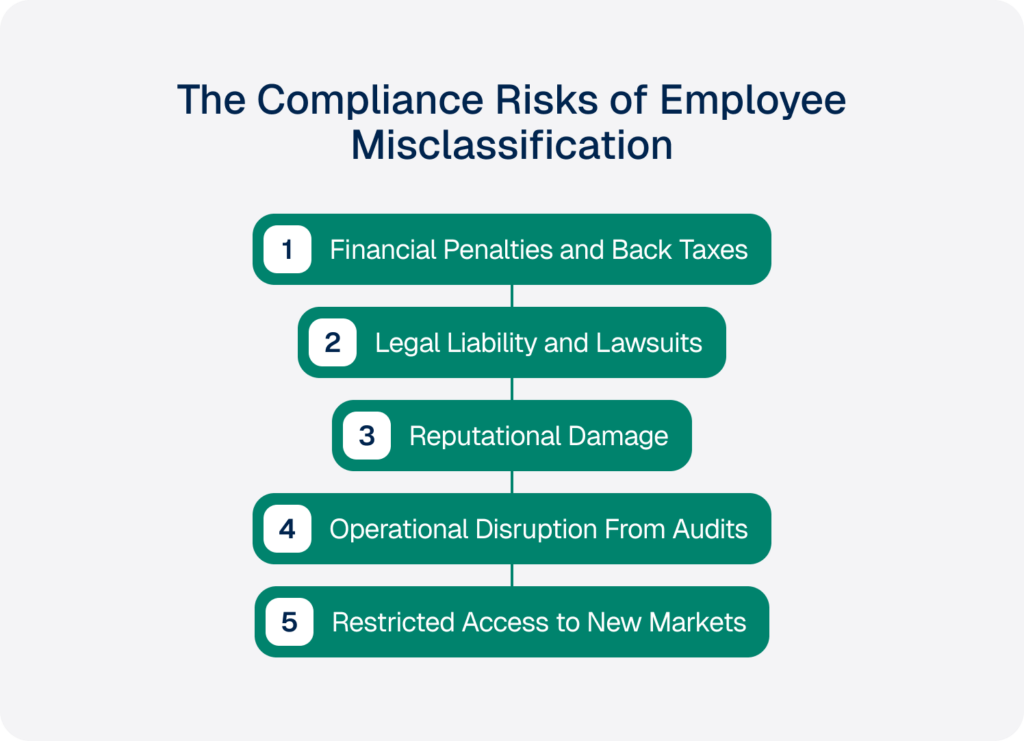
Employee misclassification can create financial, legal, and operational problems that affect the entire business.
Financial Penalties and Back Taxes
A misclassified employee can trigger liability for:
- Unpaid taxes
- Employment taxes
- Income tax withholding
- Social security contributions
- Unemployment insurance contributions
- Interest charges and financial penalties
In some countries, intentional worker misclassification can also result in criminal penalties for company leaders.
Legal Liability and Lawsuits
Misclassified workers may seek compensation for rights they should have received as employees.
Claims can include back wages, overtime pay, minimum wage violations, severance pay, health insurance, workers’ compensation coverage, and other employee benefits. Employers may also face attorney fees, legal action, and additional employee misclassification penalties.
Reputational Damage
Misclassification cases often become public. Regulators publish enforcement actions, and media coverage can spread quickly.
The damage isn’t limited to fines. A company’s reputation can suffer with employees, job candidates, customers, and investors, making recruitment and retention more difficult.
Operational Disruption From Audits
Audits can take months to resolve and pull resources away from core business priorities.
Regulators may request written contracts, payment records, communication history, worker classification assessments, and evidence supporting employee status decisions. Hiring activity often slows while investigations remain open.
Restricted Access to New Markets
Compliance issues rarely stay contained to one country. Open investigations can increase scrutiny from regulators in other jurisdictions and create delays for businesses operating internationally.
Expansion plans, new hires, and market-entry projects may stall until the classification issue is resolved.
Addressing employee misclassification risks early is far easier than responding after an investigation begins.
Real-World Examples of Employee Misclassification
Employee misclassification is already driving enforcement action across Europe. These examples show how regulators are applying worker classification rules in practice.
Spain’s Riders Law and the Gig Economy Reclassification
Spain’s 2021 Riders Law created a legal presumption that delivery-platform couriers are employees rather than independent contractors.
The consequences included:
- Mass reclassification claims
- Back wages and social security liabilities
- Increased scrutiny of gig economy business models
Platforms including Glovo, Deliveroo, and Uber Eats faced increased scrutiny and pressure to reclassify following the law’s introduction. The law became a benchmark for classifying digital platform workers across the EU.
Read more about how you can hire in Spain from abroad.
Germany’s Crackdown on Scheinselbstständigkeit
German authorities continue to investigate Scheinselbstständigkeit (false self-employment), particularly in IT and professional services.
Common consequences include:
- Retroactive social security payments
- Interest charges
- Employee misclassification penalties
- Potential criminal penalties in serious cases
Germany’s status determination process focuses on how the employment relationship actually operates rather than relying solely on contracts.
See our guide if you’re looking to hire in Germany from abroad.
The Netherlands Resumes DBA Enforcement
The Netherlands restarted active DBA enforcement on 1 January 2025 after years of limited oversight.
Authorities are now examining whether workers classified as self-employed genuinely operate independently. Businesses found to have engaged employees as independent contractors may face:
- Retroactive payroll tax assessments
- Employment tax liabilities
- Additional compliance costs
The Dutch government’s guidance on avoiding false self-employment reflects a broader shift toward stricter enforcement across Europe.
Learn to hire in the Netherlands from abroad to avoid compliance risks.
Across all three examples, regulators focused on the reality of the working relationship rather than the label in the contract.
Contractor vs. EOR vs. Direct Employment: Choosing the Right Model
The right hiring model depends on the role, level of control, and long-term plans for the worker.
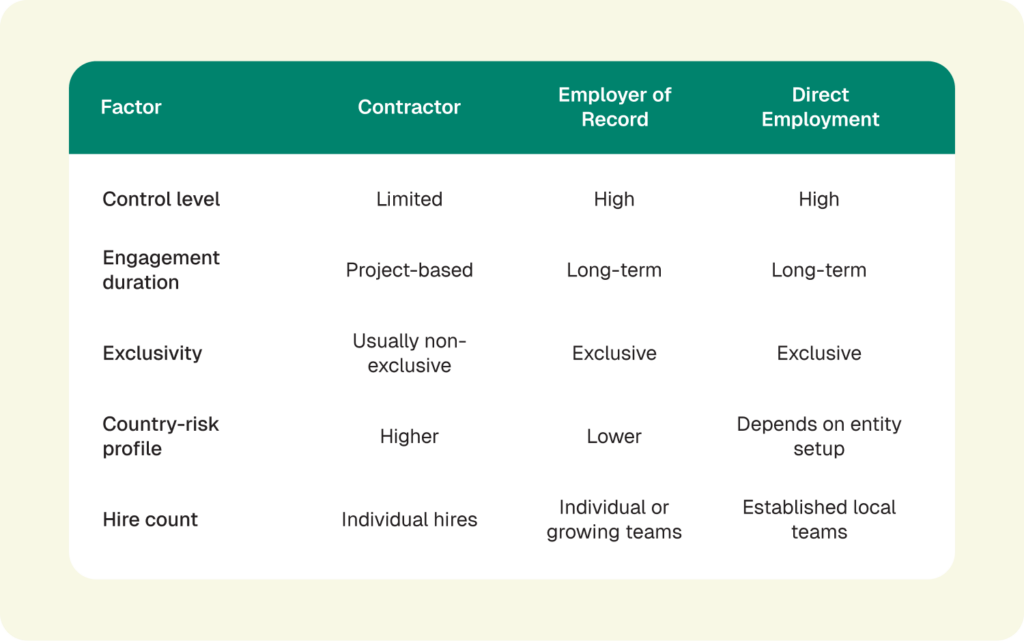
Contractors can be a good fit for project-based work and self-employed professionals serving multiple clients. Risk increases when the role starts to resemble a full-time employee position.
An Employer of Record (EOR) provides a compliant employment structure without requiring a local entity, supporting accurate worker classification and access to employee benefits.
WorkMotion combines locally compliant contracts, owned entities in key European markets, and onboarding that can often be completed within 3–5 business days, making contractor-to-employee conversion practical.
For larger teams, direct hiring may become the preferred option.
Regular reviews help identify risks before misclassification occurs and workers are considered employees by regulators.
How Technology Reduces Employee Misclassification Risk
Technology can’t eliminate compliance risk, but it can make employee misclassification far less likely by standardizing decisions and documentation.
Automated Compliance Checks at Hire Time
- Catch risks before hiring. The strongest prevention happens before the contract is signed. WorkMotion’s contractor hiring process screens engagements against local employment laws and worker classification frameworks before work begins.
- Reduce costly mistakes. Early reviews help identify independent contractor misclassification risks before a misclassified employee creates exposure to back wages, employment taxes, legal claims, or employee misclassification penalties.
Country-Specific Contract Templates
- Avoid one-size-fits-all contracts. A template that works in one country may create compliance risks in another. Local laws differ on employee classification, financial control, expense reimbursement, and other factors regulators review.
- Built around local requirements. WorkMotion’s templates are designed for specific jurisdictions and aligned with the employment relationship tests local authorities apply.
Centralized Documentation for Audits
- Keep evidence in one place. Regulators may request contracts, payment history, communications, working hours, and records supporting proper classification decisions.
- Respond faster to audits. Centralized documentation helps businesses demonstrate that workers were properly classified and weren’t engaged to avoid overtime pay protections, health insurance obligations, or other statutory benefits.
Good records also make it easier to conduct regular audits before issues become enforcement cases.
How to Document Classification Decisions Before an Audit
Documentation is often the difference between a routine review and a lengthy investigation.
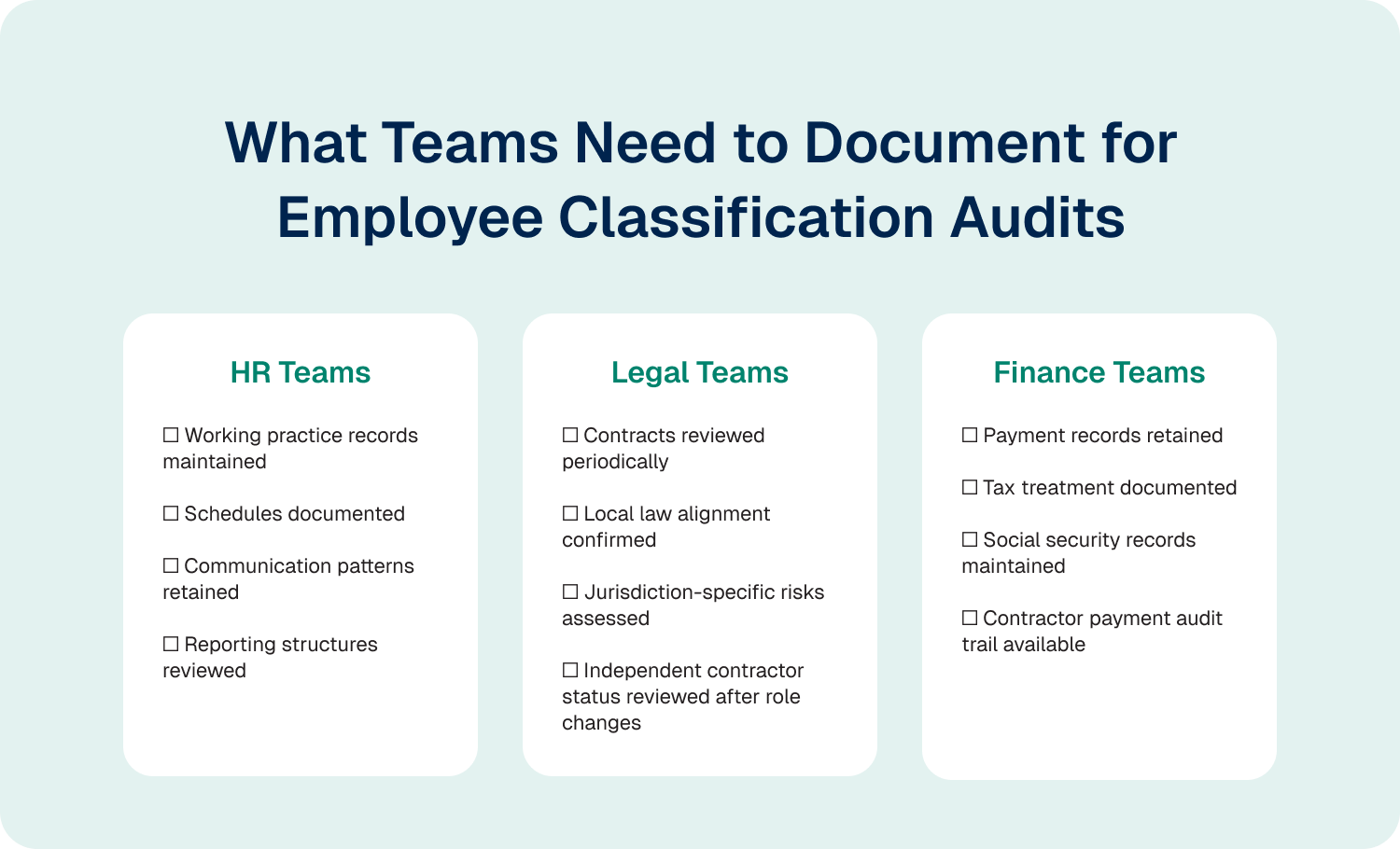
HR Teams
Maintain records showing how independent contractors actually work. This includes schedules, communication patterns, reporting structures, and evidence that contractors operate independently rather than as full-time employees.
Review checklist
- Working practice records maintained
- Schedules documented
- Communication patterns retained
- Reporting structures reviewed
Legal Teams
Review contracts regularly and assess whether they still align with local laws. A contractor relationship that was properly classified at the start may require reassessment if responsibilities or working patterns change.
Review checklist
- Contracts reviewed periodically
- Local law alignment confirmed
- Jurisdiction-specific risks assessed
- Independent contractor status reviewed after role changes
Finance Teams
Maintain a clear audit trail covering payment records, tax treatment, employer contributions, and social security obligations.
Review checklist
- Payment records retained
- Tax treatment documented
- Social security records maintained
- Contractor payment audit trail available
For higher-risk roles, quarterly reviews are often appropriate. A full annual review helps identify potential misclassified workers before compliance issues escalate.
If an EU audit occurs, regulators typically request contracts, working practice records, payment history, communication metadata, and evidence supporting the original classification decision.
Inspectors increasingly look for proof that worker classification was a deliberate process rather than an honest mistake.
Get Started With WorkMotion and Avoid Employee Misclassification, No Matter Where You’re Hiring
Employee misclassification is rarely caused by a single contract. More often, it’s the result of inconsistent processes, limited local expertise, and classification decisions that aren’t reviewed as roles evolve.
The financial penalties, legal claims, back wages, unpaid taxes, and reputational damage associated with misclassification can far exceed the cost of preventing the problem in the first place.
WorkMotion helps businesses reduce employee misclassification risks through country-specific compliance frameworks, locally aligned contracts, and compliant employment models across Europe and beyond.
If you’re ready to build a more compliant hiring process, book a demo to see how WorkMotion supports global hiring while reducing classification risk.


















![idWjC-9cC6_logos 1 [Vectorized]](https://workmotion.com/wp-content/uploads/2026/02/idWjC-9cC6_logos-1-Vectorized.svg)